
Ahmet Alptekin Kasar
Founder, Managing Director
Updated: 2026-11-03
This guide is for loft insulation contractors, renovation groups, energy consultants and builders' merchants working on Hungarian houses. The full loft-floor build-up is described in our loft floor insulation guide (in Hungarian). Here we look at one decision only: glass wool or stone wool on the floor of a cold, unheated loft.
We supply both from the same manufacturer: ODE Starflex glass wool and ODE Rockflex stone wool. The same question for facades is covered in a separate article. This one stays on the loft floor.
One requirement, two materials
The floor has to meet numbers, not a material type. Hungary's Decree 9/2023 (V. 25.) ÉKM (in Hungarian) sets U ≤ 0.17 W/m²K for a floor below a loft or crawl space.
If the job is a single-family house measure claimed under Hungary's energy efficiency obligation scheme (EKR), data sheet 1.3 also applies. Under Annex 1 of Decree 41/2025 (XII. 30.) EM (in Hungarian), insulation that is not blown must have λ ≤ 0.039 W/(m·K) (1.3.1.1 eb). Board and roll products in a loft go down in at least two overlapping layers (point f). The loft-floor saving is tied to a thermal resistance of R ≥ 6.25 m²K/W (1.3.4.2). Our EKR catalogue article walks through the conditions.
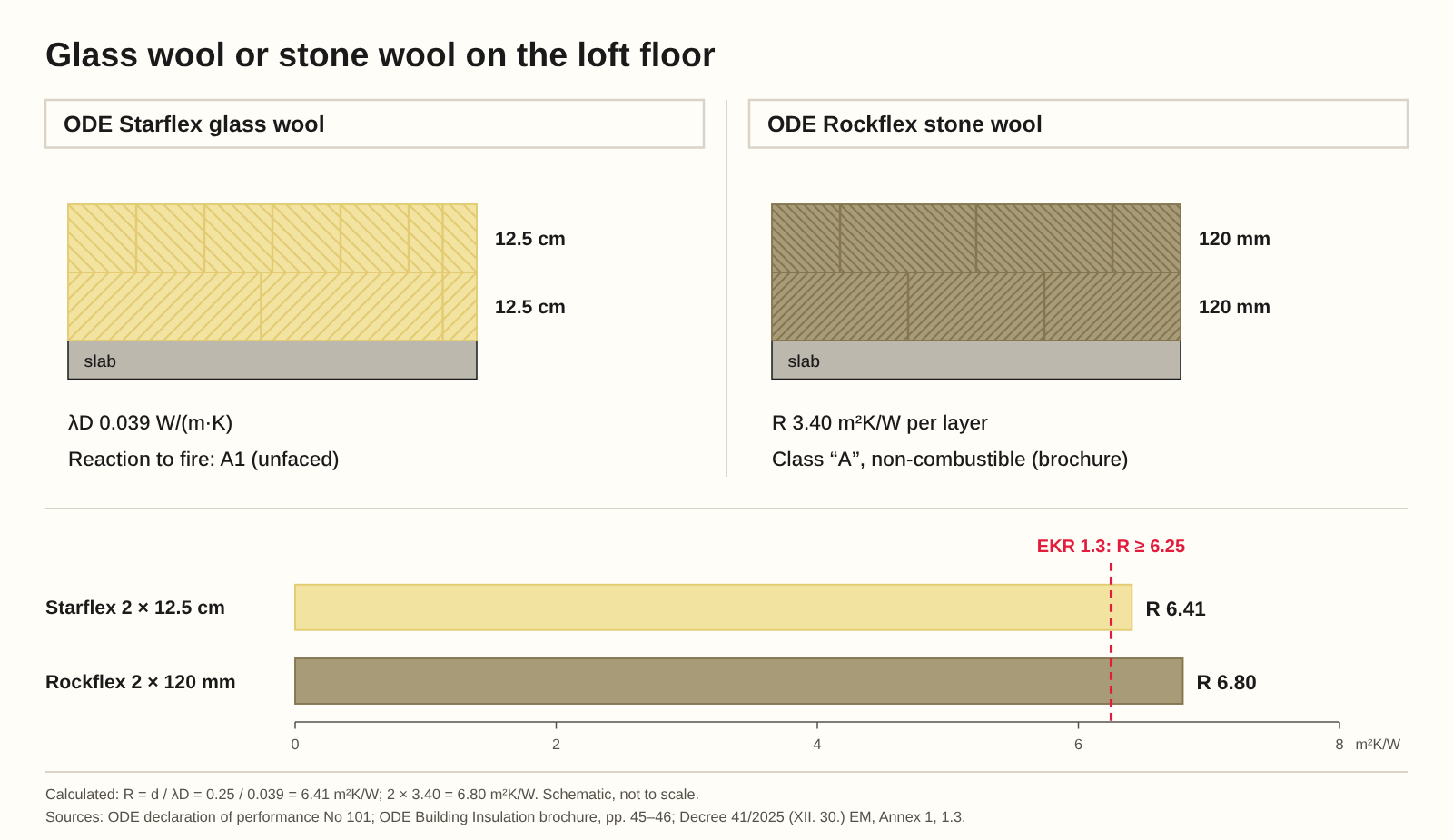
Glass wool. The ODE Starflex declaration of performance (DoP No 101) gives λD 0.039 W/(m·K) for the 0.039 blanket type, in thicknesses of 25–240 mm. Two 12.5 cm layers give R = 0.25 / 0.039 = 6.41 m²K/W. That is a calculated value.
Stone wool. The ODE building insulation brochure lists the Rockflex Partition Board ABL at 25–120 mm with R 0.70–3.40 m²K/W (p. 46). The top of the range belongs to the 120 mm board. Two 120 mm layers give 2 × 3.40 = 6.80 m²K/W, again calculated. The brochure names "roof space flooring" among the board's uses. On conductivity it says only that Rockflex is "lower than 0.036 W/mK" (p. 45). For the EKR λ condition, the λD on the DoP of the type actually delivered is what counts, so ask for it with the quote.

| Property | ODE Starflex glass wool | ODE Rockflex stone wool | Source |
|---|---|---|---|
| Product form | roll (blanket) | board (Partition Board ABL) | brochure pp. 8 and 46 |
| Layers | 2 × 12.5 cm | 2 × 120 mm | EKR 1.3.1.1 f): at least 2 layers |
| Thermal conductivity | λD 0.039 W/(m·K) | per the brochure below 0.036 W/mK; λD from the type's DoP | DoP No 101; brochure p. 45 |
| Thermal resistance per layer | – | R 3.40 m²K/W (120 mm; range 25–120 mm: 0.70–3.40) | brochure p. 46 |
| Total thermal resistance | R = 0.25 / 0.039 = 6.41 m²K/W | R = 2 × 3.40 = 6.80 m²K/W | calculated |
| EKR 1.3 loft floor | R ≥ 6.25 m²K/W | R ≥ 6.25 m²K/W | Decree 41/2025 (XII. 30.) EM, 1.3.4.2 |
| Reaction to fire | A1 (unfaced, glass tissue, woven glass textile, AFH alu foil faced); alu foil kraft (AFK) faced: C-s1,d0 | class “A”, non-combustible according to EN standard; exact class on the DoP | DoP No 101; brochure p. 45 |
| Water vapour diffusion resistance factor | NPD (not declared) | μ = 1 | DoP No 101; brochure p. 45 |
Both build-ups clear the minimum. What separates them is the work on site, how the loft is used and how the material handles.
Rolls or boards: how the work differs
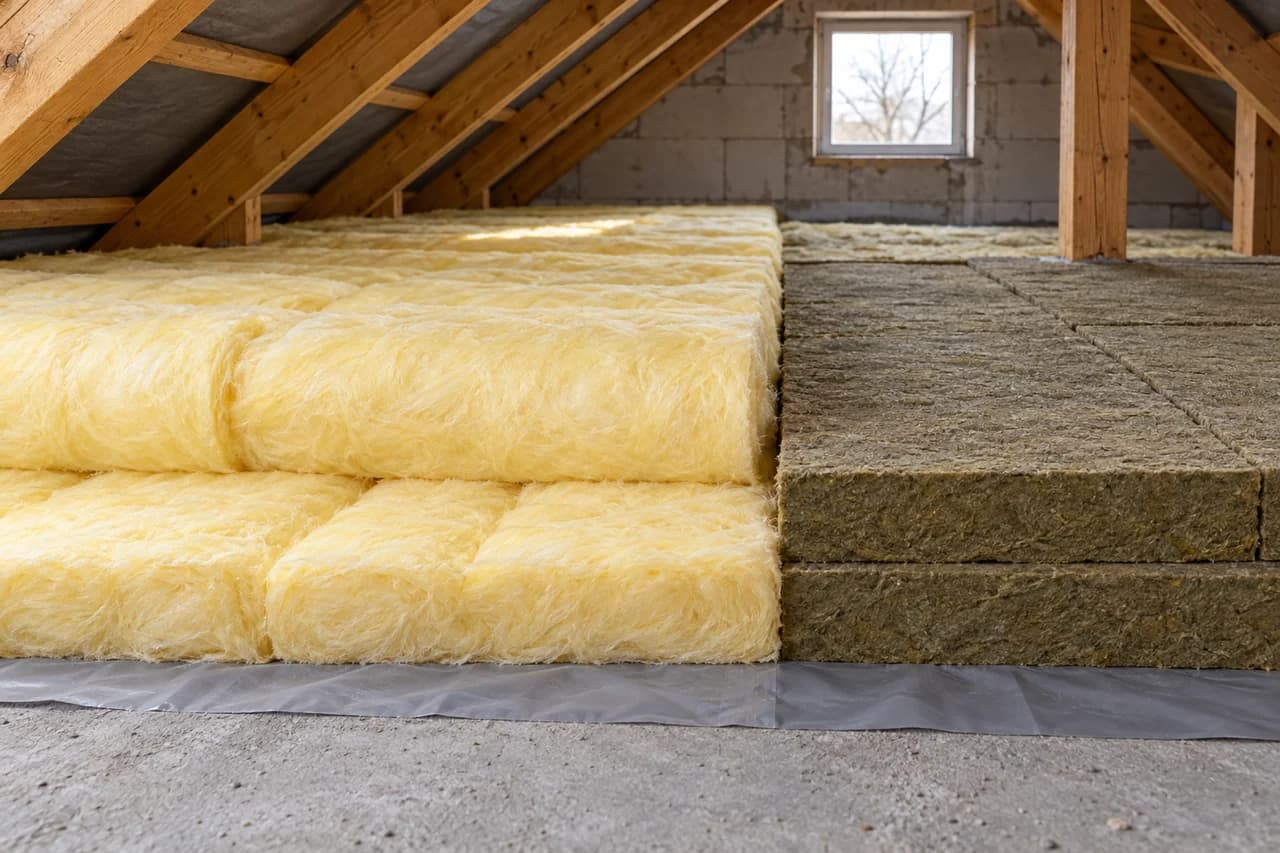
Glass wool rolls. The ODE brochure lists "Attic floors" among the uses of the Starflex blanket (p. 8). The same page says: "It easily conforms to all types of wooden and metal roofs. Since it is lightweight, it is very easy to lift up to the roof and to cut and install." Rolls go up through a loft hatch easily and are cut with a knife.
A roll lays out in long lengths, so there are fewer joints. On an uneven concrete slab or a timber joist floor it settles onto the surface and can be tucked in beside joists, pipes and chimneys. The second layer runs crosswise and covers the joints of the first.
Stone wool boards. Rockflex boards are rigid and keep their dimensions. Their straight edges butt tightly together. On an uneven slab, though, a board does not follow the surface and can leave a void underneath. Around joists and penetrations each board has to be cut to size so that no gap remains. Here too the joints of the two layers should be staggered.
The same rules apply to both materials. Lay the insulation without gaps, carry it over the ring beam to the outer face of the wall and do not compress it. The edge detail is covered in our article on the loft-floor edge thermal bridge. If blown insulation is on the table too, see blown vs roll glass wool for the loft floor.
Will people walk on it?
Many lofts are used for storage or access. On glass wool blankets the ODE brochure is explicit: "Load should not be imposed on roof blankets. For this purpose, blind floors or walkways should be laid with wooden slats or plates when necessary." (p. 15)
A stone wool board feels firmer, but that does not make it walkable. Our sources say nothing about foot traffic on the Rockflex Partition Board. If the loft will be walked on, plan a separate walkway whichever wool you use. The options are compared in our article on loft floor insulation with a walkway.
Fire and vapour
Reaction to fire. The ODE Starflex DoP declares A1 for the unfaced product and for glass tissue, woven glass textile and AFH alu foil facings. The alu foil kraft (AFK) faced version is C-s1,d0. Loft floors take the unfaced blanket. The brochure describes Rockflex as a class "A" non-combustible material according to EN standard (p. 45). The exact class comes from the DoP of the type delivered. Our article on reaction to fire classes explains the classes.
Vapour. The brochure gives Rockflex a water vapour diffusion resistance factor of μ = 1 (p. 45). The glass wool DoP lists that property as "NPD", no performance determined. For blankets laid in a loft the brochure says they carry no vapour-tight facing such as polyethylene film (p. 15).
The moisture logic of the build-up is the same for both. A vapour control layer goes underneath, on the warm side; EKR 1.3.1.1 g) asks for at least Sd 20 m. A breathable dust cover of at most Sd 0.03 m goes on top of fibrous insulation. The loft itself has to be ventilated. In the brochure's words: "Care should be taken to ventilate the attic space to prevent condensation." (p. 15)
Which one when?
A few questions usually settle it:
- What is the floor like? Rolls follow an uneven slab or a joist floor better. On a flat slab both forms lay well.
- How does the material get up there? Rolls are light and pass through a small hatch. Boards go up piece by piece.
- How much cutting? With many penetrations, joists and chimneys, rolls are quicker to fit. On large open areas boards also move fast.
- What does the specification say? If the design or the client asks for stone wool, the figures above meet the same conditions.
- Will it be walked on? Then the walkway is a separate element, whatever the wool.
ODE Starflex holds an EUCEB certificate, covered in a separate article. The two wools also meet on industrial roofs, see hall roof insulation under and over trapezoidal sheet.
Material supply
We supply contractors with ODE Starflex glass wool and, on request, ODE Rockflex stone wool boards. Stone wool is quoted on quantity and thickness. Road transit from Türkiye to Hungary takes 3–5 days, about 5 on average. When the material is not in stock, lead time is typically 1–2 weeks. We deliver across Hungary.
For context: our Hungarian homeowner offer, 12 700 Ft/m² gross, is built with glass wool (BK45 Sd 20 m, 25 cm ODE Starflex, BD70 Sd 0.02 m) and installed by a contractor partner. Walkways are built on request as an extra.
Send us the loft floor area and the material you have chosen, and we will put together a material list: contact · +36 30 485 0258 · info@euconx.com. We reply the same working day.
Frequently asked questions
Is glass wool or stone wool better for a loft floor?
Thermally neither wins once the build-up meets the requirement. 2 × 12.5 cm ODE Starflex (λD 0.039) gives R = 6.41 m²K/W; 2 × 120 mm Rockflex Partition Board gives 6.80 m²K/W on the brochure figure. The difference is in handling and cutting.
Does stone wool meet the EKR loft-floor conditions?
The conditions are not tied to a material: λ ≤ 0.039 W/(m·K), at least two overlapping layers and R ≥ 6.25 m²K/W. The Rockflex λD has to be shown on the DoP of the delivered type. Whether a measure counts also depends on the other conditions, such as the building and the paperwork.
How thick should stone wool be on a loft floor?
According to the brochure, the 120 mm Rockflex Partition Board has R 3.40 m²K/W. Two layers give 6.80 m²K/W, above 6.25. For other thicknesses, calculate from the data sheet and DoP of the type delivered.
Can I walk on stone wool boards in the loft?
Our sources say nothing about foot traffic on the Rockflex Partition Board. If the loft is used for access or storage, plan a separate walkway for either material. The brochure says no load should be imposed on glass wool blankets.
Which one is non-combustible?
The ODE Starflex DoP declares A1 for the unfaced product. The brochure calls Rockflex a class "A" non-combustible material; the exact class is on the type's DoP.
Does stone wool need a vapour control layer underneath too?
Yes, the build-up is the same for both. EKR 1.3.1.1 g) asks for at least Sd 20 m under the insulation in a loft and a breathable cover of at most Sd 0.03 m on fibrous insulation.
Sources
1. Decree 9/2023 (V. 25.) ÉKM, Annex 1 (maximum U-values), National Legislation Database (in Hungarian): https://njt.jog.gov.hu/jogszabaly/2023-9-20-8X
2. Decree 41/2025 (XII. 30.) EM, Annex 1, points 1.3.1.1 eb), f), g) and 1.3.4.2, Magyar Közlöny 2025/160 (in Hungarian): https://magyarkozlony.hu/hivatalos-lapok/p1UZBNSoHiBBftW595F66949b7f7ae914/dokumentumok/5858f900426cb56e532a468a989dbb1417d9aef0/letoltes
3. ODE Starflex / Lunaflex / Evomineral declaration of performance No 101 (λD 0.039 W/(m·K), reaction to fire, NPD): https://ode.com.tr/_upload/pdf/GLASSWOOL_BLANKET-BOARD_DECLARATION_OF_PERFORMANCE_-_EN_13162.pdf
4. ODE Building Insulation brochure: Starflex blanket areas of use (p. 8), loads on blankets, facings and attic ventilation (p. 15), Rockflex λ, class "A" and μ = 1 (p. 45), Rockflex Partition Board ABL (p. 46): https://ode.com.tr/_upload/pdf/ode_building_insulation_brochure_3.pdf
5. BK45 declaration of performance (Sd 20 m): https://euconx.com/downloads/dop/euconx-bk45-dop.pdf · BD70 declaration of performance (Sd 0.02 m): https://euconx.com/downloads/dop/euconx-bd70-dop.pdf
6. EuConX company data (transit, lead time, reply time, delivery across Hungary) and Hungarian homeowner offer
Planning a project? Let’s talk.
Send the material schedule or project requirements. We’ll help match the product and prepare a clear quotation.