
Ahmet Alptekin Kasar
Founder, Managing Director
Updated: 2026-10-30
This guide is for facade and roofing contractors, designers, fire-safety specialists, developers and builders' merchants who put together material schedules for projects in Hungary and the wider CEE region. It explains what the class on a Declaration of Performance (DoP) means, which tests sit behind it, and how it maps to the terms of the Hungarian fire code. Our list of non-combustible products is in the A1 and A2 building materials article (in Hungarian).
What the class on a DoP tells you
Reaction to fire is one of the essential characteristics a manufacturer declares in the DoP. The classes are set out in the Annex to Commission Delegated Regulation (EU) 2016/364, adopted under the Construction Products Regulation (EU) No 305/2011. EN 13501-1 is the classification standard. Under Article 1 of the Regulation, a product is classified when its intended use means it may contribute to the generation and spread of fire and smoke.
A class is earned by testing a specific product. It does not follow from the material type, so two boards of the same material can carry different classes, and a faced board can differ from an unfaced one.
Reaction to fire is not fire resistance. The class describes how a material behaves once fire reaches it: whether it ignites, how much heat it releases, whether flame spreads across it. Fire resistance (REI, for example) is rated for a complete element such as a wall or floor. An insulation product's DoP gives the former.
Seven classes: tests and limits
Four test methods separate the classes. EN ISO 1182 measures temperature rise (ΔT), mass loss (Δm) and duration of flaming (tf). EN ISO 1716 gives the gross calorific potential (PCS). EN 13823, the single burning item (SBI) test, measures the fire growth rate (FIGRA), lateral flame spread (LFS) and total heat release (THR600s); smoke and flaming droplets are also assessed in it. EN ISO 11925-2 is the small-flame test: it measures flame spread (Fs) under a 15 s or 30 s flame exposure.
A1 needs both EN ISO 1182 and EN ISO 1716. A2 needs one of them plus the SBI. Classes B, C and D rest on the SBI and the 30 s small-flame test; E and F on the 15 s small-flame test only. Class F means the product does not meet the E criterion. The recitals of the Regulation explain the change: the old F class stood for "no performance determined", and 2016/364 replaced it with a class for products that do not reach E.

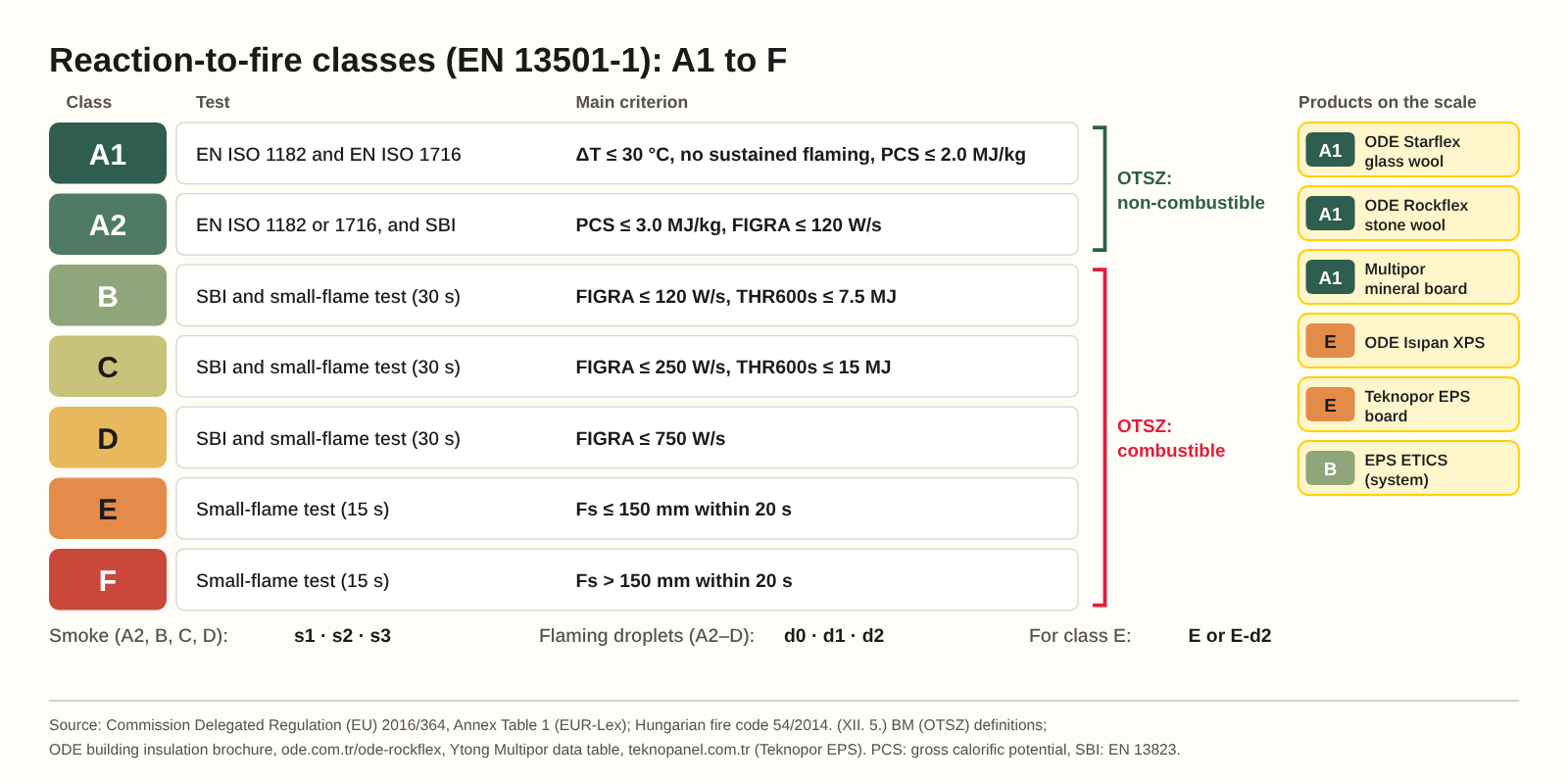
| Class | Test | Main criteria | Hungarian fire code |
|---|---|---|---|
| A1 | EN ISO 1182 and EN ISO 1716 | ΔT ≤ 30 °C, Δm ≤ 50 %, tf = 0 (no sustained flaming); PCS ≤ 2.0 MJ/kg | non-combustible |
| A2 | EN ISO 1182 or EN ISO 1716, and EN 13823 (SBI) | ΔT ≤ 50 °C, Δm ≤ 50 %, tf ≤ 20 s, or PCS ≤ 3.0 MJ/kg; FIGRA ≤ 120 W/s, LFS < edge of specimen, THR600s ≤ 7.5 MJ | non-combustible |
| B | SBI and EN ISO 11925-2 (30 s) | FIGRA ≤ 120 W/s, LFS < edge of specimen, THR600s ≤ 7.5 MJ; Fs ≤ 150 mm within 60 s | combustible |
| C | SBI and EN ISO 11925-2 (30 s) | FIGRA ≤ 250 W/s, LFS < edge of specimen, THR600s ≤ 15 MJ; Fs ≤ 150 mm within 60 s | combustible |
| D | SBI and EN ISO 11925-2 (30 s) | FIGRA ≤ 750 W/s; Fs ≤ 150 mm within 60 s | combustible |
| E | EN ISO 11925-2 (15 s) | Fs ≤ 150 mm within 20 s | combustible |
| F | EN ISO 11925-2 (15 s) | Fs > 150 mm within 20 s | combustible |
| Additional class | Criterion |
|---|---|
| s1 | SMOGRA ≤ 30 m²/s² and TSP600s ≤ 50 m² |
| s2 | SMOGRA ≤ 180 m²/s² and TSP600s ≤ 200 m² |
| s3 | not s1 or s2 |
| d0 | no flaming droplets/particles in the SBI within 600 s |
| d1 | no flaming droplets/particles persisting longer than 10 s in the SBI within 600 s |
| d2 | not d0 or d1; ignition of the paper in EN ISO 11925-2 also gives d2 |
| Class E | paper not ignited: no additional class; paper ignited: E-d2 |
Source: Commission Delegated Regulation (EU) 2016/364, Annex Table 1 and its notes (EUR-Lex); the fire-code column is points 101 and 122 of Annex 1 to Hungarian decree 54/2014. (XII. 5.) BM. The PCS limits shown apply to homogeneous products and to the product as a whole.
Reading the full designation
A full designation has three parts: the class, smoke production and flaming droplets. The smoke and droplet ratings exist only for A2, B, C and D, because both are assessed in the SBI. A1 carries no additional class.
- A2-s1,d0: class A2, the lowest smoke rating (s1), and no flaming droplets in the SBI within 600 seconds (d0). Non-combustible under the Hungarian fire code.
- B-s2,d0: class B, smoke rating s2, no flaming droplets. Combustible under the Hungarian fire code.
- E: in the small-flame test the flame spread no more than 150 mm within 20 seconds, and the paper did not ignite.
- E-d2: the same, but the paper ignited.
When a specification calls for A2-s1,d0, a product declared A2-s2,d0 does not match the required smoke rating, even though both are non-combustible. Compare the whole string on the schedule, not just the letter.
Non-combustible and combustible in Hungary
Hungary's National Fire Protection Regulation (OTSZ, decree 54/2014. (XII. 5.) BM) ties its terms to the European classes in Annex 1. Under point 101, a non-combustible material includes "building materials classified A1 and A2", and a solid building material whose gross heat of combustion for the product as a whole does not exceed 3.0 MJ/kg. Under point 122, solid combustible material includes "solid building materials classified B–F". Point 176 defines the fire-protection class as the category describing how building materials and building elements behave in fire, established by testing.
On Hungarian drawings and tenders, "nem éghető" insulation therefore means an A1 or A2 product. A class B product counts as combustible, however well it performs in the SBI.
Fire-protection facade bands
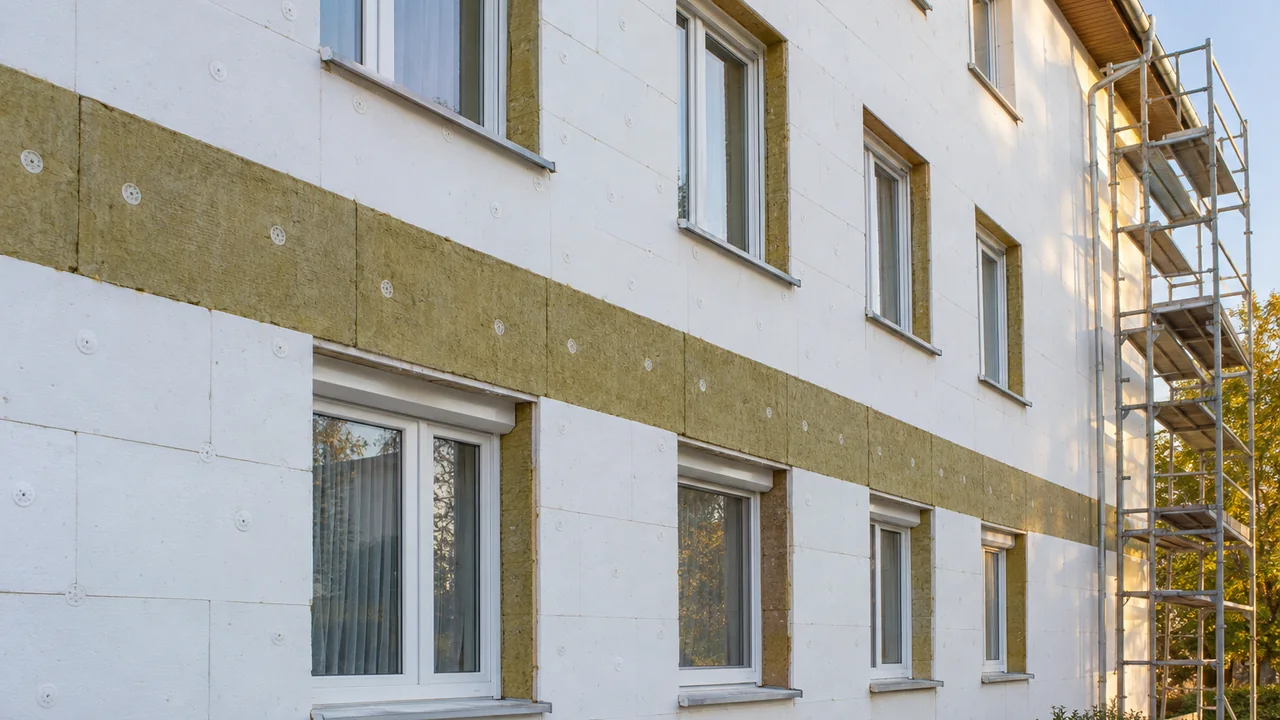
Point 173 of the OTSZ defines the fire-protection facade band (tűzvédelmi célú homlokzati sáv): a band on the external wall that interrupts and replaces the B–E class insulation of a cladding, coating or rendered insulation system, and limits fire spread. Under § 25 (4), the band may only be made of A1 or A2 material.
That is why stone wool bands appear on EPS-insulated facades. Under § 25 (3), a B–D class facade system whose insulation core is B–E class and thicker than 10 cm may be used if, among other conditions, a band is built above every facade opening and testing confirms the facade fire-spread limit. Under § 25 (2), some locations, high-rise external walls for example, allow only A1 or A2 systems.
Whether a given building needs bands, where they run and how large they are is decided by the project's fire-safety designer. We do not give dimensions here for that reason.
Product class and system class
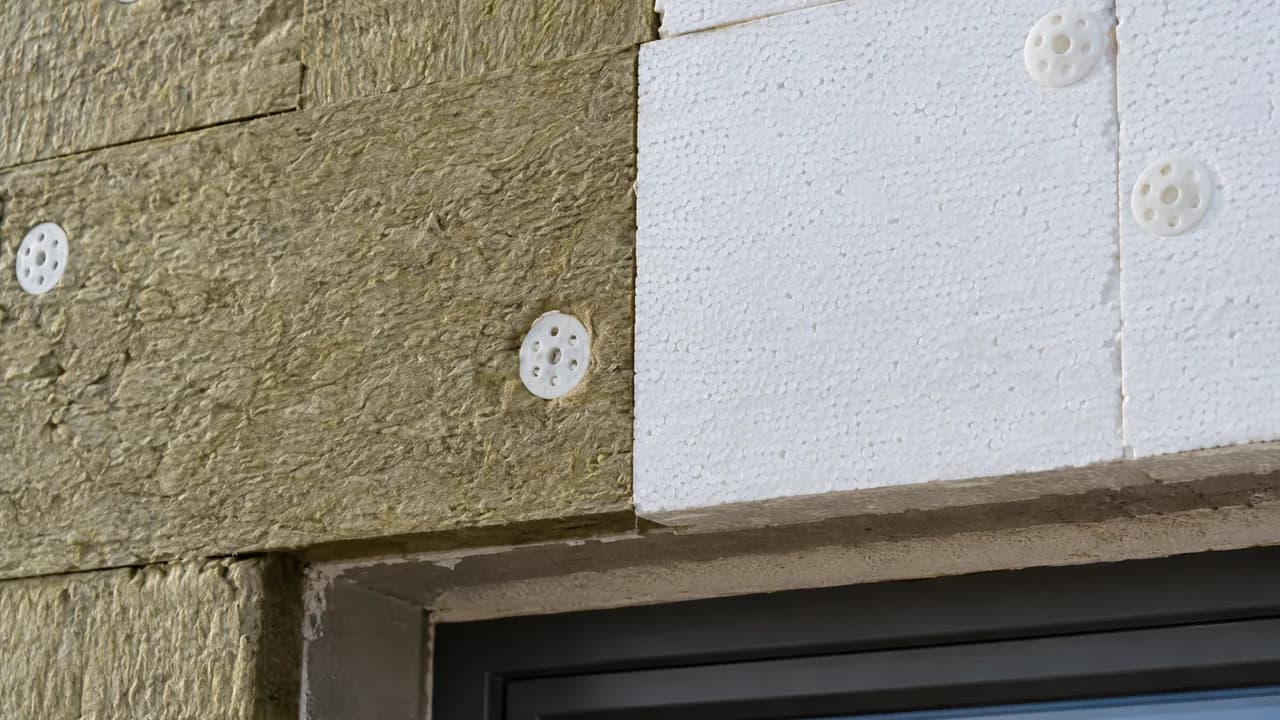
Teknopanel declares its Teknopor EPS boards as class E and EPS ETICS systems as class B (TS EN 13501-1). The two figures do not contradict each other. The board class comes from testing the board on its own. The system class applies to the assembled system, tested with adhesive, mesh and render.
A system class cannot be worked out from the board class; it comes from the system's own test and classification. Where the fire strategy sets a class for the facade system, ask for the system documentation. Where it sets a class for an insulation product, in a roof or a floor for example, ask for the product's DoP.
Where the products we supply sit
- ODE Starflex glass wool: class A1 non-combustible under EN 13501-1, according to ODE's building insulation brochure (p. 7). For the blanket and board, the brochure gives A1 for unfaced types (pp. 8 and 10).
- ODE Rockflex stone wool: class A1 under EN 13501-1, according to the manufacturer's product page. ODE also gives a service temperature of −50 to +760 °C; that is an application figure, not a fire class.
- Multipor mineral insulation board: A1 according to Türk Ytong's technical data. Sourcing on request.
- ODE Isıpan XPS: class E under EN 13501-1 (brochure, p. 21).
- Teknopor EPS board: class E; the EPS ETICS system is class B (Teknopanel). Sourcing on request.
Choosing between A1 glass wool and stone wool on a facade is covered in our stone wool vs glass wool comparison. The class is one criterion among several: thermal conductivity, compressive strength and moisture behaviour matter as much. Our basement ceiling insulation guide compares A1 and E boards for the same job.
What to ask the supplier for
A fire class is proven by a document issued for the product, not by a line in a catalogue. When you request a quotation, ask for:
- The DoP with the reaction to fire class in full (for example A2-s1,d0).
- The classification report under EN 13501-1, where the designer or the fire authority asks for it.
- Product or system: for a facade system, the class of the system, not only of the board.
- The version supplied: faced or unfaced, because the brochure's A1 figure for Starflex refers to unfaced types.
For material from a Turkish manufacturer, the DoP and CE marking are the manufacturer's documents. How sourcing, paperwork and transport work is covered in our guide to sourcing insulation from Turkey.
Supply
We ship ODE Starflex glass wool, ODE Rockflex stone wool and ODE Isıpan XPS from Türkiye; Multipor and Teknopor EPS are sourced on request. Road transit takes 3–5 days, about 5 on average. If the material is not in stock, order, production and transport typically take 1–2 weeks together; the quotation fixes the actual timing. We deliver across Hungary. EuConX supplies materials and does not carry out fire-safety design: the project's fire-safety designer sets the required class.
Send us the fire class your project specifies and the area, and we will quote A1 or class E insulation: contact · +36 30 485 0258 · info@euconx.com. We reply the same working day.
Frequently asked questions
What does A2-s1,d0 mean?
Reaction to fire class A2, smoke rating s1 and flaming-droplet rating d0. s1 is the lowest smoke rating (SMOGRA ≤ 30 m²/s², TSP600s ≤ 50 m²); d0 means no flaming droplets appeared in the SBI test within 600 seconds. Under the Hungarian fire code, A2 counts as non-combustible.
Which Euroclasses count as non-combustible?
In Hungary, A1 and A2, under point 101 of Annex 1 to the OTSZ. Solid building materials in classes B to F are combustible under point 122.
What class are XPS and EPS?
ODE Isıpan XPS is class E according to ODE's brochure. Teknopor EPS board is also class E according to Teknopanel, while the EPS ETICS system is class B. Both boards are combustible under the Hungarian fire code.
Why is an EPS ETICS class B when the board is E?
The system class comes from testing the assembled system with adhesive, mesh and render. The board class comes from testing the board alone. The designer checks the class required for the facade system against the system documentation.
Is reaction to fire the same as fire resistance?
No. The reaction to fire class describes how a material behaves once fire reaches it. Fire resistance (REI, for example) is rated for a complete element. An insulation product's DoP gives the reaction to fire class.
Which document proves the class?
The manufacturer's DoP with the full designation and, where needed, the classification report under EN 13501-1. For a facade system, the system's documentation, not only the board's.
Sources
1. Commission Delegated Regulation (EU) 2016/364 on the classification of the reaction to fire performance of construction products, Article 1, recitals, Annex Table 1 and notes: https://eur-lex.europa.eu/legal-content/EN/TXT/?uri=CELEX:32016R0364
2. Hungarian decree 54/2014. (XII. 5.) BM (OTSZ), Annex 1 points 101, 122, 173 and 176; § 25 (2)–(4) (in Hungarian): https://njt.jog.gov.hu/jogszabaly/2014-54-20-0A
3. ODE Building Insulation brochure: ODE Starflex reaction to fire (pp. 7, 8 and 10), ODE Isıpan reaction to fire (p. 21): https://ode.com.tr/_upload/pdf/ode_building_insulation_brochure_3.pdf
4. ODE Rockflex product page: https://ode.com.tr/ode-rockflex
5. Teknopanel, Teknopor EPS insulation board: https://www.teknopanel.com.tr/tr-tr/urun-detay/teknopor-eps-urunleri-teknopor-isi-yalitim-levhasi
6. Türk Ytong, Multipor insulation board, product page and technical data table: https://www.ytong.com.tr/multipor-isi-yalitim-levhasi · https://www.ytong.com.tr/images/urunler/multipor-isi-yalitim-levhasi-teknik-ozellikler.jpg
7. EuConX company data (transit, lead time, reply time, delivery in Hungary)
Planning a project? Let’s talk.
Send the material schedule or project requirements. We’ll help match the product and prepare a clear quotation.