
Ahmet Alptekin Kasar
Founder, Managing Director
Updated: 2026-10-19
This guide is for developers, contractors and specifiers comparing the two methods on an unheated loft above a heated storey. The full layer build-up and ceiling types are covered in our attic floor insulation guide (in Hungarian), and the thickness logic behind 25 cm in our 25 cm glass wool specification.
The two methods
Blown loose fill. Glass wool, stone wool or cellulose is blown onto the ceiling by machine. There is no cutting and no jointing: the fill flows around joists, pipes and low eaves.
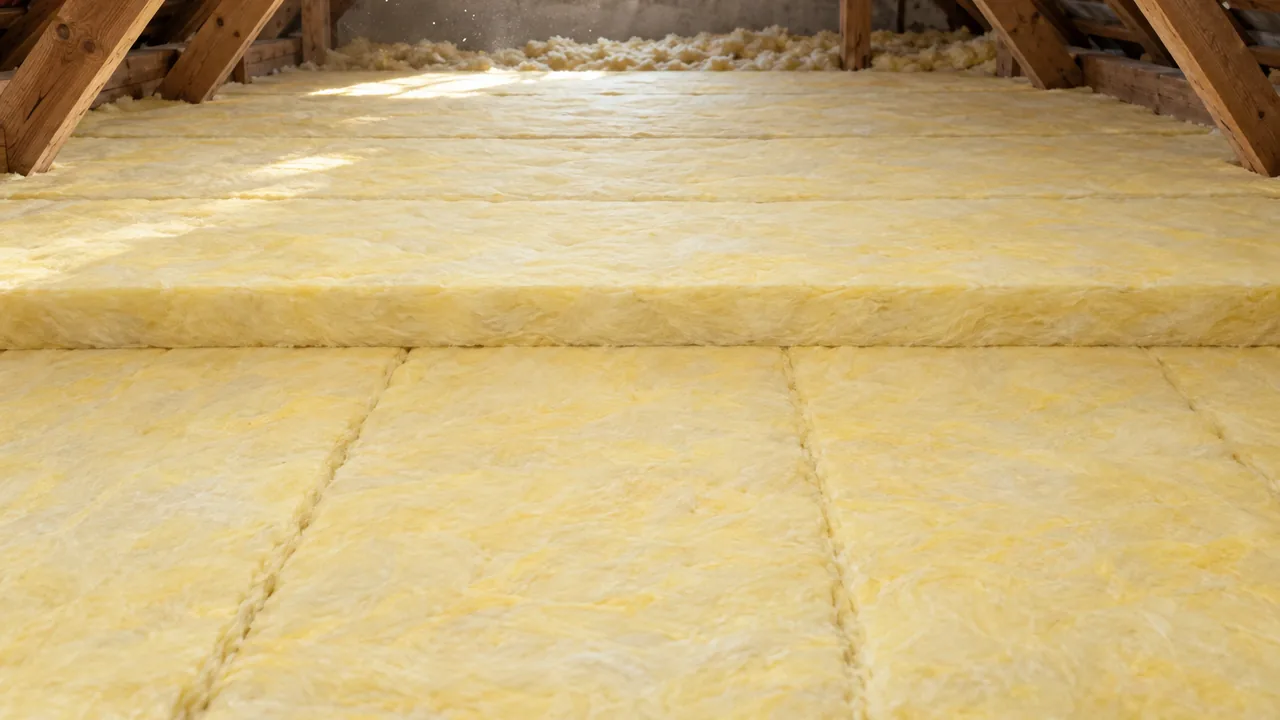
Roll glass wool. A factory-made blanket of declared thickness is laid by hand. We lay it in two layers, the second at right angles to the first so that no joint runs through the full depth. Thickness, density and λD are declared by the producer in the Declaration of Performance (DoP); ODE's glass wool DoP is issued under EN 13162 (ODE DoP).
Both can perform well. What differs is what you have to verify afterwards.
Settling: the number to ask for
Loose fill compacts after installation. Producers declare how much, and the thermal design must use the depth after settling, not the blown depth. Examples from documents we checked:
- A European Technical Assessment for a blowing glass wool (ETA-18/0707, 5 June 2025) declares settling of at most 9% without binder and 11% with binder; the nominal thickness is the installed thickness minus that percentage (DIBt, ETA-18/0707).
- A cellulose loose fill (ETA-05/0226, 2 February 2026) declares at most 10% at a bulk density of at least 30 kg/m³ (DIBt, ETA-05/0226).
- One producer brochure (February 2025) allows for up to 15% on top-floor ceilings (Saint-Gobain Isover).
- A French ACERMI certificate (1 April 2026) requires 275 mm blown to keep 270 mm after settling for R = 6.00 m²K/W (ACERMI 04/D/016/378).
There is no single settling figure for "blown insulation", so we do not quote one. Put the declared settling and the settled depth in the specification.
Rolls have no settling class because they are not loose fill. Their risk is compression: boards, boxes or foot traffic squash the wool and it insulates less. The Energy Saving Trust gives the same warning, and notes that UK building regulations recommend at least 270 mm of mineral wool in lofts (Energy Saving Trust).

Depth, coverage and density
Loose fill. The ETAs above require the installer to fix height marks, check installed thickness and density, and issue a certificate stating product, installer, date and installed thickness (ETA-18/0707). Without markers and a certificate, depth can only be checked by digging. Density matters as much as depth: under-blown fill looks deep but is looser and settles more, so compare the bags used with the area and the producer's minimum mass per m².
Rolls. Depth is measured with a tape as the layers go down, and the crosswise second layer is visible. Typical defects are gaps at joists, walls and the chimney; they are easy to see and correct during laying.
Walkability and storage
Neither build-up is walkable or suitable for storage. Loose fill is not bonded, so where people step or drag things it thins out and must be topped up. A damaged roll section can be replaced. If the loft needs access to a chimney, hatch or roof light, plan a raised walkway. For storage, the Energy Saving Trust suggests raising the floor and leaving a ventilation gap between insulation and boards.
Moisture and inspection
The moisture logic is the same for both methods:
- Vapour control layer on the warm side, on the ceiling surface, with taped laps and sealed penetrations. We supply EuConX BK45 (Sd 30 m).
- Vapour-open above, either a breathable membrane or a ventilated loft space. In our roll build-up, EuConX BD70 (Sd 0.2 m) goes on top of the wool. Never cover loft vents.
Blowing does not remove the need for the vapour control layer. Do not insulate over leaks or wet fill with either method. For later inspection, rolls can be lifted and put back; loose fill has to be raked aside and topped up.
Comparison
| Criterion | Blown loose fill | Roll glass wool (2 × 12.5 cm) |
|---|---|---|
| Settling | Declared per product (e.g. ≤ 9%, ≤ 10%, ≤ 15% in the sources above); design on settled depth | No settling class; protect against compression |
| Depth control | Depth markers and installation certificate needed | Measured with a tape when laid |
| Walkability | Not walkable; thins out where stepped on | Not walkable; compresses, sections replaceable |
| Inspection and repair | Rake aside, then top up | Lift and relay |
| Awkward corners and low eaves | Strong: flows around obstacles | Needs cutting and fitting |
| Cost logic | Machine, material, density and depth; membranes often extra | Material and hand laying; membranes included in our package |
When each one wins
Loose fill suits lofts that are low, hard to move around in, or full of joists, pipes and corners, on a dry, sound ceiling. The Energy Saving Trust also points to blown insulation for lofts that are hard to access. Ask for depth markers, the installation certificate and the settled depth in writing.
Rolls win on reasonably flat, accessible ceilings where you want the depth and the membranes to be visible and the loft to stay inspectable. That is the typical Hungarian family-house loft, and it is what we supply.
Neither should go in while the roof leaks or the ceiling is wet.
Hungary's free loft floor scheme (EKR) is still listed as free on kormany.hu, but works have been paused at most contractors since spring 2026 because the HEM quotas ran out, with no restart date. EuConX is not a HEM partner and writes no grant applications. Status details: loft insulation 2026 (in Hungarian).
For heated rooms in the roof, the job moves to the roof slope: see our pitched roof insulation guide. For the R and U arithmetic, see U-value calculation.
Cost context
Blown insulation often looks cheaper per m². The only dated Hungarian figure we found is a June 2025 contractor overview quoting 4 000–8 000 Ft/m² for blown insulation, with no thickness, no VAT basis and no scope (befujas.hu, 2 June 2025). Treat it as approximate and not like-for-like (status October 2026; we found no newer dated source).
For context only, the Hungarian homeowner offer at szigeteles.euconx.com is 12 700 Ft/m² gross (10 000 Ft net + 27% VAT) for a turnkey roll build-up: BK45, 25 cm ODE Starflex in two layers, BD70, delivery and installation by our contractor partner. Clearing, repairs, walkways and difficult access are extra, and the final price follows a site survey. The worked examples are in attic floor insulation cost 2026. For trade supply of rolls and membranes we quote per project.
Frequently asked questions
Which insulates better, blown or roll glass wool?
At the same effective thickness and λ, the same. For loose fill, use the settled depth; for rolls, the laid depth.
How much does blown insulation settle?
It depends on the product and is declared by the producer. The ETAs and producer data we checked state upper limits of about 9%, 10%, 11% and 15%.
How do I verify the depth of a blown layer?
From depth markers and the installation certificate stating the installed thickness. Ask for both before signing off the work.
Can you walk on either?
No. Plan a raised walkway or boarded area if the loft needs access or storage.
Does blown insulation need a vapour control layer?
Yes, on the warm side, exactly as with rolls, with a vapour-open layer or ventilation above.
Does EuConX install blown insulation?
No. We supply ODE Starflex rolls and EuConX BD70 and BK45 membranes. A contractor partner installs.
Material quotes and project enquiries: contact form · +36 30 485 0258 · info@euconx.com. We reply on the same working day.
Sources
1. DIBt: ETA-18/0707, blowing glass wool (Knauf Insulation Supafil), 5 June 2025: https://www.dibt.de/pdf_storage/2025/ETA-18!0707%288.12.01-19!23%29e.pdf
2. DIBt: ETA-05/0226, cellulose loose fill (isofloc), 2 February 2026: https://www.dibt.de/pdf_storage/2026/ETA-05!0226%288.12.01-31!25%29e.pdf
3. Saint-Gobain Isover: Einblasdämmung brochure, 12 February 2025: https://dam.pim-cps.saint-gobain.com/MAM/assets/1/2A56B6E6394744A8B08382600E84659A/doc/FA89341C0A6D493E85C149EDEFDA010B/ISOVER_6-Seiter_Einblas_20250212-web.pdf
4. ACERMI: certificate 04/D/016/378 (Knauf Insulation Supafil Loft 045), 1 April 2026: https://acermi.com/en/certified-insulation-products/certificate/04-d-016-378-27/
5. Energy Saving Trust: Roof and loft insulation (updated 8 May 2026): https://energysavingtrust.org.uk/advice/roof-and-loft-insulation/
6. befujas.hu: Attic insulation prices (in Hungarian), 2 June 2025: https://befujas.hu/padlas-szigeteles-arak-mitol-fuggnek-a-koltsegek-es-a-megterules/
7. ODE: glass wool Declaration of Performance (EN 13162): https://ode.com.tr/_upload/pdf/CAMYUONUO_PERFORMANS_BEYANI_SIOLTE-LEVHA_-_EN_13162.pdf
8. EuConX: attic floor insulation guide (in Hungarian): https://euconx.com/resources/padlasfodem-szigeteles
9. EuConX: ODE Starflex glass wool
Planning a project? Let’s talk.
Send the material schedule or project requirements. We’ll help match the product and prepare a clear quotation.