

Ahmet Alptekin Kasar
Founder, Managing Director
Updated: 2026-11-04
This guide is for roofing contractors, renovation teams, builders' merchants and design teams. It covers one product: what the foil top is for, where ODE recommends it, how it is laid under ODE's general principles, and what matters at chimney bases and valleys. The whole ODE range is in our ODE Opal, Granat and Rubin type table.
What the foil top is for
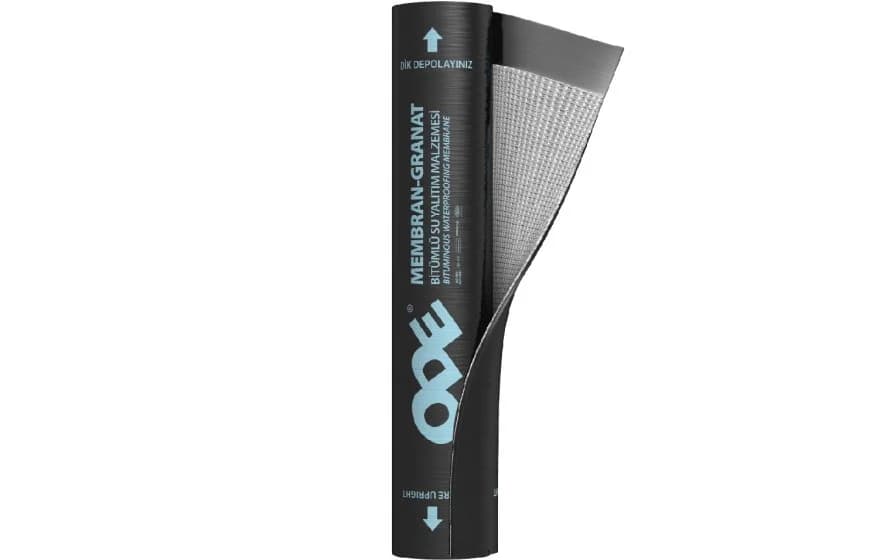
The top layer of a roof takes the sun and the weather. On ODE's other exposed membranes a mineral granule finish protects the bitumen, and for an exposed top layer ODE specifies a UV-resistant mineral-faced membrane (p. 128). On Granat ALU an aluminium foil does that job.
ODE describes it like this (p. 86):
- The top surface is covered with aluminium foil and is UV-resistant.
- Its flexibility lets it adapt to every detail.
- The APP additives and its reflectivity give it a long ageing process.
ODE gives no reflectance figure and says nothing about thermal effects, so this guide does not either.
Under the application principles (p. 127), finished waterproofing must be covered to protect it from all weather. The exceptions are mineral-faced, sand-faced and aluminium-foil-faced surfaces. The foil face of Granat ALU can therefore stay exposed.
Where ODE recommends it, and which layer
ODE names three uses: roof waterproofing, chimney bases ("baca dipleri") and roof valleys ("çatı dereleri"). On the same catalogue page (p. 86) it describes the membrane's place in two ways:
- in the feature list: "son kat membran olarak kullanılır", used as the final-layer membrane;
- in the product table: "ikinci kat membran olarak kullanılır", used as the second-layer membrane.
Our reading: in a two-layer system the second layer is also the top, final one, so both sentences point to the same position. The build-up itself is the designer's decision.
The application principles (p. 126) call for two layers of ODE Membran on flat roofs and roofs up to 5 % slope, and allow a glass-tissue ODE Membran for the first layer.
The figures you need (p. 86 and the family table, p. 94):
| Property | Granat GP 300 ALU |
|---|---|
| Modifier, carrier | APP, polyester felt |
| Top / bottom surface | UV-resistant aluminium foil / PE film |
| Thickness | 3 mm |
| Roll | 1 × 10 m |
| Cold bending | −10 °C |
| Tensile strength | 800/600 N/50 mm |
| Pallet | 30 rolls, 300 m² |
| Application | torch-on |
Source: ODE Su Yalıtımı Kataloğu R15, p. 86 and the "Bir bakışta ODE Membran ailesi" table, p. 94. ODE describes the membrane as suitable for cold and temperate climates.
Laying it under ODE's principles
The "Uygulama esasları" section of the catalogue (pp. 126–127) covers the whole ODE Membran range. These points matter for Granat ALU:
1. Weather. No work below +5 °C. In cold weather keep the rolls at room temperature for 24 hours before use, or they may crack when unrolled. No work in rain, snow, damp or frost.
2. Chamfer. Where vertical and horizontal elements meet, form a 45° chamfer of at least 8 × 8 cm. ODE says SBS-modified membranes can be laid without one; Granat ALU is APP-modified, so that exception does not apply to it.
3. Substrate and primer. The surface must be smooth, clean and dry. Prime reinforced concrete with ODE Bitüm Emülsiyon and allow 24 hours to dry. The product page gives the primer consumption as 400 g/m² in one coat.
4. Direction and start. In every layer the rows run perpendicular to the slope and start from the lowest points: outlets and valley mouths. Lay all layers in the same direction, never crosswise.
5. Joints. Stagger the end joints of the first layer. Centre the second layer over the long and cross joints of the first, fully bonded by heating.
6. Bonding. Heat membrane and substrate together and fuse the laps as well. Molten bitumen should flow out at the laps; press it down with a spatula, trowel or roller without exposing the felt.
7. Fully bonded strip. Along the roof perimeter, at chimney bases and at roll ends, bond the membrane over its full area for at least one metre.
On laps, the notes to the terrace details say (p. 130): "Rulolar serilirken enden en az 10 cm ve boydan 15 cm bindirme yapılmalıdır." That is, at least 10 cm at the roll ends and 15 cm along the length.

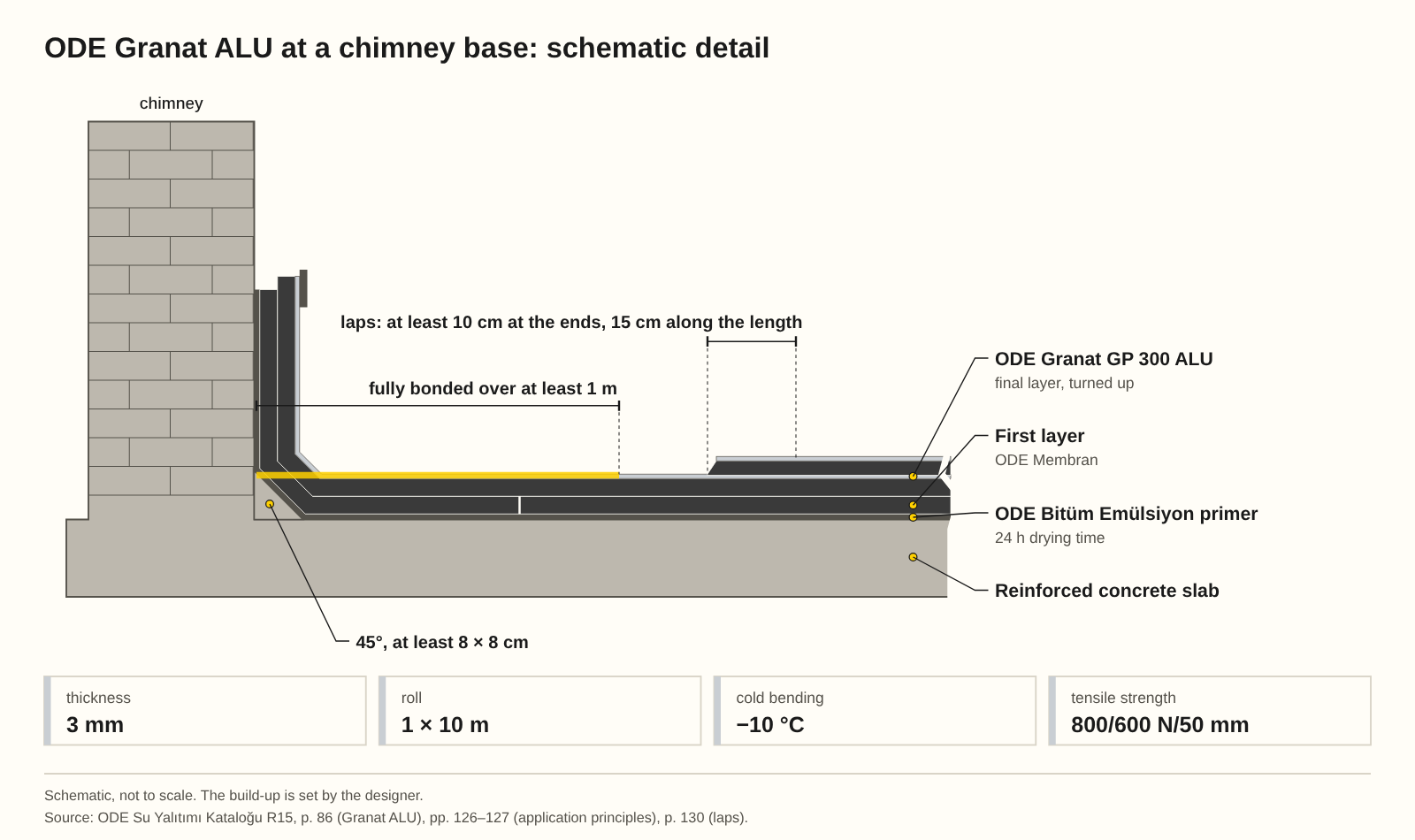
| Element | Figure | Source |
|---|---|---|
| Primer | ODE Bitüm Emülsiyon, 24 h drying; 400 g/m² in one coat | p. 126; ODE product page |
| First layer | ODE Membran; glass-tissue type allowed | p. 126 |
| Final layer | ODE Granat GP 300 ALU, turned up the chimney | p. 86 |
| Chamfer | 45°, at least 8 × 8 cm | p. 126 |
| Fully bonded strip | along the perimeter, at chimney bases and roll ends, at least 1 m | p. 127 |
| Laps | at least 10 cm at the ends, 15 cm along the length | p. 130 |
| Membrane | 3 mm; 1 × 10 m; −10 °C; 800/600 N/50 mm | p. 86 |
Chimney bases and valleys
Chimney bases and valleys are where water collects or changes direction. ODE asks for a separate fully bonded strip there, and that is where it recommends the flexible foil-faced membrane.
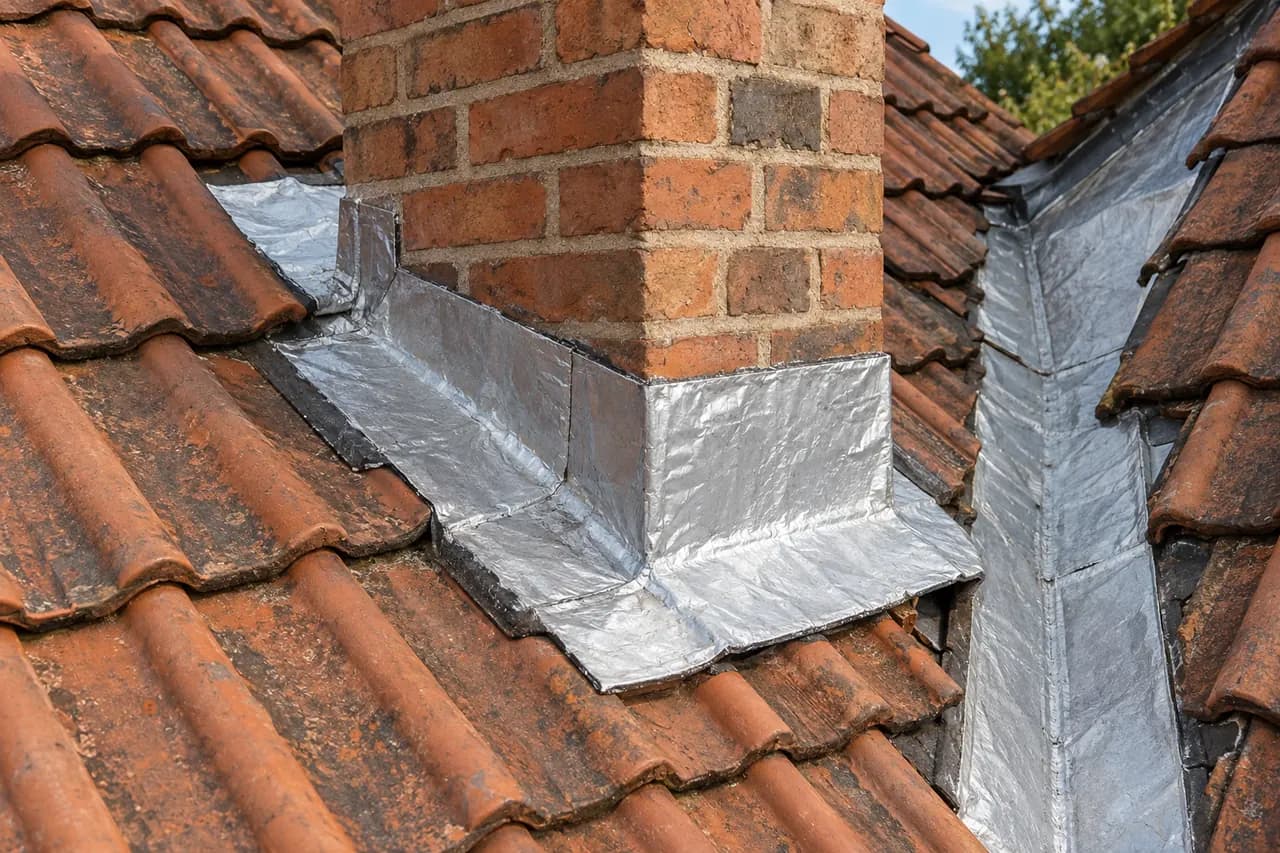
Chimney base. The membrane turns up the side of the chimney over the chamfer and is fully bonded in a strip of at least one metre around it. For pitched concrete roofs, ODE fixes the top of the upstand mechanically with a Z-profile pressure bar and seals the top edge of the profile with UV-resistant mastic (p. 140). Upstand height and termination detail are set by the designer.
Valley. ODE starts the rows from the lowest points, valley mouths included (p. 127). Form the laps so that run-off water cannot get under them. The valley detail itself is the designer's.
Substrate. The surface at the junction must be clean, dry and primed. A membrane will not bond for long to crumbling render, wet brickwork or a loose kerb, so repair those first on a renovation. ODE allows old waterproofing to stay as the bottom layer once damaged areas and blisters are repaired, with new membrane laid only after ODE Bitüm Emülsiyon primer (p. 127).
What Granat ALU is not
Granat ALU is a waterproofing membrane. It is not a vapour control layer and not a reflective insulation. Aluminium-faced vapour barriers hold back moisture on the warm, inner side of a build-up, while the foil on Granat ALU sits on the outer, weather side of the waterproofing. On a flat roof the vapour control is a separate layer under the insulation (p. 128).
Where another layer goes on top, the foil is not exposed. On an inverted roof the waterproofing sits under the XPS; see our inverted vs warm flat roof comparison. On a walkable terrace a separating geotextile, mortar and tiles go on top of the two membrane layers (p. 128); see our walkable roof terrace guide. The difference between APP and SBS is explained in our APP vs SBS article.
For general guidance on the ODE Membran range, see our application areas and installation guide and the range overview (in Hungarian). The sand-faced type of the same range, made for bridge decks, has its own article.
Supply for contractors
We supply ODE bitumen membranes from Turkey by the truckload for contractors and merchants. Whether Granat GP 300 ALU is available for your date is confirmed in the quote, together with the manufacturer documents. The catalogue states no fire class and no product standard for Granat ALU; whatever documents belong to the type are attached to the quote. Our DoP and CE documents guide explains what to check. EuConX supplies the material; it does not design or install.
Road transit from Turkey to Hungary takes 3–5 days, about 5 on average. When the material is not in stock, lead time is typically 1–2 weeks. We deliver across Hungary.
Send us the roof area and a list of the details (chimney bases, valleys, parapets), and we will return a material list: contact · +36 30 485 0258 · info@euconx.com. We reply the same working day.
Frequently asked questions
What is an aluminium foil bitumen membrane used for?
ODE recommends Granat GP 300 ALU for roof waterproofing, chimney bases and roof valleys. The aluminium foil top is UV-resistant, and according to ODE the flexible sheet adapts to every detail.
Is Granat ALU a first or second layer?
On p. 86 ODE's catalogue calls it once a "son kat" (final layer) and once an "ikinci kat" (second layer) membrane. In a two-layer system the second layer is also the top, final one; that is our reading. The build-up is set by the designer.
Does the foil face need covering?
Under ODE's principles finished waterproofing must be covered against the weather, except mineral-faced, sand-faced and aluminium-foil-faced surfaces. The foil face of Granat ALU can stay exposed.
Is an aluminium foil bitumen membrane a vapour barrier?
No. Granat ALU is a waterproofing membrane with its foil on the outer, weather side. A vapour control layer is a separate layer on the inner side of the build-up, under the insulation on a flat roof.
What laps are needed, and where is full bonding required?
The notes to ODE's terrace details ask for at least 10 cm at the roll ends and 15 cm along the length (p. 130). Along the roof perimeter, at chimney bases and at roll ends, the membrane is fully bonded for at least one metre (p. 127).
How much Granat ALU is on a pallet?
300 m², or 30 rolls. Each roll is 1 × 10 m and the membrane is 3 mm thick.
Sources
1. ODE Yalıtım: Su Yalıtımı Kataloğu R15 (Turkish): Granat Alüminyum Folyolu features and product table (p. 86), "Bir bakışta ODE Membran ailesi" table (p. 94), application principles (pp. 126–127), terrace roof build-ups (p. 128), notes to terrace details (p. 130), pitched concrete roofs (p. 140): https://ode.com.tr/_upload/pdf/ODE_Su_Yalitimi_Katalogu_R15_compressed.pdf
2. ODE Granat Alüminyum Folyolu product page (Turkish), with the consumption of ODE Bitüm Emülsiyonu: https://ode.com.tr/ode-granat-aluminyum-folyolu
3. EuConX company data (transit, lead time, reply time, delivery across Hungary)
Planning a project? Let’s talk.
Send the material schedule or project requirements. We’ll help match the product and prepare a clear quotation.