
Ahmet Alptekin Kasar
Founder, Managing Director
Updated: 2026-10-27
This guide is for contractors, developers and specifiers working on flat roofs and terraces in Hungary and the wider CEE region. It explains what the polymer modifier changes and how to choose using the manufacturers' own figures. The full grade table for the ODE Opal, Granat and Rubin families is in a separate article. For the roof build-up itself, see inverted vs warm flat roofs.
What the modifier changes
A modified bitumen membrane is bitumen blended with a polymer. The polymer sets how the sheet behaves in cold and in heat.
APP (atactic polypropylene) is a plastomer. It makes the bitumen stiffer and more stable in heat. For its APP families, Opal and Granat, ODE lists easy application in high air temperatures, UV resistance and the long ageing life that APP gives.
SBS (styrene-butadiene-styrene) is an elastomer. It makes the bitumen rubber-like, so the sheet stays flexible in the cold. For its SBS family, Rubin, ODE lists easy application at low air temperatures, flexibility that follows every detail, and easier work on projects with many details.
Neither modifier is a higher grade than the other. Each has a profile. Carrier, thickness and surface also change within one family, so compare grades one by one.
Cold bending and flow resistance: the manufacturers' figures
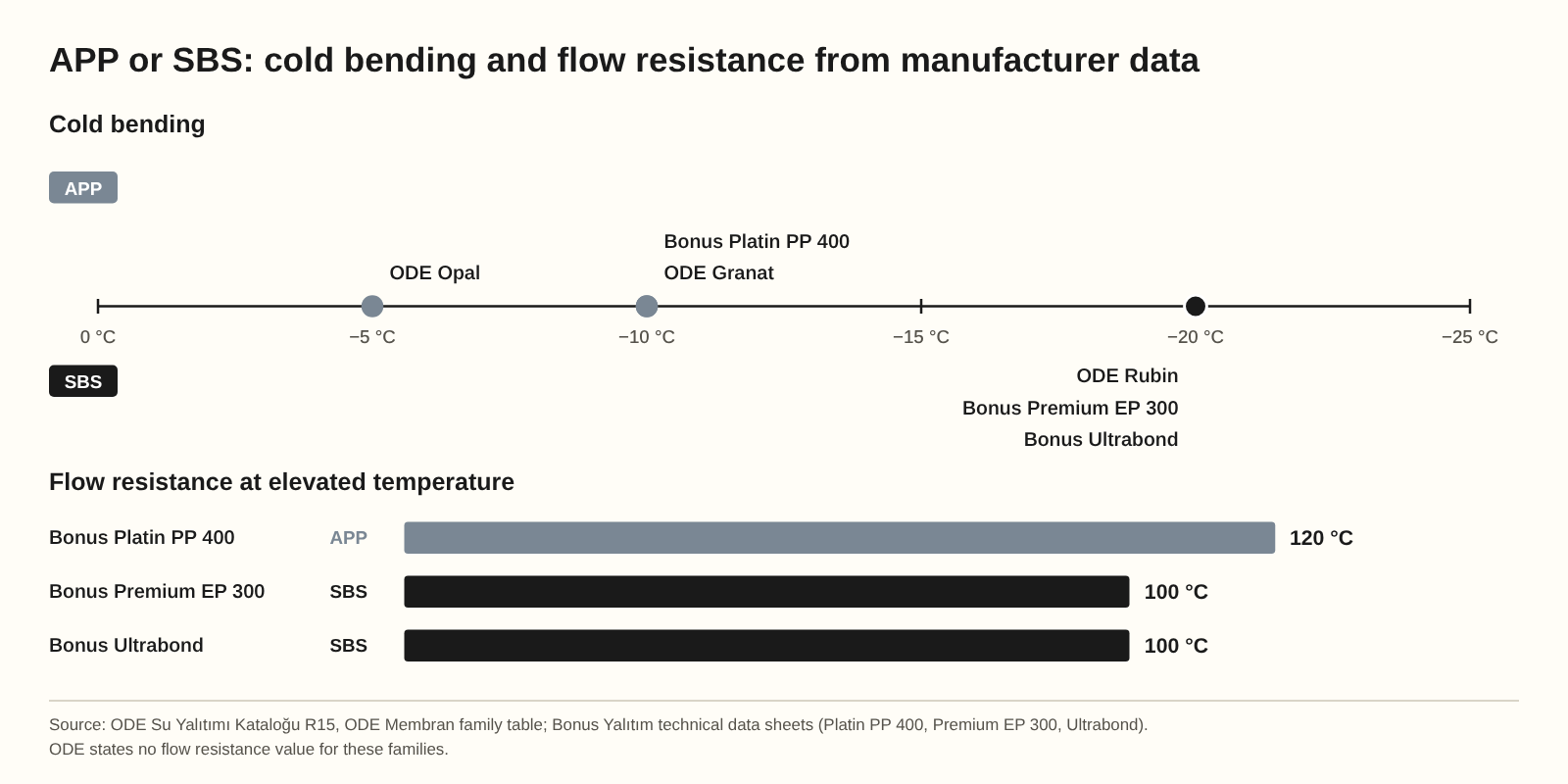
Two figures come first. Cold bending (low-temperature flexibility) is the temperature at which the sheet can be bent without cracking. Flow resistance is the temperature up to which the bitumen stays in place on a slope.

| Membrane | Modifier | Cold bending | Flow resistance |
|---|---|---|---|
| ODE Opal | APP | −5 °C | not stated |
| ODE Granat | APP | −10 °C | not stated |
| Bonus Platin PP 400 | APP | −10 °C | 120 °C |
| ODE Rubin | SBS | −20 °C | not stated |
| Bonus Premium EP 300 | SBS | −20 °C | 100 °C |
| Bonus Ultrabond | SBS | −20 °C | 100 °C |
Source: ODE Su Yalıtımı Kataloğu R15, "Bir bakışta ODE Membran ailesi" table; Bonus Yalıtım technical data sheets (Platin PP 400, Premium EP 300, Ultrabond). ODE gives no flow resistance value for the Opal, Granat and Rubin families.
Both manufacturers show the same pattern for cold bending: APP grades sit at −5 to −10 °C, SBS grades at −20 °C. Only Bonus publishes flow resistance, with 120 °C for its APP grade and 100 °C for both SBS grades. We therefore print no flow figure for ODE, and we do not read the Bonus numbers across to other SBS membranes.
Carrier: glass tissue or polyester
The carrier is the reinforcement inside the sheet, and tensile strength depends mostly on it. From the ODE family table:
- Glass tissue carrier, 2 and 3 mm: 300/200 N/50 mm in all three families.
- Polyester carrier, 3 and 4 mm: 600/400 N/50 mm for Opal, 800/600 N/50 mm for Granat and Rubin.
- Bonus Platin PP 400 and Premium EP 300: 800/600 N/50 mm. Bonus Ultrabond: 1000/800 N/50 mm.
ODE uses the 2 mm glass tissue grade as a vapour control layer on traditional pitched roofs and terraces, and the 3 mm grade as the first waterproofing layer on terraces. The polyester grades go in as the first or second layer on terraces, as a single layer on pitched roofs that are covered over, and on foundations and basement walls exposed to ground and surface water. So the role of the layer picks the carrier, not the modifier: ODE makes both its APP and its SBS sheets with either carrier.
Surface: PE film below, mineral on the cap sheet
Every ODE sheet has a torch-melt PE film on the underside. Grades with PE film on top as well are for lower and intermediate layers.
An exposed cap sheet needs a mineral-surfaced (MIN) grade. ODE describes a UV-resistant mineral finish in red, green or grey, 3.5 mm thick. On terraces ODE uses it as the final layer over a first layer, and on pitched roofs it can be laid as a single layer. Where the waterproofing stays exposed, choosing the cap sheet is therefore two decisions: modifier and surface.
When to use which
Exposed cap sheet. Heat and UV are the main loads. ODE points to the UV resistance of its APP Opal and Granat sheets, and in the Bonus data the APP grade has the higher flow resistance (120 °C against 100 °C). Mineral-surfaced grades exist with both modifiers.
Two-layer system. The first layer can be a 3 mm glass tissue or a polyester grade, the second a polyester or mineral-surfaced grade. ODE lays the second layer staggered so that it centres over the seams of the first. The designer chooses the modifier for each layer.
Cold-weather work. SBS stays more flexible in the cold, and ODE recommends Rubin for work that has to be done at low temperatures. The lower limit still applies: ODE allows no membrane application below +5 °C or in rain.
Moving substrates and light metal roofs. ODE recommends Rubin for steel roofs with high movement and for pitched or flat light metal roofs, and its mineral-surfaced Rubin grade as the cap sheet on light metal roofs that need flexibility.
Hot weather and strong sun. For Opal, ODE lists easy application in high air temperatures. By climate, ODE places Opal in temperate, Granat in cold and temperate, and Rubin in very cold climates.
Comparison table
| Criterion | APP (plastomeric) | SBS (elastomeric) |
|---|---|---|
| Cold bending in the cited data | ODE Opal −5 °C; ODE Granat and Bonus Platin PP 400 −10 °C | ODE Rubin, Bonus Premium EP 300, Bonus Ultrabond −20 °C |
| Flow resistance | Bonus Platin PP 400: 120 °C; ODE: not stated | Bonus Premium EP 300 and Ultrabond: 100 °C; ODE: not stated |
| What ODE highlights | Easy application in high air temperatures (Opal), UV resistance, long ageing life | Easy application at low air temperatures, flexibility at details |
| Climate per ODE | Opal temperate, Granat cold and temperate | Rubin very cold |
| Typical place | Exposed cap sheet, hot and sunny roofs | Cold-weather work, light metal roofs, moving substrates |
| Tensile, polyester carrier | Opal 600/400, Granat and Bonus Platin PP 400 800/600 N/50 mm | Rubin and Bonus Premium EP 300 800/600, Bonus Ultrabond 1000/800 N/50 mm |
| Application in the ODE table | Torch-applied | Torch-applied |
Source: ODE Su Yalıtımı Kataloğu R15; Bonus Yalıtım technical data sheets. The Bonus membranes are made to TS EN 13707 and TS EN 13969.
Installation: both are torch-applied
Every Opal, Granat and Rubin grade in the ODE family table is torch-applied, and the installation rules are shared:
- The substrate is a screed laid to falls, wood-float finished, free of oil, dirt and dust. Where vertical and horizontal surfaces meet, form a 45° fillet, 8 × 8 cm.
- Prime with ODE Bitüm Emülsiyon and let it dry for one day at 15–20 °C, or two days in colder weather.
- Do not apply below +5 °C or in rain.
- Lay the sheets across the slope, starting from the lowest point. Overlap 15 cm lengthwise and 10 cm crosswise.
- Torch-bond at the seams only or over the full surface. Where torching is not possible, or the roof needs securing against wind load, fix mechanically.
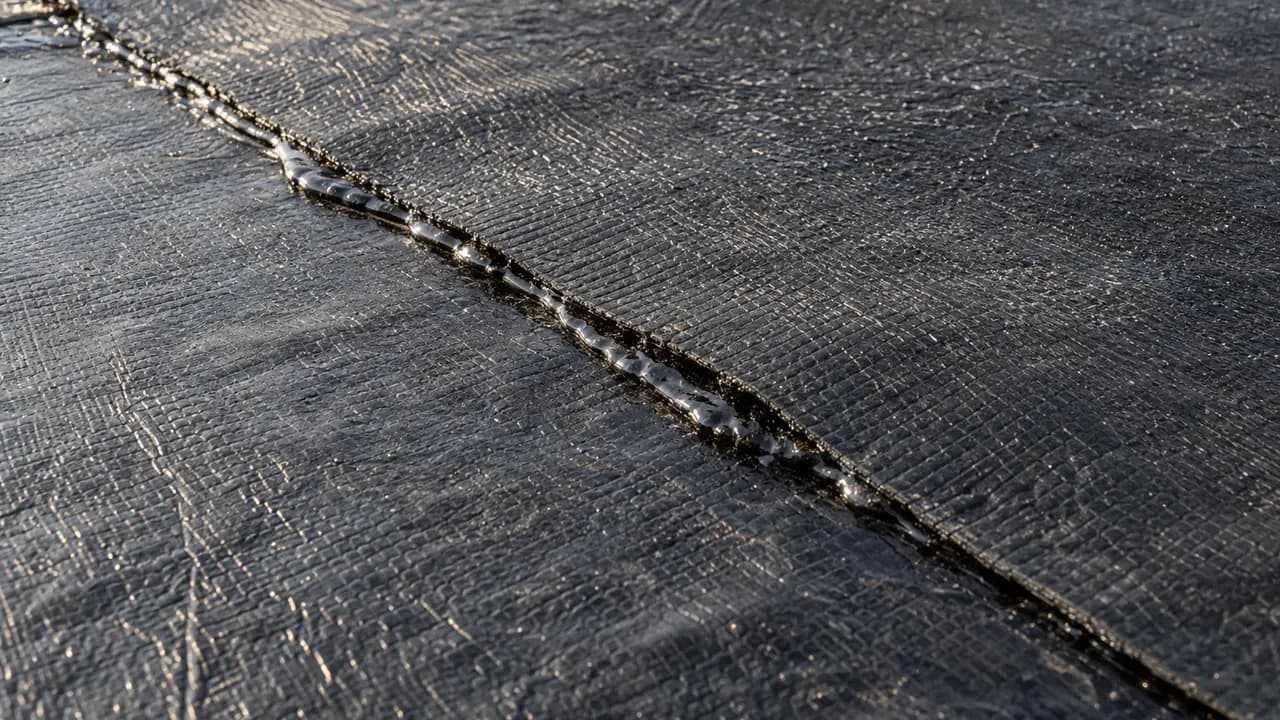
Step-by-step installation is covered in the ODE Membran application guide.
The ODE family in brief
ODE Membran covers APP- and SBS-modified sheets in three families: Opal (APP, −5 °C), Granat (APP, −10 °C) and Rubin (SBS, −20 °C). Each comes in 2 and 3 mm glass tissue, 3 and 4 mm polyester and 3.5 mm mineral-surfaced grades. Type codes, roll and pallet sizes and the special Via and aluminium-foil grades are in the ODE Opal, Granat and Rubin grade table.
Sourcing through EuConX
EuConX supplies the material; we do not install membranes. We bring ODE and Bonus membranes from Turkey, and Bonus Yalıtım is one of our partners. Road transit takes 3–5 days, about 5 on average. When the material is not in stock, ordering, production and transport together typically take 1–2 weeks, and the quote fixes the actual time. Ordering by the truckload is covered in sourcing insulation from Turkey.
Ask for the data sheet of the grade and a quote by the pallet: contact us · +36 30 485 0258 · info@euconx.com. We reply the same working day.
Frequently asked questions
What is the difference between APP and SBS bitumen membranes?
The polymer modifier. APP is a plastomer and keeps the sheet stable in heat. SBS is an elastomer and keeps it flexible in the cold. In the cited data, APP grades pass cold bending at −5 or −10 °C and SBS grades at −20 °C.
Which one handles heat better?
In the Bonus data, the APP Platin PP 400 resists flow up to 120 °C, while the SBS Premium EP 300 and Ultrabond reach 100 °C. ODE gives no flow resistance value for Opal, Granat or Rubin, so ask for the data sheet of the exact grade.
Which membrane should I use in winter?
ODE recommends its SBS Rubin family for work at low temperatures because it stays more flexible in the cold. ODE still allows no membrane application below +5 °C or in rain.
APP or SBS on a metal roof?
ODE recommends SBS Rubin for steel roofs with high movement and for light metal roofs, because its flexibility follows the movement of the deck.
What goes on top as the exposed layer?
A mineral-surfaced (MIN) grade with a UV-resistant finish, laid by ODE as the final layer over a first layer. The load decides the modifier: APP for heat and UV, SBS for cold and movement.
How much overlap do the sheets need?
ODE specifies 15 cm lengthwise and 10 cm crosswise. The second layer is staggered so that it centres over the seams of the first.
Sources
1. ODE Yalıtım: Su Yalıtımı Kataloğu R15 (ODE Membran, Opal, Granat and Rubin pages and the "Bir bakışta ODE Membran ailesi" table, in Turkish): https://ode.com.tr/_upload/pdf/ODE_Su_Yalitimi_Katalogu_R15_compressed.pdf
2. ODE Membran range: https://ode.com.tr/ode-membran · ODE Granat: https://ode.com.tr/ode-granat
3. Bonus Yalıtım: Platin PP 400 technical data sheet: https://bonusyalitim.com.tr/media/urunbrosur/73f97b-platin-pp-400.pdf
4. Bonus Yalıtım: Premium EP 300 technical data sheet: https://bonusyalitim.com.tr/media/urunbrosur/27a274-premuim-ep-300.pdf
5. Bonus Yalıtım: Ultrabond technical data sheet: https://bonusyalitim.com.tr/media/urunbrosur/20d3ca-bonus-ultrabond--tds-compressed.pdf
6. EuConX company data (transit, lead time, reply time)
Planning a project? Let’s talk.
Send the material schedule or project requirements. We’ll help match the product and prepare a clear quotation.