
Ahmet Alptekin Kasar
Founder, Managing Director
Updated: 2026-10-19
This guide is for developers, contractors and specifiers working on flat roofs in Hungary and the wider CEE region. For the board itself, see our ODE Isıpan XPS guide. For the thickness maths, see the U-value calculation guide.
The Hungarian target: 0.17 W/m²K
Hungary's energy decree 9/2023. (V. 25.) ÉKM, Annex 1, caps the average U-value of a flat roof at 0.17 W/m²K (status October 2026). The same value applies to roofs that undergo an energy-saving refurbishment.
For a sense of scale: with XPS at λ 0.035 W/mK, counting only the insulation and the surface resistances, you need about 20 cm to reach 0.17. On an inverted roof the rainwater correction comes on top, so the design thickness is usually greater. The designer sets the final figure.
Both build-ups side by side

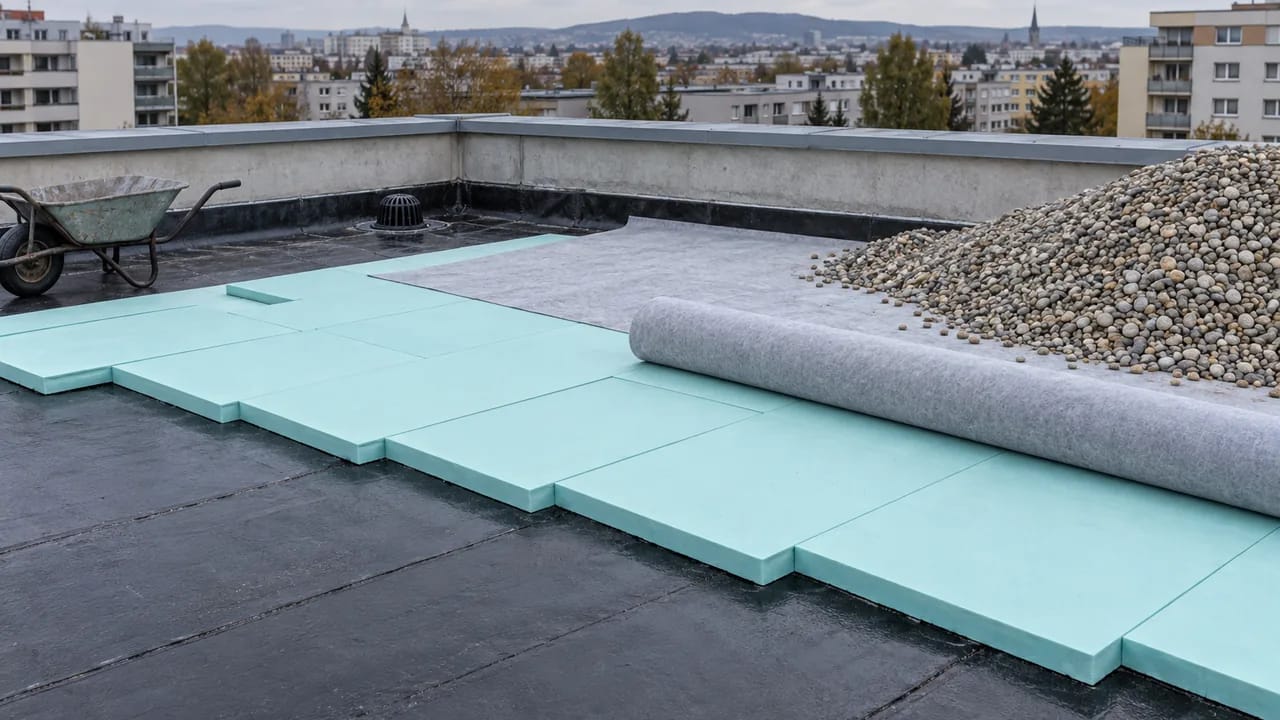
Inverted roof, bottom to top: reinforced concrete deck, screed to falls, waterproofing (bitumen sheets or a single-ply membrane), XPS insulation, filter and separation fleece, gravel or paving ballast.
Warm roof, bottom to top: reinforced concrete deck, screed to falls, vapour control layer, insulation, waterproofing.
Inverted roof: what you gain and what it demands
Putting the membrane under the insulation keeps it on the warm side and out of the weather. A Hungarian design guide from Ravago lists this protection against mechanical damage and UV as the main benefit (Ravago, 2023). The membrane also acts as the vapour control layer, so no separate one is needed.
The trade-off is that the insulation works in the wet. It has to be closed-cell, take up very little water and survive freeze-thaw cycles, and that is what XPS is for. When you order, check the EN 13164 declaration of performance (DoP) for the long-term water absorption and freeze-thaw codes (WL(T), WD(V), FTCD). These decide whether a board is fit for an inverted roof.
Filter fleece. Lay a vapour-open, non-absorbent geotextile over the XPS. Ravago specifies 110–140 g/m² polypropylene with 15 cm laps. Never lay a vapour-tight sheet such as PE film, or a highly absorbent felt, on the boards: it traps moisture in them.
Ballast. The boards must be held down against wind uplift, and against floating off in heavy rain. Ravago calls for at least 50 mm of washed 16/32 gravel, with paving slabs or mechanical fixing added at edges and around plant. Include the ballast load in the structural check.
Falls and drainage. Do not build an inverted roof dead flat. Ravago cites a minimum of 2–2.5%, and the boards should not sit in standing water for long. The BBA's inverted roof bulletin likewise asks for falls and drainage paths designed to avoid ponding (BBA Information Bulletin No. 4).
One layer of XPS or two? Manufacturers disagree here. Austrotherm allows only a single insulation layer on an inverted roof (Austrotherm). Ravago accepts a second layer in refurbishment, but only with a water-diverting membrane between the two layers. Neither source accepts two layers with nothing in between.
The rainwater correction
On an inverted roof, cold rainwater runs through the board joints onto the membrane and carries heat away. EN ISO 6946, Annex F, adds a correction for this, which the BBA summarises as ΔUr = p · f · x · (R1/Rtot)². Here p is the average rainfall during the heating season (mm/day), f is the fraction that reaches the membrane, x = 0.04 W·day/(m²·K·mm), R1 is the thermal resistance of the insulation above the membrane, and Rtot is the total resistance.
According to the BBA, f = 0.75 for rebated boards under an open covering, 1 for butt-jointed boards and 0.5 for green roofs. With a water flow reducing layer over the insulation, a minimum f of 2.5% is recommended, which gives f · x = 0.001. You may ignore the correction if it is below 3% of the uncorrected U-value. In practice: never size an inverted roof on its "dry" U-value.
Warm roof: when it is the better fit
In a warm roof the insulation stays dry under the membrane. The membrane, though, takes the UV and large temperature swings, and the deck needs a vapour control layer. IKO puts it plainly: the vapour control layer beneath the insulation stops moisture vapour being driven into it (IKO, 2022). GreenSpec adds that the vapour control layer belongs on the warm side of the insulation (GreenSpec).
A warm roof needs no gravel, so it is lighter and suits lightweight decks as well. Membranes are bonded or mechanically fixed, and single-ply sheets can also be loose-laid and ballasted. The risk is that a leak puts water straight into the insulation, where it is trapped above the vapour control layer. Seal in only dry insulation, and repair a damaged membrane quickly.
Fire during torch-on work. XPS has a maximum service temperature of +75 °C (ODE Isıpan catalogue range −50/+75 °C). EPS melts under the heat of a torch, so it needs a purpose-made protective underlay or another solution the system supplier specifies (Stedenbouw, 2020). Never torch directly onto insulation.
Comparison at a glance
| Criterion | Inverted roof | Warm roof |
|---|---|---|
| Membrane position | Below the insulation, shielded from UV and temperature swings | On top, exposed to UV and temperature swings |
| Vapour control layer | Not needed, the membrane does the job | Needed, below the insulation on the warm side |
| Insulation | XPS rated for inverted roofs only (DoP: WL(T), FTCD) | EPS, XPS or load-bearing mineral wool, as designed |
| Holding down | Gravel (min. 50 mm, 16/32) or paving | Bonded, mechanically fixed or ballasted, per system |
| U-value | Rainwater correction (ΔUr) required | Standard calculation |
| Weight | Higher; check the structure | Lower; suits lightweight decks |
| Refurbishment | Can be laid over a sound membrane as an overlay | New insulation and membrane, over the old layers or after strip-out, depending on condition |
| Terraces, green roofs | Listed among the ODE Isıpan XPS applications | Needs specific design for load and membrane protection |
Refurbishment: overlaying an existing roof
An existing warm roof often does not need stripping. Ravago describes adding insulation over the existing membrane as an overlay, which turns that membrane into the waterproofing of a new inverted roof. First survey the membrane, and check the strength and moisture content of the existing insulation. Sometimes the membrane or the insulation has to be repaired or replaced. The weak points are wall abutments, movement joints, edges and outlets. Austrotherm adds that the old membrane must be cleaned without damaging it. If the roof system has failed, GreenSpec recommends total renewal, and the extra load from gravel or paving must be checked.
The products we supply
All figures below are the manufacturers' catalogue data. The project design sets thickness and layer count.
Insulation. ODE Isıpan XPS is closed-cell extruded polystyrene. λ from 0.035 W/mK; the PRM 300 grade has 300 kPa compressive strength at 10% deformation; EN 13164; Euroclass E; μ 100; service range −50/+75 °C. ODE lists terraces, inverted roofs and green roofs among its applications. Teknopanel Teknopor EPS (λ 0.034–0.038 W/mK) is an option under a warm roof membrane. Teknopanel is a potential partner, so we source it on request only. For ODE Rockflex stone wool board our catalogue states only its temperature range (−50/+760 °C). Under a flat roof membrane it qualifies only if its DoP shows the required compressive class, which we check per project.
Bitumen membranes (Bonus).
| Sheet | Modifier | Thickness | Cold bending | Flow resistance | Standard, fire |
|---|---|---|---|---|---|
| Bonus Platin PP 400 | APP | 4 mm | −10 °C | 120 °C | TS EN 13707 / 13969, E |
| Bonus Premium EP 300 | SBS | 3 mm | −20 °C | 100 °C | TS EN 13707 / 13969, E |
| Bonus Ultrabond | SBS | 4.5 mm | −20 °C | 100 °C | TS EN 13707 / 13969, 8 m × 1 m roll |
| Bonus Plus | bitumen (PG 40 M / PP 40 M) | 3.5 mm | −5 °C | 110 °C | EN 13707, E, external fire BROOF |
The SBS sheets stay flexible in the cold (−20 °C), while the APP sheet is more stable in heat (120 °C). ODE Epikon polymer-bitumen sheets reach −5, −10 or −20 °C cold bending, depending on grade. For the wider membrane range, see our waterproofing membrane overview (in Hungarian).
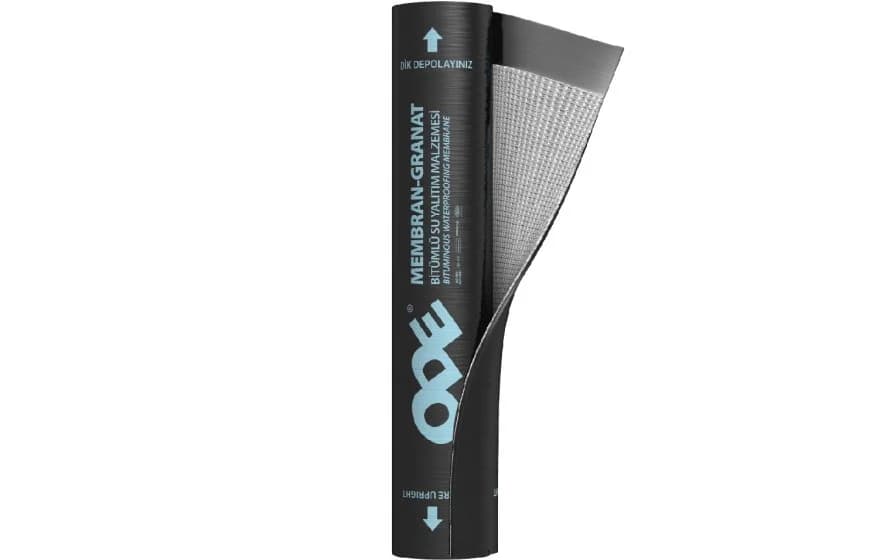
ODE Granat aluminium-foil sheet. According to ODE's product page, this is an APP-modified bitumen sheet on a non-woven polyester carrier, with a UV-resistant aluminium foil top face and a PE film underside: 3 mm, 1 m × 10 m rolls, −10 °C cold bending, 800/600 N/50 mm tensile strength, for cold and temperate climates. ODE's waterproofing catalogue (R15) lists it as torch-applied. The foil face makes sense as the exposed top layer of a warm roof; on an inverted roof the sheet sits under the XPS, so the foil does nothing there. Neither the product page nor the catalogue states a product standard or fire class for it, so we request the DoP separately when quoting. For the full ODE Membran range: ode.com.tr/ode-membran.
Single-ply. Sika Sarnafil AT-15 is a 1.5 mm FPO (flexible polyolefin) membrane. It weighs 1.65 kg/m², comes in 20 m × 2 m rolls, has a tensile strength of at least 950 N/50 mm (machine direction) and cold bending at or below −50 °C. Sika Hungary's EPS data sheet says a TPO-based membrane on EPS needs no extra separation layer, whereas PVC needs a geotextile or glass fleece because of plasticiser migration (Sika Hungary).
Vapour control for a warm roof. EuConX BK45 is a 45 g/m² vapour control membrane, Sd 30 m, watertightness W1. It is an option where the system designer accepts a sheet vapour control layer, for example in a mechanically fixed system. Keep flame away from it.
We compare XPS and EPS on cost and performance separately: XPS vs EPS (in Hungarian). We quote no prices here, because material cost depends on thickness, membrane type and volume.
Contractor checklist
- Falls: at least 2–2.5% on an inverted roof, with no ponding anywhere. Where falls are negative, add local screed or an extra outlet.
- Outlets: on an inverted roof, drain both the membrane level and the top surface. With a water flow reducing layer, provide drainage at both levels (BBA).
- XPS: EN 13164 DoP with declared water absorption and freeze-thaw codes for inverted use. Stagger the joints and keep the deck free of debris.
- Layers: one layer of XPS, or two with a water-diverting membrane between them, as the chosen system specifies.
- Filter fleece: 110–140 g/m² PP geotextile with 15 cm laps. Never PE film or absorbent felt on the boards.
- Ballast: at least 50 mm of washed 16/32 gravel, with extra ballast or fixing at edges and around plant. Have the engineer check the load.
- Solvents: solvents such as acetone or petrol attack XPS, so only solvent-free bitumen products and adhesives may touch it (Ravago).
- Single-ply: on EPS, PVC needs a separation layer and TPO/FPO does not (Sika). The membrane manufacturer's instructions always win.
- Torch-on work: never torch directly onto EPS or XPS.
- Upstands: UK practice (BS 6229, cited by IKO) sets at least 150 mm above finished roof level. The project designer fixes the local detail.
- U-value: include the rainwater correction for inverted roofs.
- Refurbishment: survey the membrane, check the old insulation for moisture and strength, and repair details before overlaying.
Frequently asked questions
What is the difference between an inverted roof and a warm roof?
In an inverted roof the XPS sits above the waterproofing and is held down by fleece and gravel or paving. In a warm roof the insulation sits below the waterproofing, with a vapour control layer underneath.
Does an inverted roof need a vapour control layer?
No separate one: the waterproofing under the insulation does that job. Never put a vapour-tight sheet such as PE film on top of the boards.
How thick should flat roof insulation be in Hungary?
The Hungarian limit is U ≤ 0.17 W/m²K. With XPS at λ 0.035 that means about 20 cm of insulation alone, plus the rainwater correction on an inverted roof.
Can EPS be used in an inverted roof?
Use XPS whose DoP declares long-term water absorption and freeze-thaw resistance. EPS belongs in a warm roof, under the membrane.
Can an old flat roof be upgraded without stripping it?
Often, yes, as an overlay: XPS and ballast go over the sound existing membrane. Survey the membrane and the old insulation first, and repair the details.
Where does the material come from, and with which papers?
ODE, Bonus and Sika are verified partners. Road transit from Turkey to Hungary takes 3–5 days, and each load travels with CE marking, the declaration of performance and a certificate of origin.
Send your build-up or bill of materials through our contact page, call +36 30 485 0258 or write to info@euconx.com. We reply on the same working day.
Sources
1. Decree 9/2023. (V. 25.) ÉKM, Annex 1 (U-value requirements): https://njt.jog.gov.hu/jogszabaly/2023-9-20-8X
2. Ravago: inverted roof design guide (Hungarian, October 2023): https://ravagobuildingsolutions.com/hu/wp-content/uploads/sites/36/2023/11/ravatherm-forditott-teto-kisokos-2023-10.pdf
3. Austrotherm: inverted roof brochure (Hungarian): https://www.austrotherm.hu/fileadmin/user_upload/HU/Letoltesek/Prospektusok/HU_Austrotherm_Zenit_2016.pdf
4. BBA Information Bulletin No. 4 (inverted roofs, ΔU per EN ISO 6946 Annex F): https://www.bbacerts.co.uk/wp-content/uploads/2023/06/Information-Bulletin-No.4-17-06-74.pdf
5. IKO: Best practices for flat roof build-ups (2022): https://ikogroup.co.uk/news-advice/best-practices-flat-roof-build-ups/
6. IKO: Upstand requirements for flat roof design (2022): https://ikogroup.co.uk/news-advice/upstand-requirements-for-flat-roof-design/
7. GreenSpec: Concrete flat roof insulation: https://greenspec.co.uk/building-design/concrete-flat-roof-insulation/
8. Sika Hungary: EPS product data sheet (July 2025): https://hun.sika.com/content/dam/dms/hucon/y/sikatherm-eps-200.pdf
9. Stedenbouw: protecting EPS during torch-on work (2020): https://stedenbouw.nl/en/?p=822
10. ODE Isıpan XPS, product page and DoP: https://ode.com.tr/ode-isipan · https://ode.com.tr/_upload/pdf/ODE_ISIPAN_PERFORMANS_BEYANI_-_EN_13164.pdf
11. ODE Granat aluminium-foil sheet and ODE Membran range: https://ode.com.tr/ode-granat-aluminyum-folyolu · https://ode.com.tr/ode-membran · ODE waterproofing catalogue R15: https://ode.com.tr/_upload/pdf/ODE_Su_Yalitimi_Katalogu_R15_compressed.pdf
12. Bonus Yalıtım product pages: https://bonusyalitim.com.tr/tr/urun-detay/platin-membran-1 · https://bonusyalitim.com.tr/tr/urun-detay/premium-membran-5 · https://bonusyalitim.com.tr/tr/urun-detay/ultrabond-membran-11 · https://bonusyalitim.com.tr/media/urunsertifika/62c643-bonus-membran-plus-performans-beyani-en-1.pdf
13. Sika Sarnafil AT-15 product data sheet: https://irl.sika.com/dam/dms/ie01/o/pds-sarnafil-at-15.pdf
14. ODE Epikon: https://ode.com.tr/epikon
15. EuConX catalogue: ODE Isıpan XPS · BK45
Planning a project? Let’s talk.
Send the material schedule or project requirements. We’ll help match the product and prepare a clear quotation.