
Ahmet Alptekin Kasar
Founder, Managing Director
Updated: 2026-10-27
This is a grade table and selection guide for contractors, specifiers and merchants. All figures come from the family table and product pages of the ODE Su Yalıtımı Kataloğu R15. For the general APP vs SBS comparison, see the separate guide. There is also an overview of the range (in Hungarian) and an installation guide.
Three families: Opal, Granat, Rubin
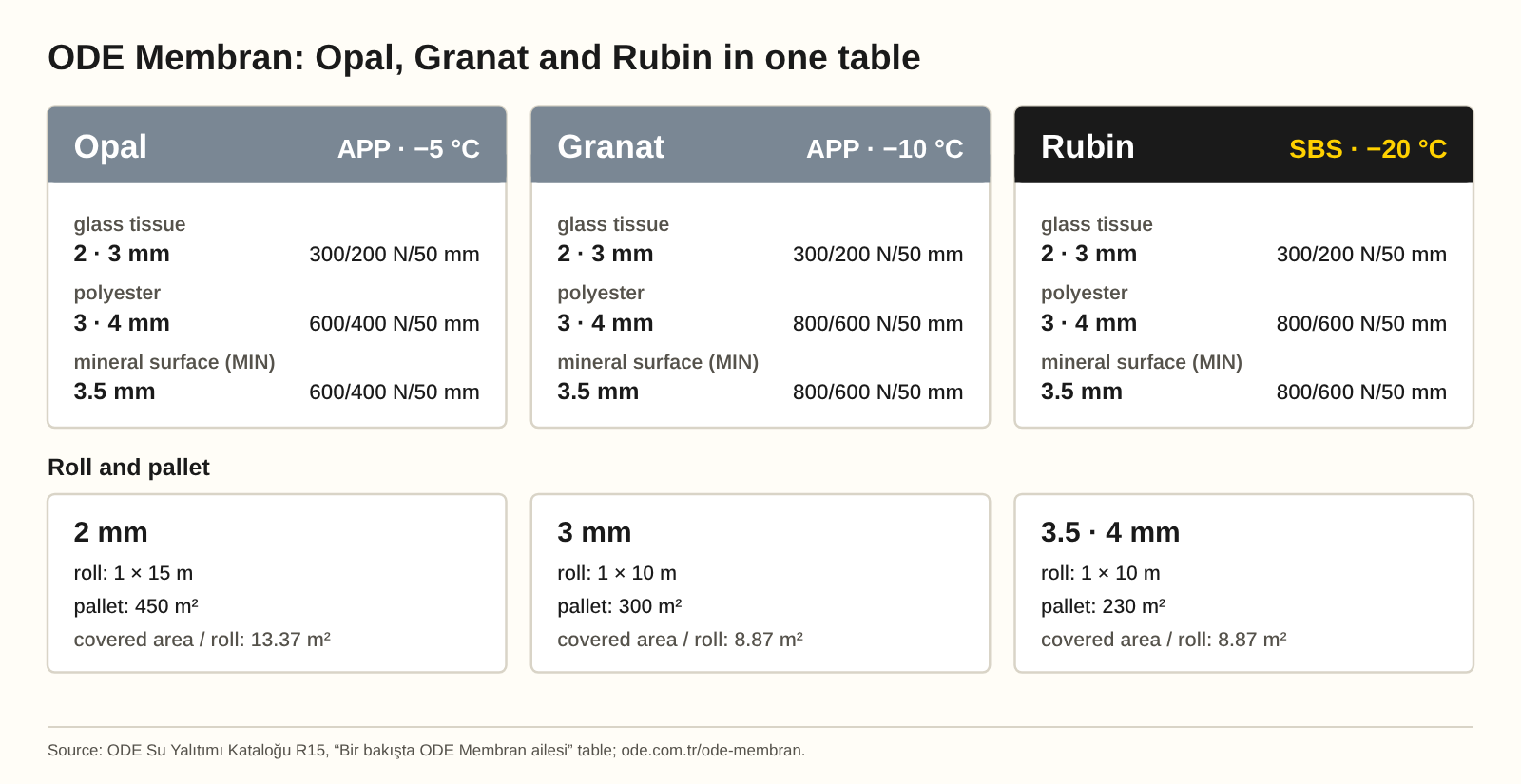
ODE Membran covers APP- and SBS-modified bitumen sheets. The three families differ in modifier and cold bending. Carriers, thicknesses and roll sizes are largely the same across them.
Opal. APP-modified, cold bending −5 °C, recommended by ODE for temperate climates. It is made with a glass tissue or a polyester carrier. ODE lists easy application in high air temperatures, high UV resistance and the long ageing life that APP gives. Polyester Opal has a tensile strength of 600/400 N/50 mm, lower than the other two families.
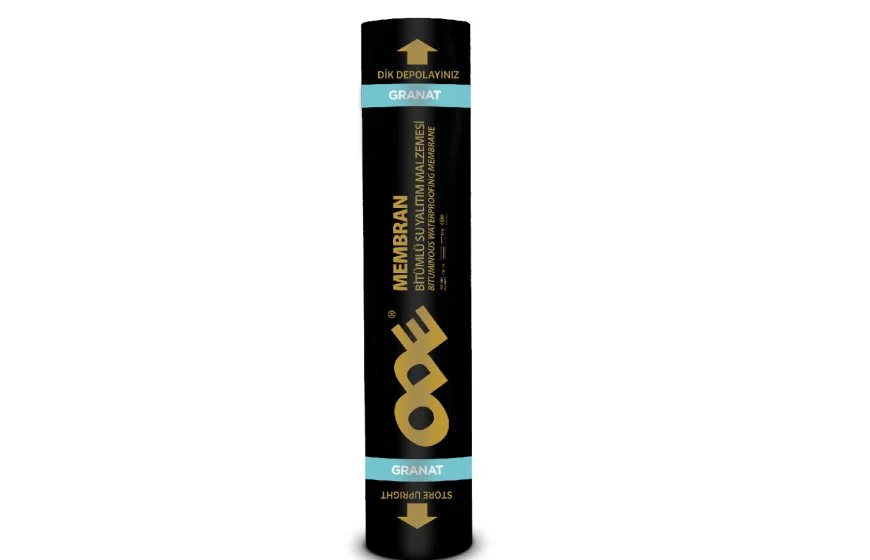
Granat. APP-modified, cold bending −10 °C, for cold and temperate climates. ODE highlights its performance, UV resistance and the long ageing life from APP. With a polyester carrier it reaches 800/600 N/50 mm. Only Granat has an aluminium-foil grade; Via grades exist in Granat and Rubin.
Rubin. SBS-modified, cold bending −20 °C, for very cold climates. According to ODE, SBS makes it easy to apply at low air temperatures, its flexibility follows every detail, and it is easier to work with on detail-heavy projects. ODE recommends it for work at low temperatures and for steel roofs with high movement. With a polyester carrier it reaches 800/600 N/50 mm.
How to read the type code
The ODE code has four parts. Take Opal OP 400 MIN:
- First letter, family: O = Opal, G = Granat, R = Rubin.
- Second letter, carrier: C = glass tissue (camtülü), P = polyester.
- Number, thickness: 200 = 2 mm, 300 = 3 mm, 400 = 4 mm, and 500 = 5 mm on Via grades.
- Suffix, top surface: MIN = mineral (red, green or grey), ALU = aluminium foil, VİA = silica sand for engineering structures. Without a suffix the top surface is PE film.
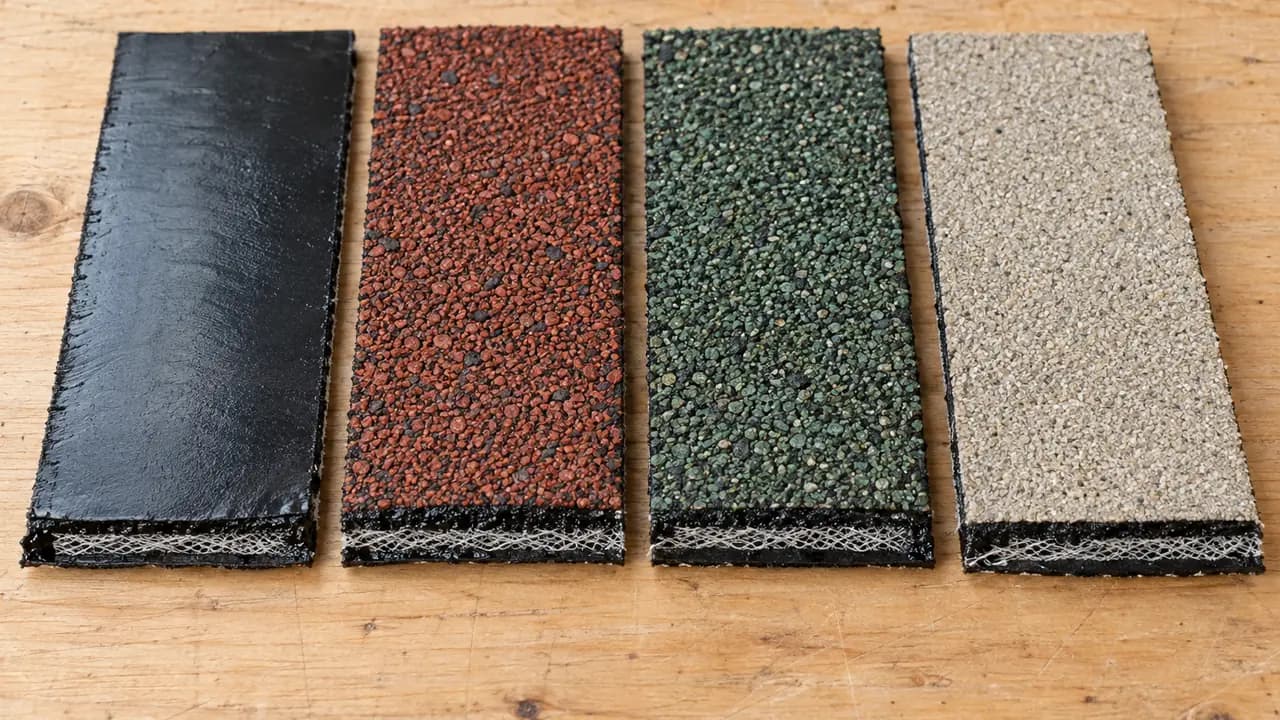
One exception: according to the family table the 400 MIN grades are 3.5 mm thick, not 4 mm. The underside of every grade is torch-melt PE film, and the table lists torch application for every grade.
The full grade table

| Grade | Modifier | Carrier | Top surface | Thickness | Cold bending | Tensile (N/50 mm) | Roll | Roll (m²) | Covered area (m²) | Rolls/pallet | Pallet (m²) |
|---|---|---|---|---|---|---|---|---|---|---|---|
| Opal OC 200 | APP | glass tissue | PE film | 2 mm | −5 °C | 300/200 | 1 × 15 m | 15 | 13.37 | 30 | 450 |
| Opal OC 300 | APP | glass tissue | PE film | 3 mm | −5 °C | 300/200 | 1 × 10 m | 10 | 8.87 | 30 | 300 |
| Opal OP 300 | APP | polyester | PE film | 3 mm | −5 °C | 600/400 | 1 × 10 m | 10 | 8.87 | 30 | 300 |
| Opal OP 400 | APP | polyester | PE film | 4 mm | −5 °C | 600/400 | 1 × 10 m | 10 | 8.87 | 23 | 230 |
| Opal OP 400 MIN | APP | polyester | mineral | 3.5 mm | −5 °C | 600/400 | 1 × 10 m | 10 | 8.87 | 23 | 230 |
| Granat GC 200 | APP | glass tissue | PE film | 2 mm | −10 °C | 300/200 | 1 × 15 m | 15 | 13.37 | 30 | 450 |
| Granat GC 300 | APP | glass tissue | PE film | 3 mm | −10 °C | 300/200 | 1 × 10 m | 10 | 8.87 | 30 | 300 |
| Granat GP 300 | APP | polyester | PE film | 3 mm | −10 °C | 800/600 | 1 × 10 m | 10 | 8.87 | 30 | 300 |
| Granat GP 400 | APP | polyester | PE film | 4 mm | −10 °C | 800/600 | 1 × 10 m | 10 | 8.87 | 23 | 230 |
| Granat GP 400 MIN | APP | polyester | mineral | 3.5 mm | −10 °C | 800/600 | 1 × 10 m | 10 | 8.87 | 23 | 230 |
| Rubin RC 200 | SBS | glass tissue | PE film | 2 mm | −20 °C | 300/200 | 1 × 15 m | 15 | 13.37 | 30 | 450 |
| Rubin RC 300 | SBS | glass tissue | PE film | 3 mm | −20 °C | 300/200 | 1 × 10 m | 10 | 8.87 | 30 | 300 |
| Rubin RP 300 | SBS | polyester | PE film | 3 mm | −20 °C | 800/600 | 1 × 10 m | 10 | 8.87 | 30 | 300 |
| Rubin RP 400 | SBS | polyester | PE film | 4 mm | −20 °C | 800/600 | 1 × 10 m | 10 | 8.87 | 23 | 230 |
| Rubin RP 400 MIN | SBS | polyester | mineral | 3.5 mm | −20 °C | 800/600 | 1 × 10 m | 10 | 8.87 | 23 | 230 |
Source: ODE Su Yalıtımı Kataloğu R15, "Bir bakışta ODE Membran ailesi" table. Underside PE film on every grade, torch-applied. Mineral finish in red, green or grey.
Besides the nominal roll area, the table gives a covered area per roll ("kapladığı alan"): 13.37 m² for 2 mm and 8.87 m² for all other grades. Use this figure for quantities, since the overlaps do not cover new surface.
Special grades: Via and aluminium foil
Granat Via and Rubin Via. Made for waterproofing viaduct, bridge and railway decks, laid as a single layer. The top is silica sand, and ODE states that asphalt or concrete can be placed directly on it without a protective felt. The carrier is a high-strength polyester, with a tensile strength of 1000/800 N/50 mm. The standard is TS EN 14695.
Granat GP 300 ALU. UV-resistant aluminium foil on top, PE film below, 3 mm. ODE recommends it for roof waterproofing, at chimney bases and in roof valleys, as the second layer.
| Grade | Modifier | Top surface | Thickness | Cold bending | Tensile (N/50 mm) | Roll | Covered area (m²) | Rolls/pallet | Pallet (m²) |
|---|---|---|---|---|---|---|---|---|---|
| Granat GP 400 VİA | APP | silica sand | 4 mm | −10 °C | 1000/800 | 1 × 10 m | 8.87 | 23 | 230 |
| Granat GP 500 VİA | APP | silica sand | 5 mm | −10 °C | 1000/800 | 1 × 10 m | 8.87 | 20 | 200 |
| Rubin RP 400 VIA | SBS | silica sand | 4 mm | −20 °C | 1000/800 | 1 × 10 m | 8.87 | 23 | 230 |
| Rubin RP 500 VIA | SBS | silica sand | 5 mm | −20 °C | 1000/800 | 1 × 10 m | 8.87 | 20 | 200 |
| Granat GP 300 ALU | APP | aluminium foil | 3 mm | −10 °C | 800/600 | 1 × 10 m | 8.87 | 30 | 300 |
Source: ODE Su Yalıtımı Kataloğu R15, Granat Via, Rubin Via and Granat Alüminyum Folyolu pages and family table. Polyester carrier and PE film underside on every grade.
Which grade for which job
ODE gives a place of use ("kullanım yeri") for every grade. In summary:
- 2 mm glass tissue (OC, GC, RC 200): vapour control layer on traditional pitched roofs and terraces.
- 3 mm glass tissue (OC, GC, RC 300): first waterproofing layer on terraces, damp-proofing of walls and foundations, and wet rooms.
- 3 and 4 mm polyester (OP, GP, RP): first or second layer on terraces, single layer on pitched roofs that are covered over. Opal and Granat also go on foundations and basement walls exposed to ground and surface water, with or without pressure; Rubin on foundations exposed to pressurised ground and surface water. Rubin polyester grades also suit pitched and flat light metal roofs.
- 3.5 mm mineral (400 MIN): exposed final layer over a first layer on terraces, or a single layer on pitched roofs. Rubin RP 400 MIN is also the cap sheet for reinforced concrete terraces and light metal roofs that need flexibility.
- Via: bridge, viaduct and railway decks, single layer.
- ALU: second layer on roofs, at chimney bases and in roof valleys.
Climate and site conditions pick the family: Opal for temperate, Granat for cold and temperate, Rubin for very cold climates, cold-weather work and moving metal roofs. The designer sets the number of layers and the build-up.
Ordering by the pallet: a worked example
Pallet size depends on thickness: 2 mm comes 30 rolls and 450 m² to a pallet; 3 mm, 30 rolls and 300 m²; 3.5 and 4 mm, 23 rolls and 230 m²; 5 mm Via, 20 rolls and 200 m².
An example: 1,000 m² of covered area in a 4 mm polyester grade (P 400) needs 1,000 ÷ 8.87 = 112.7 rolls, rounded up to 113. That is 113 ÷ 23 = 4.9 pallets, or 4 full pallets plus 21 rolls. In a two-layer system the second layer is counted separately, and upstands and details take extra material. The designer's layer count and detailing set the real quantity.
Ordering by the truckload is covered in sourcing insulation from Turkey. ODE sets out its storage rules on pages 162–163 of the catalogue; storage on site is covered in our storage article (in Hungarian).
Documents
The catalogue states no product standard and no fire class for the Opal, Granat and Rubin families, so ask for the declaration of performance of the grade you order. ODE Membran has an environmental product declaration (EPD), registration number S-P-00673.
ODE's concrete-bonded foundation membrane is covered in the ODE Epikon Proof article, and its Epikon roof membranes in the Epikon Aflame and Cool article.
Sourcing through EuConX
EuConX supplies the material; we do not install membranes. Road transit from Turkey takes 3–5 days, about 5 on average. When the material is not in stock, ordering, production and transport together typically take 1–2 weeks, and the quote fixes the actual time.
Ask for the data sheet of the grade and a quote by the pallet: contact us · +36 30 485 0258 · info@euconx.com. We reply the same working day.
Frequently asked questions
What is the difference between ODE Opal, Granat and Rubin?
Modifier and cold bending. Opal is APP, −5 °C, for temperate climates. Granat is APP, −10 °C, for cold and temperate climates. Rubin is SBS, −20 °C, for very cold climates, cold-weather work and steel roofs with high movement.
What does the code GP 400 MIN mean?
G = Granat, P = polyester carrier, 400 = the 4 mm series, MIN = mineral top surface. According to the family table, the 400 MIN grades are 3.5 mm thick.
How big is an ODE roll, and how many fit on a pallet?
The 2 mm roll is 1 × 15 m, 30 rolls and 450 m² per pallet. The 3 mm roll is 1 × 10 m, 30 rolls and 300 m². The 3.5 and 4 mm rolls are 1 × 10 m, 23 rolls and 230 m².
How much area does one roll cover?
The ODE table gives 13.37 m² for a 2 mm roll and 8.87 m² for all others. 1,000 m² in a 4 mm grade takes 113 rolls, which is 4.9 pallets.
Which grade goes on top as the exposed layer?
The mineral-surfaced 400 MIN grade: 3.5 mm, with a UV-resistant finish in red, green or grey. ODE uses it over a first layer on terraces, and as a single layer on pitched roofs.
What is ODE Granat Via for?
Waterproofing viaduct, bridge and railway decks in a single layer. Asphalt or concrete can be placed on its silica-sand surface without a protective felt. It comes in 4 and 5 mm, 1000/800 N/50 mm, to TS EN 14695.
Sources
1. ODE Yalıtım: Su Yalıtımı Kataloğu R15 (ODE Membran, Opal, Granat, Granat Via, Granat Alüminyum Folyolu, Rubin and Rubin Via pages and the "Bir bakışta ODE Membran ailesi" table; EPD on pp. 12–13; in Turkish): https://ode.com.tr/_upload/pdf/ODE_Su_Yalitimi_Katalogu_R15_compressed.pdf
2. ODE Membran range: https://ode.com.tr/ode-membran
3. ODE Granat: https://ode.com.tr/ode-granat
4. EuConX company data (transit, lead time, reply time)
Planning a project? Let’s talk.
Send the material schedule or project requirements. We’ll help match the product and prepare a clear quotation.