

Ahmet Alptekin Kasar
Founder, Managing Director
Updated: 2026-11-04
This guide is for road and bridge contractors, parking-deck contractors, design teams and procurement. It covers one product: where Granat Via is used, how it is laid step by step according to ODE's catalogue, and what to check on site. The whole ODE range, including the Via rows, is in our ODE Opal, Granat and Rubin type table.
Why a deck needs waterproofing
On page 83 of its catalogue ODE states the aim: protect the concrete of engineering structures from water and its harmful effects, so that the structure stays in service longer. It names three mechanisms.
- Freeze–thaw. Water that enters hairline cracks breaks up the concrete during freeze–thaw cycles.
- Carbonation. Carbon dioxide reacts with the cement and weakens the mechanical properties of the concrete.
- Reinforcement corrosion. Carbonation and winter de-icing salt make the reinforcing steel rust.
Water does not stop at the surfacing. Salty meltwater finds its way through cracks and joints in the asphalt to the deck. The waterproofing membrane keeps that water above the concrete.
What makes a deck membrane different
On a flat roof ODE specifies two layers of membrane (p. 126), with a mineral-faced top layer where it is left exposed (p. 128). On a deck there is one layer, and hot asphalt goes on top of it. Granat Via is made for that. ODE lists these features (p. 82):
- It is laid as a single layer.
- The top surface is covered with silica sand of a special particle size, so that the asphalt bonds to it over the full area.
- It resists the laying temperature of the asphalt placed on top.
- Its high-weight non-woven polyester felt gives a strength above the targeted 1000/800 N/50 mm.
- The felt sits towards the top of the sheet, so the lower part in contact with the deck is thicker. ODE explains this by the roughness of the substrate.
- Cold bending is −10 °C.
According to the product table (p. 84), asphalt or concrete can be placed directly on the membrane without a protection felt. The underside is PE film, melted off with the torch.
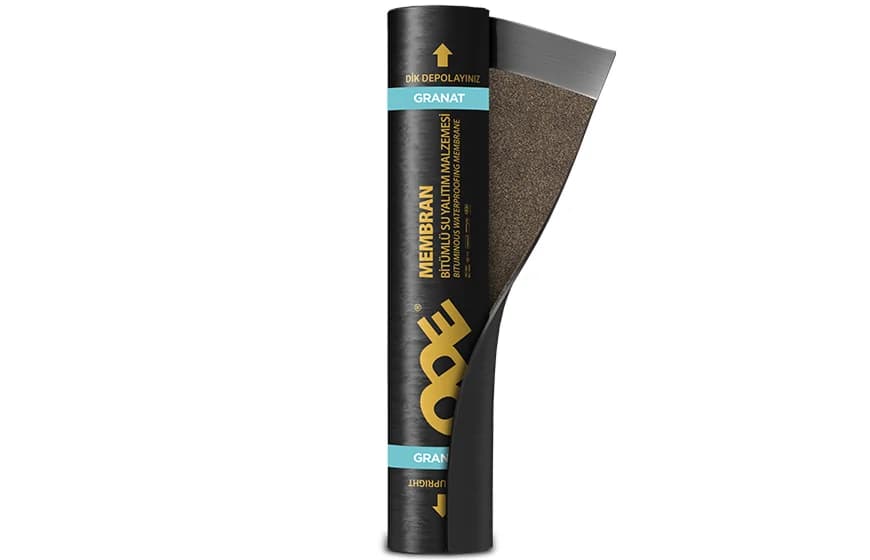
4 or 5 mm. ODE lists two types: GP 400 VİA at 4 mm, 230 m² per pallet, and GP 500 VİA at 5 mm, 200 m² per pallet. Both come in 1 × 10 m rolls. The catalogue gives no rule for choosing between them; that is the designer's call. The Via type also has an SBS-modified sibling, Rubin Via (RP 400 VIA and RP 500 VIA, −20 °C), listed in the family table (p. 94). Our APP vs SBS article explains the difference between the two modifiers.
Laying Granat Via step by step
Deck preparation. ODE (p. 84) asks for a concrete deck that is sufficiently cured and ready. It must be cleaned of oil, dirt and dust, with pressure washing where needed. The surface should be uniform: loose render removed with a stiff brush, sharp edges softened, voids filled. Steel decks are grit-blasted. ODE notes that a protective concrete is usually cast over the beams; when that concrete is cast, 35–50 cm strips of Granat Via are cut and bonded over the beam joints.
Then ODE's installation steps (p. 84):
1. Primer and membrane go onto a dry substrate, in good weather, at an air temperature above +5 °C.
2. Prime the whole surface with ODE Bitüm Emülsiyon, preferably with a wide brush. The primer's own page gives a consumption of 400 g/m² in one coat (p. 116).
3. At least 24 hours after priming, lay Granat Via parallel to the deck, with staggered joints.
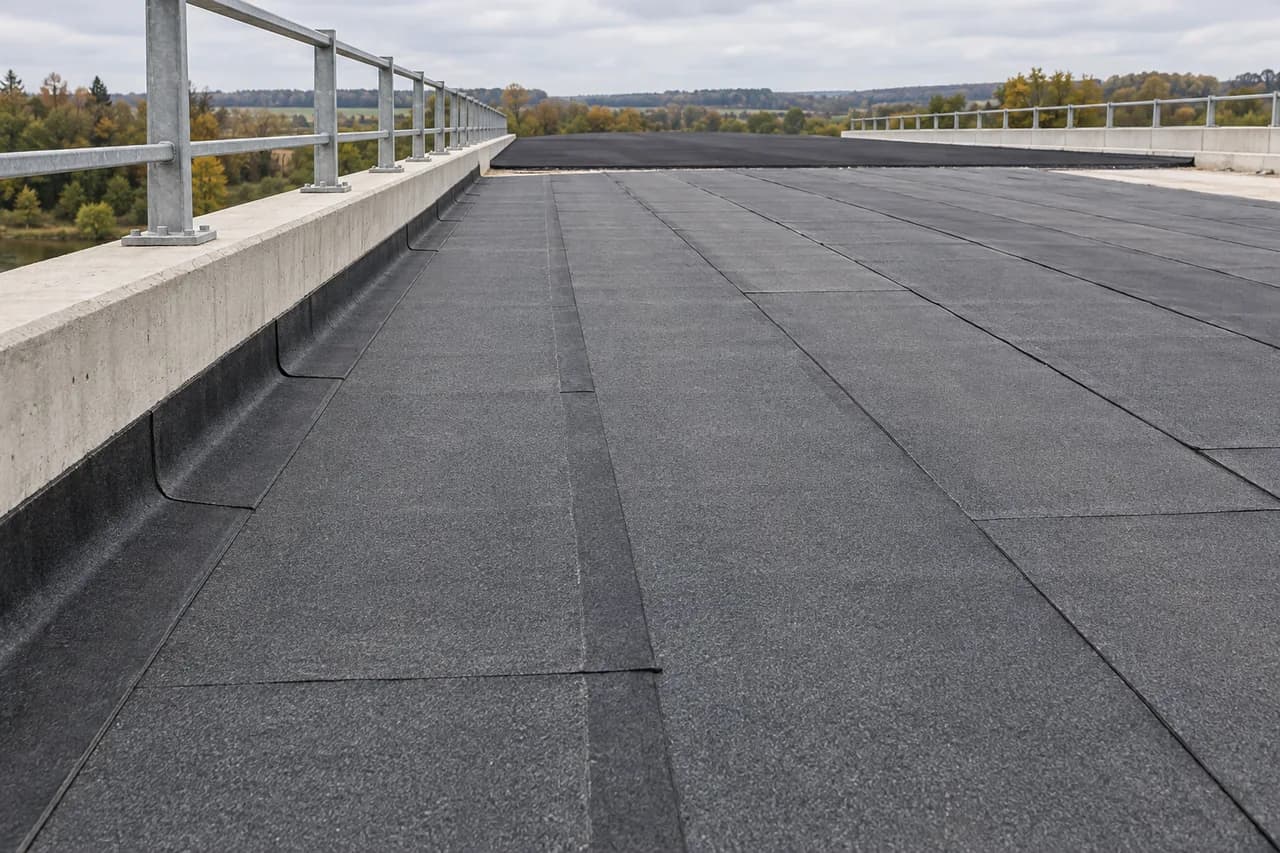
4. Torch-bond the rolls over the full area with a propane torch. Heat the underside of the membrane and the substrate at the same time, so that molten bitumen flows into the joints as the roll opens and seals them. ODE stresses full adhesion to prevent blisters.
5. Laps are 15 cm on the long side and 10 cm on the short side. On the short-side lap, brush the silica sand off with a wire brush or embed it in the bitumen by heating.
6. At kerbs and similar elements, take the membrane 10 cm up, or join a separate cut piece.

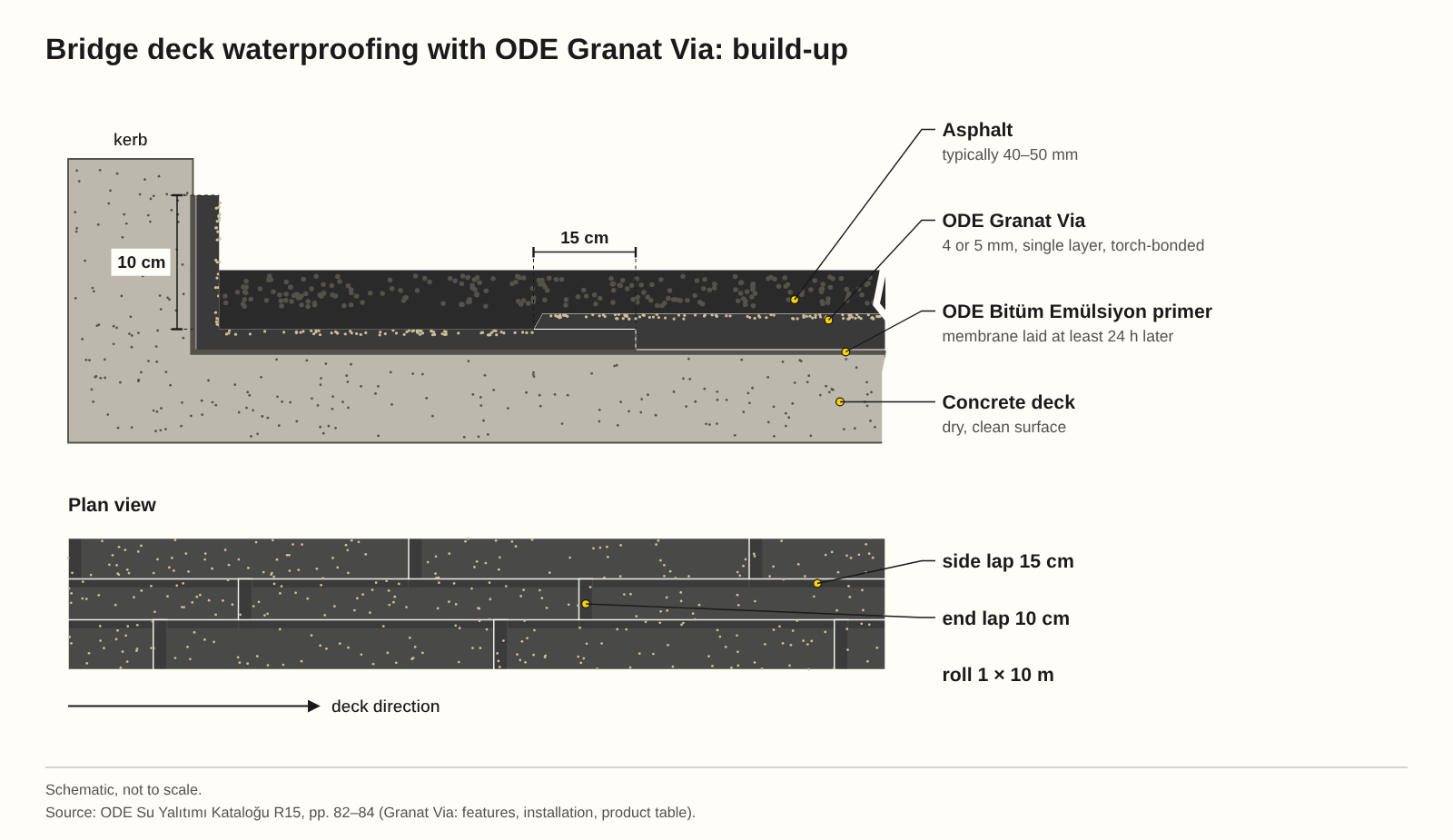
| Layer (bottom up) | Product / material | Figure | Source |
|---|---|---|---|
| Deck | concrete; steel decks grit-blasted | dry, clean, uniform surface | ODE catalogue, p. 84 |
| Primer | ODE Bitüm Emülsiyon | membrane at least 24 h later; 400 g/m² in one coat | pp. 84 and 116 |
| Waterproofing | ODE Granat Via, GP 400 VİA or GP 500 VİA | 4 or 5 mm; single layer; fully torch-bonded; laps 15 cm long side, 10 cm short side; 10 cm upstand at kerbs; roll 1 × 10 m | pp. 82 and 84 |
| Surfacing | asphalt, placed directly on the membrane without a protection felt | typically 40–50 mm | p. 84 |
Blisters, asphalt thickness and timing
ODE's warnings (p. 84) cover three points.
Blisters. If air is trapped under the membrane after bonding, cut the blister in a "+" shape, let the air out, reheat and bond the sheet back onto the concrete. Then cover the cuts with an extra patch.
Asphalt thickness. Typically 40–50 mm of asphalt is laid. ODE notes that thinner layers let the membrane laps show through and affect the evenness of the surface. The asphalt build-up and thickness are set by the designer.
Timing. Do not leave the membrane in the sun for long. According to ODE, long sun exposure can cause air bubbles, so the asphalt should follow soon after the membrane. Plan the waterproofing and surfacing sequence together.
What to check on site
- The deck is dry and clean, and the air temperature is above +5 °C.
- The primer is dry. ODE's installation step says at least 24 hours; the primer's page says one day at 15–20 °C and two days in colder weather (p. 116).
- The membrane is bonded over the full area with no trapped air, and blisters have been repaired as described above.
- Laps are 15 and 10 cm, bitumen has flowed out at the edges, and there is no loose sand in the short-side laps.
- The membrane is turned up at kerbs.
- Surfacing follows soon after the waterproofing.
What belongs to the designer and the road authority
The deck structure, expansion joints, drainage, the asphalt build-up and any approvals are decisions for the designer and the road authority. This article summarises ODE's installation guidance; it is not a design.
ODE states that Granat Via complies with TS EN 14695 and holds a TSE 11758-1 certificate and a test report from Turkey's highways authority, Karayolları (p. 82). These are Turkish documents. Which requirements and which evidence apply to a bridge in Hungary is for the designer and the road authority to decide. We send the manufacturer documents with the quote. Our DoP and CE documents guide explains what to check on such documents.
Parking decks and roadways on buildings
The catalogue also mentions the product under "Yapı üstü araç yolları", roadways with vehicle traffic built on top of structures (p. 129). For asphalt applications it specifies a single layer of ODE Granat Viyadük membrane that conforms to TSE 11758-1 and TS EN 14695 and has a highways test report, with asphalt laid directly on top. In the same section, for inverted build-ups, it specifies XPS insulation of at least 500 kPa (ODE Isıpan PRM DT) to take vehicle braking and acceleration loads and pressure. Here too, the designer chooses the build-up.
ODE's general guidance for the membrane range adds to this: see our ODE Membran application areas and installation guide and the ODE Membran range overview (in Hungarian). The aluminium-foil roofing type of the same range has its own article.
Supply for contractors
We supply ODE bitumen membranes from Turkey by the truckload for contractors. Whether GP 400 VİA or GP 500 VİA is available for your date is confirmed in the quote, together with the manufacturer documents. EuConX supplies the material; it does not design or install.
Road transit from Turkey to Hungary takes 3–5 days, about 5 on average. When the material is not in stock, lead time is typically 1–2 weeks. We deliver across Hungary. Our guide to sourcing insulation from Turkey describes the ordering process.
Send us the deck area and the planned build-up, and we will return a material list with the manufacturer documents: contact · +36 30 485 0258 · info@euconx.com. We reply the same working day.
Frequently asked questions
What is ODE Granat Via used for?
Waterproofing viaduct, bridge and railway decks in a single layer. It is an APP-modified bitumen membrane on a polyester felt, with silica sand on top and PE film underneath. ODE also specifies it for asphalt roadways with vehicle traffic built on top of structures.
Does Granat Via need a protection felt under the asphalt?
Not according to ODE's product table: asphalt or concrete can be placed directly on the sanded surface without a protection felt. The membrane resists the laying temperature of the asphalt.
What laps does Granat Via need?
15 cm on the long side and 10 cm on the short side. On the short-side lap, brush the silica sand off with a wire brush or embed it in the bitumen by heating.
How thick is the asphalt on top?
Typically 40–50 mm, according to ODE. With thinner layers the laps show through the asphalt. The asphalt build-up is set by the designer.
4 mm or 5 mm Granat Via?
ODE makes both: GP 400 VİA, 4 mm, 230 m² per pallet; GP 500 VİA, 5 mm, 200 m² per pallet. The catalogue gives no selection rule; the designer chooses the thickness.
Which documents does the membrane have?
ODE states that it complies with TS EN 14695 and holds a TSE 11758-1 certificate and a Karayolları (Turkish highways authority) test report. These are Turkish documents. Requirements in Hungary are set by the designer and the road authority; we send the manufacturer documents with the quote.
Sources
1. ODE Yalıtım: Su Yalıtımı Kataloğu R15 (Turkish): Granat Via features (p. 82), why engineering structures need waterproofing (p. 83), surface preparation, installation steps, warnings and product table (p. 84), Granat Via and Rubin Via rows in the family table (p. 94), ODE Bitüm Emülsiyonu (p. 116), flat roof principles (pp. 126, 128), roadways on structures (p. 129): https://ode.com.tr/_upload/pdf/ODE_Su_Yalitimi_Katalogu_R15_compressed.pdf
2. ODE Granat Via product page (Turkish): https://ode.com.tr/ode-granat-via
3. EuConX company data (transit, lead time, reply time, delivery across Hungary)
Planning a project? Let’s talk.
Send the material schedule or project requirements. We’ll help match the product and prepare a clear quotation.