
EuConX Editorial
EuConX Editorial
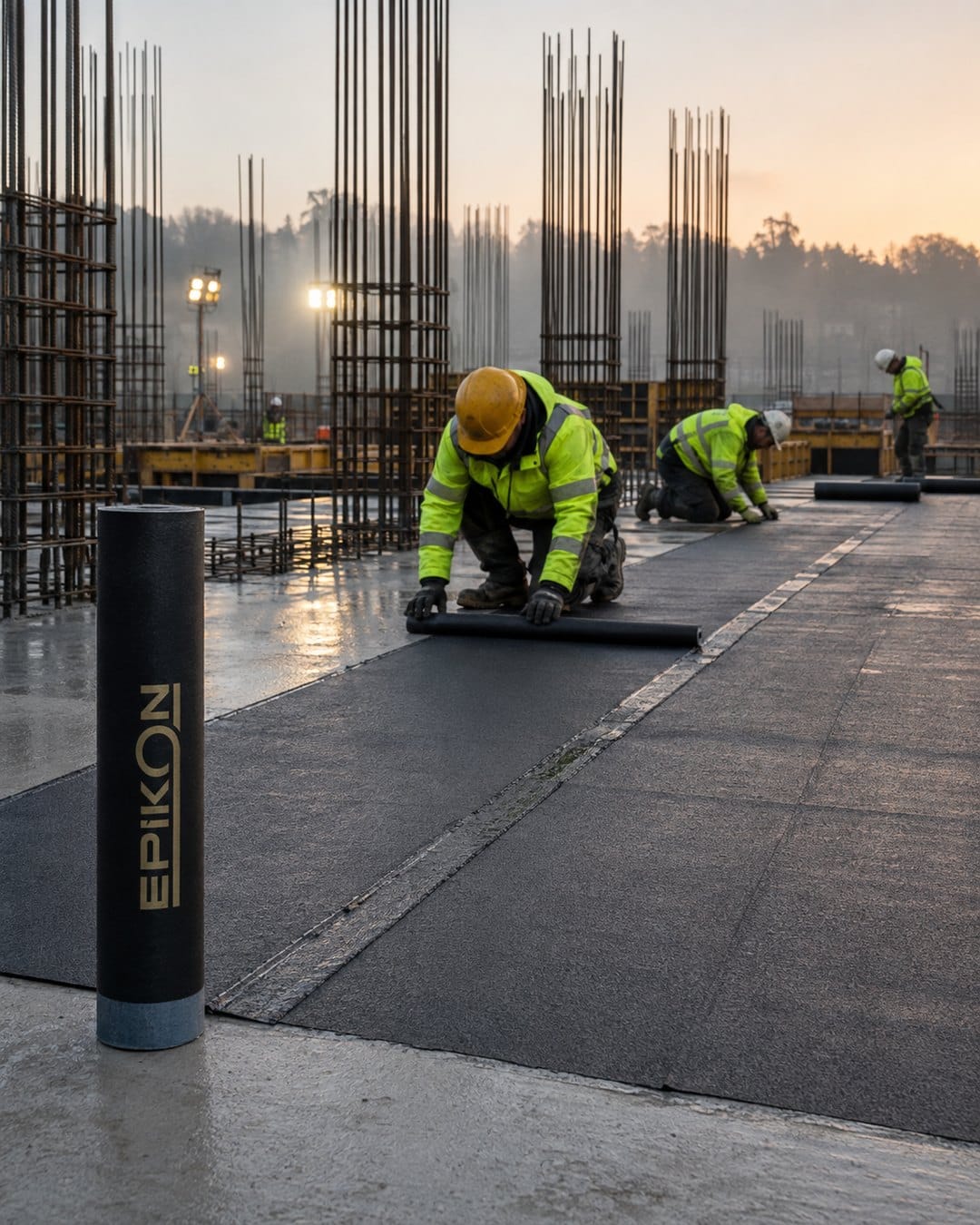
Water can enter a basement at one point and appear well away from the defect. The damp patch may sit at a wall-to-slab junction while water has travelled behind the membrane to find an opening. ODE Epikon Proof pre-applied foundation waterproofing addresses that hidden route by bonding its sand-textured face to freshly poured concrete.
We start with the water pressure, the access that will disappear after the pour and the details that must stay continuous. The Proof grade follows from those conditions, and price comparisons then stay between like-for-like systems. For the building owner, the value is practical: a local defect can remain a local investigation.
The distinction matters in below-grade waterproofing, where diagnosis is difficult and access is often gone for good. Good detailing and protection during construction remain essential. The bond changes what happens around a local defect. ODE states that Epikon Proof prevents water spreading between the concrete and waterproofing at a potential point leak. By limiting that lateral path, the system makes the source easier to localise and repair.
What the bond to fresh concrete changes
Epikon Proof is an SBS-modified polymer bitumen system installed before the structural concrete. Its fine sand-textured upper surface faces the pour and bonds to the fresh concrete. On horizontal work, the membrane sits on the blinding concrete; reinforcement can then be placed and the raft poured above it. ODE lists the omission of protective concrete and separator felt among the system benefits.
ODE also lists adhesion at overlaps, no additional tape at critical corners and reduced excavation costs. Check each point against the approved design and site method, but fewer stages and interfaces can ease foundation sequencing.
The same logic answers a difficult urban-site problem. A basement wall built against a site boundary may have only single-sided formwork, leaving no external face to waterproof after the wall is poured. EP300 Proof Vertical is the self-adhesive vertical grade for this condition. It is pre-applied on the accessible side of the temporary build-up, with the sand face ready to bond to the wall concrete. This inaccessible-face arrangement is often described as a blindside membrane application. The waterproofing is therefore in place before the route to the outside disappears. If the basement wall also gets thermal insulation, the XPS or EPS choice is covered with manufacturer data in XPS vs EPS for plinths and basement walls.
Three reasons project teams consider Proof
Bonding controls lateral water movement and keeps investigation closer to the source of a defect. During construction, horizontal grades allow the raft sequence to proceed without the protective concrete and separator felt identified by ODE. The upper face accommodates reinforcement work, while bonding is concentrated at overlaps. On one-sided walls, pre-application places the membrane before external access disappears.
These advantages should be specified as a complete system rather than reduced to a membrane thickness. Groundwater, soil, structure, access and construction sequence all affect the choice. Roof and terrace membranes answer a different exposure brief; our Epikon Aflame and Cool guide compares those options.
Grade guide: start with the ground and the structure
ODE presents three horizontal routes: EP350 Horizontal with EP200 Protector, EP450 Horizontal, and EP450 Double. EP300 Vertical covers inaccessible single-sided retaining walls. The producer says selection depends on groundwater level, soil conditions and structural requirements. For deep foundations exposed to pressurised water, it recommends EP200 as a second protective layer, but the final build-up remains a decision for the waterproofing designer and structural or geotechnical team.
| Grade | Intended place in the system | Thickness | Roll size | Pallet area | Tensile strength | Cold bending |
|---|---|---|---|---|---|---|
| EP200 Proof Protector | Protective second layer | 2 mm | 1 × 15 m | 450 m² | 600/400 N/50 mm | -20 °C |
| EP300 Proof Vertical | Single-sided retaining walls | 3 mm | 1 × 10 m | 300 m² | 800/600 N/50 mm | -20 °C |
| EP350 Proof Horizontal | Horizontal foundation layer | 3.5 mm | 1 × 10 m | 230 m² | 800/600 N/50 mm | -20 °C |
| EP450 Proof Horizontal | Horizontal foundation layer | 4.5 mm | 1 × 8 m | 184 m² | 1000/800 N/50 mm | -20 °C |
| EP450 Proof Double | Horizontal double-carrier option | 4.5 mm | 1 × 8 m | 184 m² | 1000/800 N/50 mm | -20 °C |
The -20 °C entries describe cold bending. Complete the design with the layer arrangement, wall-to-raft transition, penetrations, joints and terminations. Calculate quantity from the approved layout, including laps and an allowance for details and site loss.
Before you ask for a price
Begin with the groundwater level, expected pressure, soil conditions and seasonal design case. Separate the horizontal raft from inaccessible walls, record the excavation depth and map every transition. Then assign a named grade and thickness to each area. Carrier strength, thickness, roll length and role differ, so pallet convenience is no basis for substitution. For pressurised or deep-foundation work, obtain the engineer's written system choice.
ODE's quality certificates index lists EPD documents for Epikon, Epikon Proof and ODE Proof, plus membrane documents under EN 13707, EN 13969 and EN 14695, TSE documents and UKCA. It is an index, not an SKU matrix. An EPD reports environmental information; it is not a performance certificate. Request the current documents for the proposed grade and destination.
Questions project teams ask
Does the bond mean a point leak cannot happen?
No. Detailing and workmanship still matter. The stated benefit is that the bond prevents water spreading between membrane and concrete at a potential point leak, helping keep investigation local.
Which grade should I use with high groundwater?
ODE recommends EP200 Protector as a second layer for deep foundations exposed to pressurised water. The engineer must still decide from the groundwater, soil and structural requirements.
Is EP300 Vertical simply a thinner horizontal roll?
No. EP300 is the self-adhesive 3 mm grade for single-sided retaining walls. Horizontal systems use EP350 or an EP450 option, with EP200 where the chosen build-up requires it.
Can protective concrete and separator felt always be removed?
ODE lists their omission for horizontal Epikon Proof applications. Confirm that arrangement in the project specification and approved method before changing an existing foundation detail.
Put the right Proof system on the order
ODE Yalıtım is one of the producers EuConX works with, and we can support product matching, document requests and supply planning. You can also browse the ODE product range.
For a useful quotation, send the groundwater level, excavation depth, wall and slab build-up, requested grade and thickness, quantity, and delivery city. Drawings and the waterproofing schedule help us check that the enquiry names the same system throughout. Contact EuConX or call +36 30 485 0258.
Planning a project? Let’s talk.
Send the material schedule or project requirements. We’ll help match the product and prepare a clear quotation.