
EuConX Editorial
EuConX Editorial
Two bituminous rolls can look similar on a delivery note and answer different questions once they reach the roof. One brief may call for a thick SBS membrane with high tensile strength and firm torch-applied bonding. Another may need an exposed white mineral finish because solar exposure matters. Choosing the wrong roll can change the finished roof surface and turn a cheap substitution into rework.
We first fix the roof build-up, exposure and cold-bending class, then compare the exact SKU, roll price and pallet. This keeps a cheap-looking substitution from changing the finished surface or performance class of the roof.
Choosing between them starts with the finished surface and the required membrane class. Aflame is ODE's 5 mm SBS option for demanding waterproofing applications, including roofs and terraces. Cool is a family of white mineral cap sheets designed for high solar reflectance and high thermal emissivity. Its four grades then divide by modifier, thickness, tensile strength and cold-bending value. For buried rafts and inaccessible walls, our Epikon Proof foundation guide covers the separate question of bonding to fresh concrete.
Aflame and Cool solve different roof problems
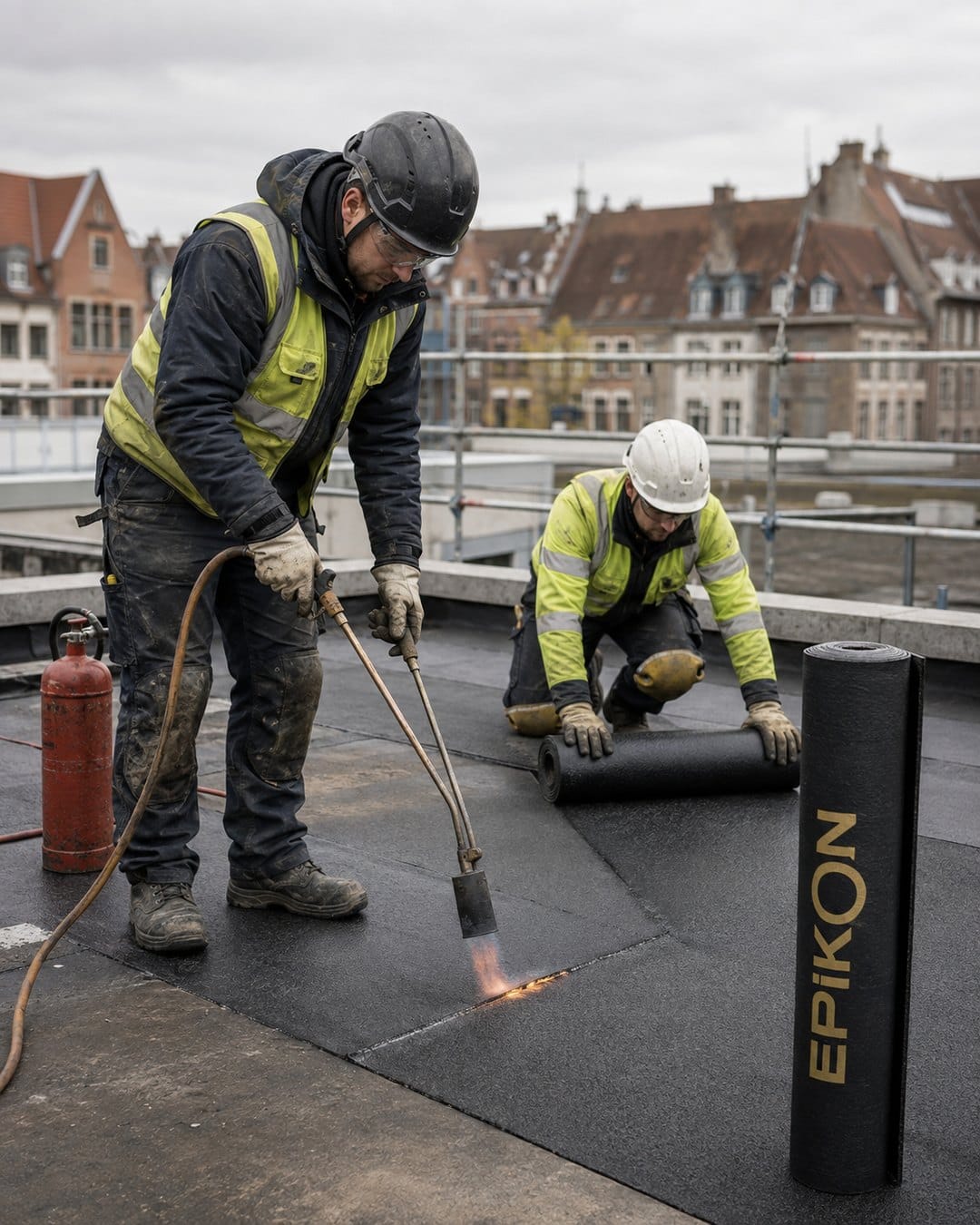
Epikon Aflame is made from SBS-modified bitumen around a nonwoven polyester carrier. At 5 mm and with a -30 °C cold-bending value, it is the thicker option; ODE publishes a 1000/800 N/50 mm tear-and-puncture-resistance figure for its carrier. The roll is 1 × 7.5 m and each pallet carries 172.5 m². Its upper face is silica sand and its underside is PE film.
ODE lists Aflame for single-layer use on foundations and retaining walls exposed to high hydrostatic pressure, as well as terraces and roofs. The producer also describes strong bonding when the sheet is torch-applied. For a roof specifier, the useful signal is clear: Aflame answers a requirement for a substantial 5 mm SBS membrane rather than for a white exposed cap.
Epikon Cool answers the surface-exposure question. Its UV-resistant white mineral upper face is intended as a reflective final layer on terraces and sloped concrete or lightweight-concrete roofs. ODE describes the range as having high solar reflectance and high thermal emissivity.
Cool's published value is its white, solar-reflective cap surface. ODE does not publish an SRI value, reflectance percentage or energy-saving figure on the product page, so any modelled building effect needs project-specific data.
What the choice changes on site
On site, Aflame is the 5 mm SBS roll with a silica-sand face for an approved torch-applied build-up. Cool is the exposed white mineral cap. That difference changes the roof's finished surface as well as the product class.
Cool then offers four levels beneath the same white finish. EP400-5 and EP400-10 use APP-modified bitumen; EP400-20 and EP400-30 use SBS, with ODE describing EP400-30 as high-performance SBS. The cold-bending range runs from -5 °C to -30 °C and tensile strength from 600/400 to 1000/800 N/50 mm, so the enquiry must name the grade.
The comparison is easier when every value stays with its own row:
| Product | Modifier | Thickness | Published strength | Cold bending | Roll / pallet | Upper finish and role |
|---|---|---|---|---|---|---|
| Epikon Aflame | SBS | 5 mm | 1000/800 N/50 mm tear and puncture resistance | -30 °C | 1 × 7.5 m / 172.5 m² | Silica sand; 5 mm SBS membrane |
| Cool EP400-5 | APP | 3.5 mm | 600/400 N/50 mm tensile strength | -5 °C | 1 × 10 m / 230 m² | White UV-resistant mineral cap |
| Cool EP400-10 | APP | 3.5 mm | 800/600 N/50 mm tensile strength | -10 °C | 1 × 10 m / 230 m² | White UV-resistant mineral cap |
| Cool EP400-20 | SBS | 3.5 mm | 800/600 N/50 mm tensile strength | -20 °C | 1 × 10 m / 230 m² | White UV-resistant mineral cap |
| Cool EP400-30 | High-performance SBS | 3.8 mm | 1000/800 N/50 mm tensile strength | -30 °C | 1 × 10 m / 230 m² | White UV-resistant mineral cap |
Cold bending is one published property, not a substitute for the roof-system design. Keep the -30 °C value attached to Aflame or Cool EP400-30; it does not apply to the APP Cool grades.
A practical way to select the roll
Start with the finished surface. A white mineral cap that remains exposed points to the Cool family; a specified 5 mm SBS sheet with Aflame's strength and cold-bending class points to Aflame. Then fix the required cold-bending class, tensile strength, layer arrangement and substrate.
Check roof slope, outlets, upstands, movement joints and penetrations on the drawings. Both producer pages identify a PE-film underside, and ODE describes torch bonding for Aflame, so the installer must also confirm substrate preparation, bonding, laps and fire controls.
Order by exact SKU and the roof layout. Cool rolls cover 10 m² gross and its pallets carry 230 m²; Aflame rolls cover 7.5 m² gross and pallets carry 172.5 m². The usable area falls once laps and details are included.
Ask for documents by product code
ODE's quality certificates index lists EPDs for Epikon membranes and membrane documents referring to EN 13707, EN 13969 and EN 14695, TSE documents under TS EN 13707 and TS EN 13969, plus UKCA. It is a document library, not confirmation that every Aflame or Cool grade carries every listed document in every market. An EPD is an environmental declaration, not evidence of waterproofing performance. Request the current declaration or certificate for the exact product and destination.
Questions that settle most enquiries
Is Cool automatically the better choice for a sunny roof?
Cool is the relevant family when the design requires an exposed white mineral cap with the solar properties ODE describes. The full roof build-up, drainage, detailing, climate and finish requirements still decide whether it is the right membrane.
Does Epikon Cool come with a stated energy saving?
No quantified saving is published on the ODE product page. It states high solar reflectance and high thermal emissivity without an SRI number or reflectance percentage. Avoid attaching a percentage or payback claim to the product without separate project evidence.
Are all four Cool grades SBS membranes?
No. EP400-5 and EP400-10 are APP-modified. EP400-20 is SBS-modified, and EP400-30 is high-performance SBS. Their thickness, tensile strength and cold-bending values also differ.
Send a roof enquiry we can answer properly
ODE Yalıtım is one of the producers EuConX works with. We can help align the named grade, producer documents and delivery plan, and you can review ODE products in the catalogue.
Send the roof or terrace build-up, substrate, slope, exposed or covered finish, design climate requirement, area, requested grade, thickness and quantity, plus the delivery city. Contact EuConX or call +36 30 485 0258.
Planning a project? Let’s talk.
Send the material schedule or project requirements. We’ll help match the product and prepare a clear quotation.