

Ahmet Alptekin Kasar
Founder, Managing Director
Updated: 2026-11-27
This page is for contractors, energy consultants, designers, tender teams and wholesalers who specify thickness and material when space is tight.
Why λ matters when the depth is fixed
The thermal resistance of an insulation layer is R = d / λ: thickness divided by thermal conductivity. When the structure sets the thickness, λ is the only lever left. With a lower λ the same R comes from less thickness, and it contributes exactly as much to the U-value of the build-up.
General material and thickness choice is covered in our λ-value and thickness calculator article. This page answers one question: what λ 0.032 glass wool gains over λ 0.039.
The real U-value of an element depends on the whole build-up. Rafters and steel studs act as thermal bridges, and the inner and outer surface resistances count too. The figures below cover the insulation layer only; the full method is in our U-value calculation article.
λ 0.039 or λ 0.032: comparison
| Aspect | Glass wool λ 0.039 | Glass wool λ 0.032 |
|---|---|---|
| λD, W/(m·K) | 0.039 (ODE Starflex) | 0.032 (ODE Starflex 032) |
| Thickness for the same R, 25 cm example | 25 cm → R 6.41 m²K/W | 20.5 cm |
| Thickness for the same R, 15 cm example | 15 cm → R 3.85 m²K/W | 12.3 cm |
| Where it pays off | Where thickness is not a constraint, e.g. a loft floor | Where depth is fixed: rafters in a pitched roof, studs in a steel-stud wall |
| Document | DoP, CE, EUCEB | EPD-IES-0030980:001; λD on the DoP of the delivered product |
It also works the other way: 15 cm of λ 0.032 wool gives R = 0.15 / 0.032 = 4.69 m²K/W, so the same depth holds a higher R.

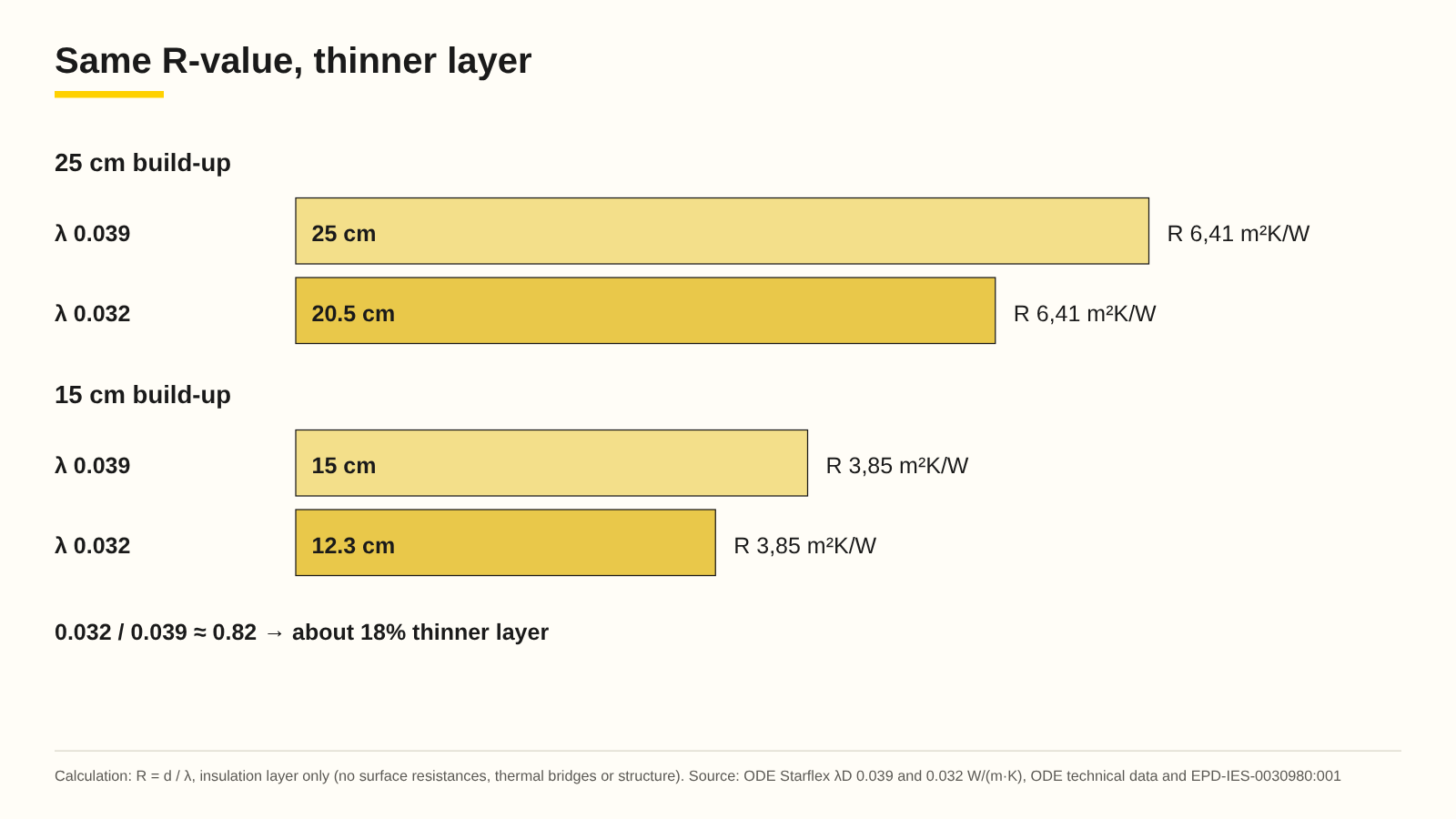
| Same R-value, thinner layer | λ | Thickness | R |
|---|---|---|---|
| 25 cm build-up | λ 0.039 | 25 cm | R 6.41 m²K/W |
| 25 cm build-up | λ 0.032 | 20.5 cm | R 6.41 m²K/W |
| 15 cm build-up | λ 0.039 | 15 cm | R 3.85 m²K/W |
| 15 cm build-up | λ 0.032 | 12.3 cm | R 3.85 m²K/W |
0.032 / 0.039 ≈ 0.82 → about 18% thinner layer. Calculation: R = d / λ, insulation layer only (no surface resistances, thermal bridges or structure). Source: ODE Starflex λD 0.039 and 0.032 W/(m·K), ODE technical data and EPD-IES-0030980:001.
Pitched roofs: when rafter depth is the limit
In a habitable attic the glass wool sits between the rafters, and the rafter depth sets the layer thickness. If nothing more can go under or over the rafters, because headroom is short or the roof plane is fixed, λ 0.032 wool gives a higher R in the same depth, or the same R from less depth.
The build-up, inside to outside: interior lining, EuConX BK45 vapour barrier (Sd 20 m) on the warm side, glass wool between the rafters, EuConX BD70 breathable membrane (Sd 0.02 m) on the cold side, roof covering. The vapour barrier stops indoor vapour before the insulation; the breathable membrane lets out whatever gets in. The difference between the two is covered in vapour barrier vs breathable membrane, the full attic build-up in pitched-roof insulation between rafters.
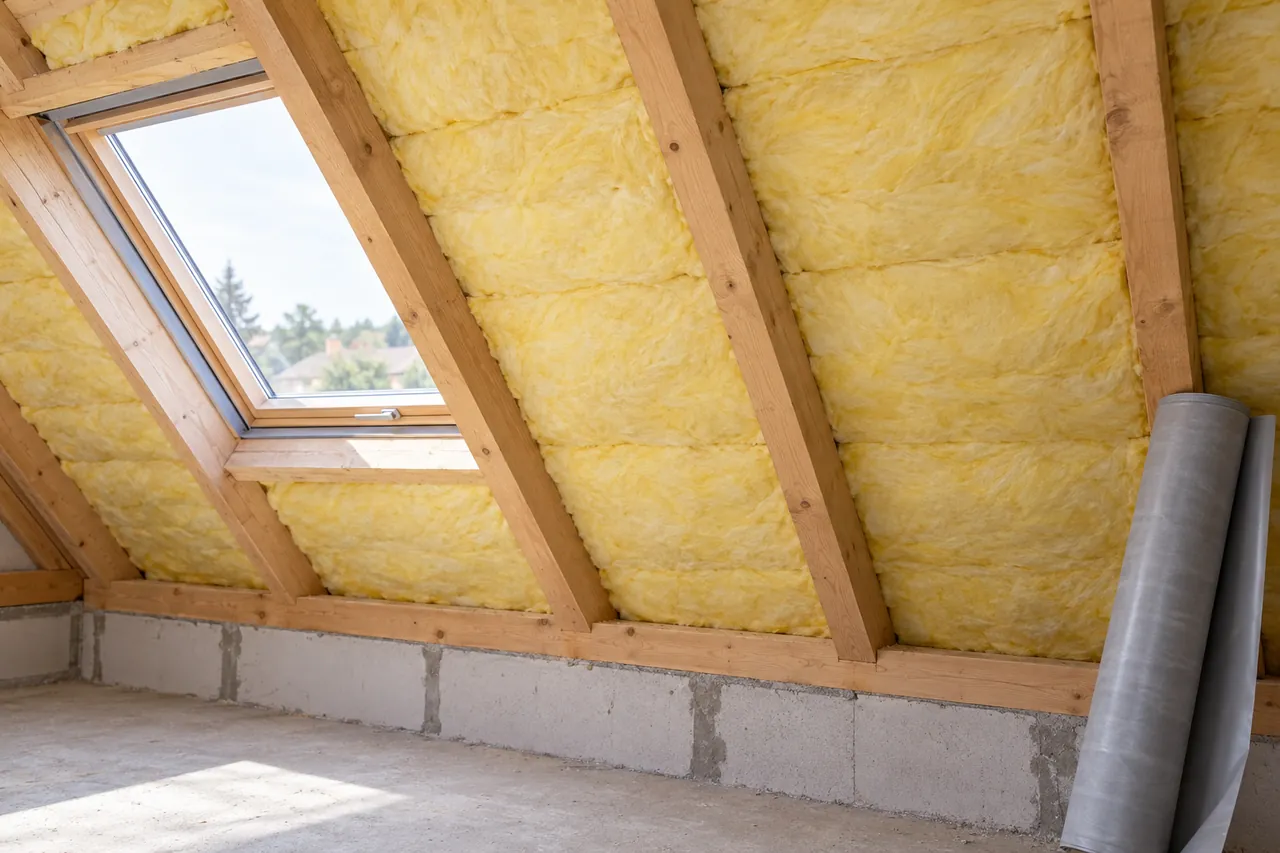
The rafter stays a thermal bridge whatever wool sits next to it. The wool has to fill each bay flush with the rafter faces and without gaps.
Steel-stud walls: the stud depth sets the layer
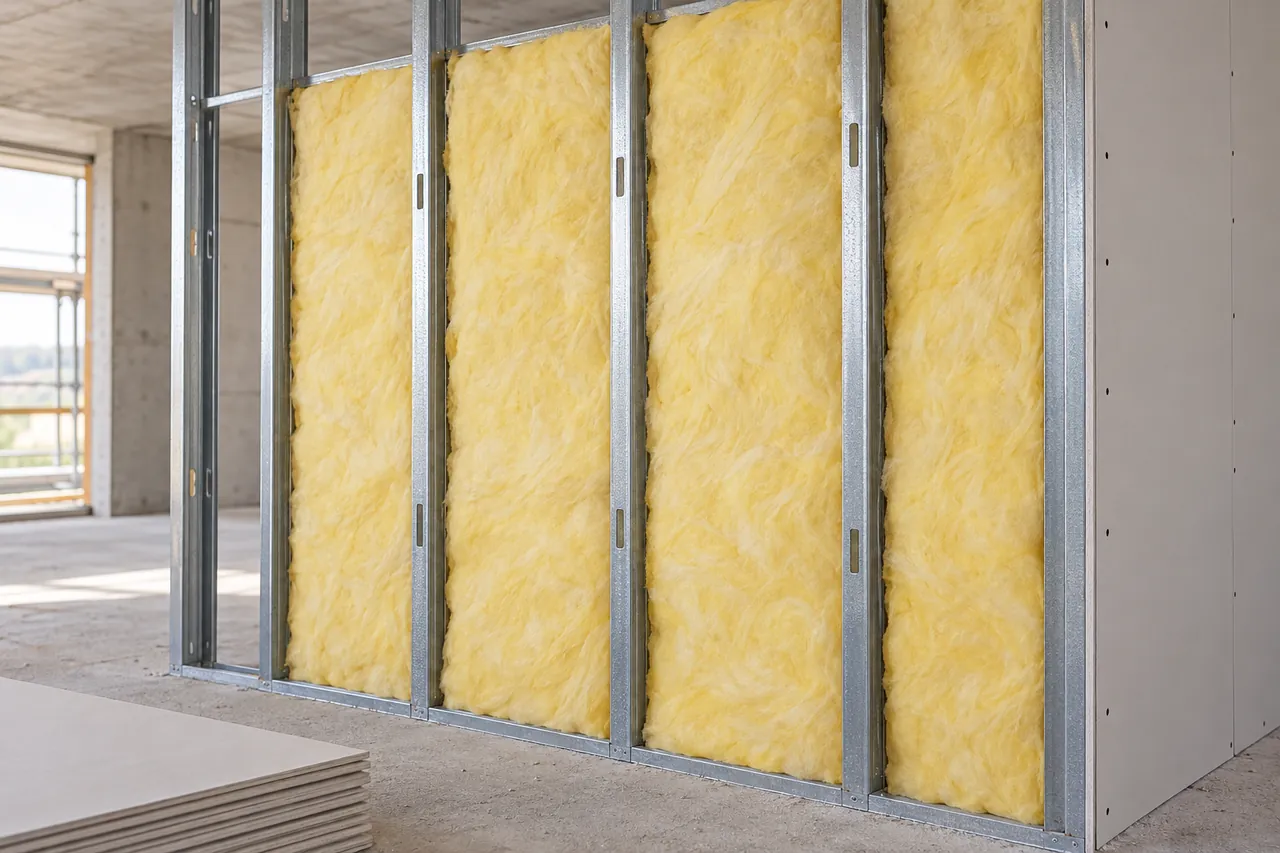
In a lightweight steel-stud wall the stud depth is the wool thickness. Here λ 0.032 wool gives a better R in the same frame, or the same R with a narrower stud and a thinner wall, which saves floor area.
Steel conducts heat far better than glass wool, so the studs strongly affect the real U-value of the wall. The calculation above leaves them out: the designer or energy consultant calculates the wall's U-value for the whole element. Vapour control on the warm side follows the wall design.
On a loft floor this is rarely the issue. There is usually room for thickness, so λ 0.039 wool reaches the same R in a thicker layer.
Which document covers λ 0.032?
ODE's environmental product declaration covers the λ 0.032 grade: EPD-IES-0030980:001 for ODE Starflex, Lunaflex and Evomineral 032, version 2026-06-29, valid until 2031-06-28. ODE gives a λ range of 0.032–0.044 W/(m·K) for Starflex blankets. Check the λD of the delivered batch on the product's declaration of performance (DoP).
ODE Starflex glass wool in the version we supply for loft floors is λD 0.039 W/(m·K), 2 × 12.5 cm with the second layer cross-laid, CE and EUCEB marked. We supply the λ 0.032 grade on quote.
The EuConX BK45 vapour barrier has an Sd of 20 m and goes on the warm side, behind the interior lining. The declaration of performance is a PDF download.
The EuConX BD70 breathable membrane has an Sd of 0.02 m and protects the insulation on the cold side, under the roof covering. The declaration of performance is a PDF download.
Supply for contractors and wholesalers
We supply λ 0.032 ODE glass wool in Hungary on quote, in one shipment with the membranes and with the documents. In the EKR programme we supplied contractors with glass wool and membranes, with the papers for every shipment; EKR is currently suspended. Material travels from Turkey to Hungary in 3–5 days (about 5 on average), and we deliver nationwide.
Our Hungarian loft-floor offer still uses λ 0.039 wool: 12,700 HUF/m² gross, with BK45 vapour barrier (Sd 20 m) on every ceiling, 25 cm of glass wool and BD70 breathable membrane (Sd 0.02 m). Walkways are extra on request; clearing, repairs and difficult access are also extra; the final price follows a survey. We supply the material and a contractor partner installs it.
Specifying glass wool and vapour control is covered in our article for energy consultants; Wekerle+ work goes through the Wekerle+ partner page.
Quotes: contact · +36 30 485 0258 · info@euconx.com. We reply the same working day.
Frequently asked questions
How much thinner is λ 0.032 glass wool for the same R-value?
About 18%, because 0.032 / 0.039 ≈ 0.82. The R of a 25 cm λ 0.039 layer (6.41 m²K/W) takes 20.5 cm of λ 0.032 wool; the R of a 15 cm layer (3.85 m²K/W) takes 12.3 cm.
Where does λ 0.032 glass wool pay off?
Where the structure fixes the depth: between rafters in a pitched roof and between studs in a steel-stud wall. Where there is room for thickness, such as a loft floor, λ 0.039 reaches the same R in a thicker layer.
Will the element have the same U-value?
The insulation layer has the same R, so it contributes the same to the U-value. The full U-value depends on the build-up: rafters and studs are thermal bridges, and surface resistances count too.
Which document covers the λ 0.032 grade?
ODE's environmental product declaration EPD-IES-0030980:001 (Starflex, Lunaflex and Evomineral 032; version 2026-06-29, valid until 2031-06-28). Check the λD of the delivered batch on its DoP.
Does the 25 cm loft-floor offer use λ 0.032 wool?
No. The offer uses ODE Starflex λD 0.039, 2 × 12.5 cm, with BK45 and BD70. We supply λ 0.032 wool on a separate quote.
Does EuConX supply λ 0.032 glass wool in Hungary?
Yes, on quote. It travels from Turkey in 3–5 days (about 5 on average), and we deliver nationwide. Quotes: contact or +36 30 485 0258.
Sources
1. ODE Yalıtım: EPD-IES-0030980:001, ODE Starflex, Lunaflex, Evomineral 032 (PDF) (version 2026-06-29, valid until 2031-06-28)
2. ODE Yalıtım: ODE Starflex product page (λ 0.032–0.044 W/(m·K))
3. ODE Yalıtım: ODE Starflex glass wool product data (λD 0.039 W/(m·K))
4. EuConX: BK45 declaration of performance (PDF) (Sd 20 m)
5. EuConX: BD70 declaration of performance (PDF) (Sd 0.02 m)
6. EuConX: product data, delivery data and company data
Planning a project? Let’s talk.
Send the material schedule or project requirements. We’ll help match the product and prepare a clear quotation.