

Ahmet Alptekin Kasar
Founder, Managing Director
Updated: 2026-11-12
This page is for energy consultants and assessors, specification engineers, aggregators, tender teams and contractors working on Hungarian renovations. It answers one question: when does a loft-floor spec call for glass wool and vapour control, and what goes into the material specification so the delivered product matches the design. What Sd means is covered in our Sd value explainer. Whether a loft floor needs a vapour barrier at all is covered in vapour barrier on a loft floor. The product data for both membranes is in BD70 and BK45 in EKR insulation (in Hungarian).
When glass wool belongs in the spec
A loft floor separates heated rooms from a cold, unheated loft. If the loft stays unused, the insulation goes on top of the ceiling, on the loft side. Rolled glass wool suits this well. It is laid straight onto the ceiling, layer count and thickness are easy to check on site.
The spec starts from the energy calculation. The consultant sets thickness and λ from the U-value requirement and the target saving. The membranes come next, and they cannot be treated separately from the insulation: glass wool only delivers its calculated value while it stays dry.
Which side is tight, which side is open
In winter, water vapour moves from the heated room towards the cold loft. If it gets into the insulation and cools down there, it can condense. Damp glass wool insulates less well, and the ceiling itself can suffer. Hence the rule: tight on the warm side, open on the cold side.
The vapour control layer goes on the warm side, directly on the ceiling. It slows vapour before it reaches the wool. A breathable membrane goes over the wool, on the cold side. It protects the insulation from dust and wind-washing, but lets vapour that does get in escape. Swap the two, or put a tight membrane on both sides, and moisture gets trapped in the insulation.
The Sd value is what separates the two membranes. It expresses vapour resistance as an equivalent thickness of still air in metres. A high value holds vapour back; a low value lets it through.

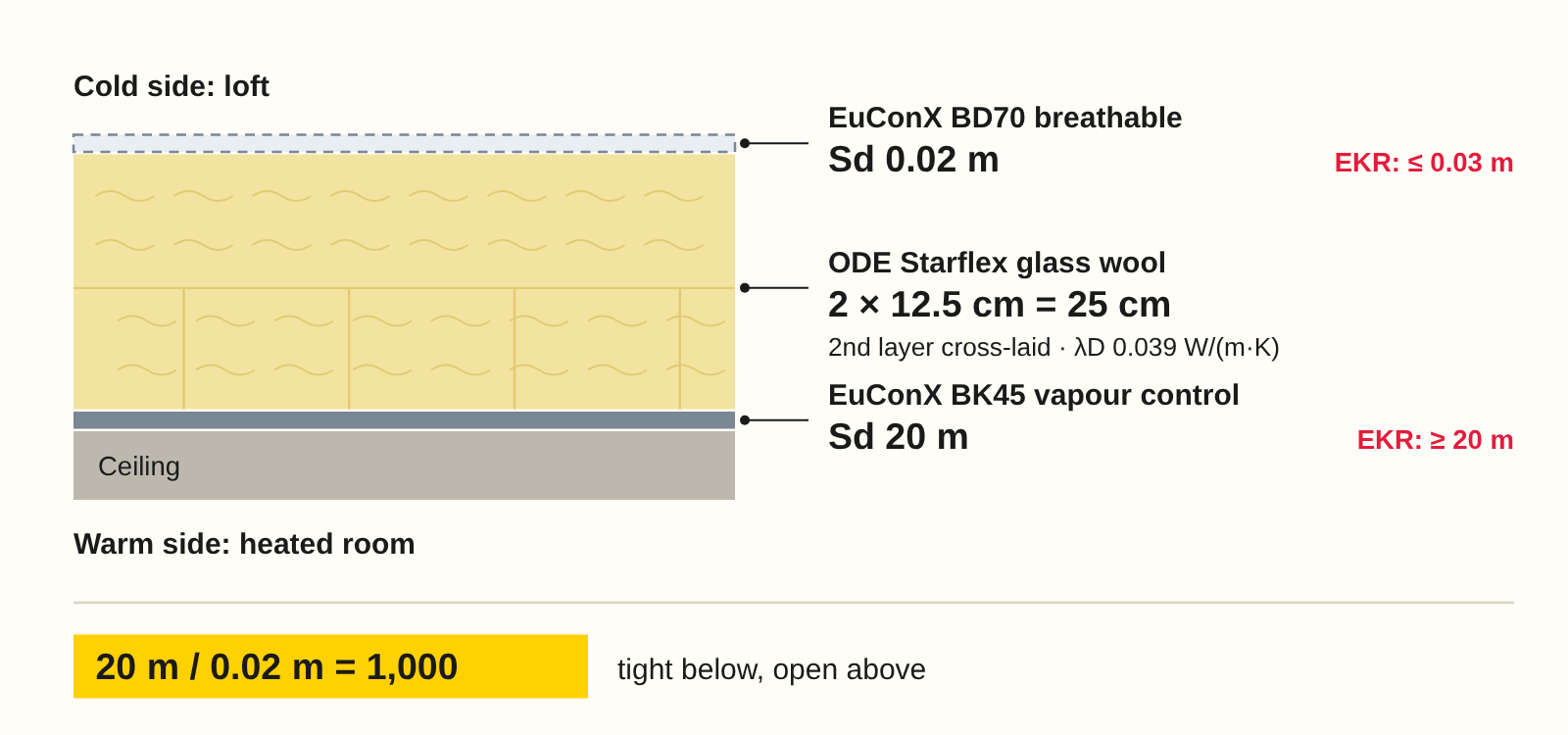
| Layer (from bottom) | Role | Value | EKR reference | Source |
|---|---|---|---|---|
| Ceiling | substrate, warm side | – | – | – |
| EuConX BK45 vapour control layer | slows vapour from the room | Sd 20 m | at least Sd 20 m under the insulation | BK45 DoP; Decree 18/2025 EM annex, 1.3.1.1. g), 1.5.1.1. g) |
| ODE Starflex glass wool | thermal insulation, two layers, second cross-laid | 2 × 12.5 cm = 25 cm; λD 0.039 W/(m·K) | – | ODE DoP (EN 13162) |
| EuConX BD70 breathable membrane | protects the wool, lets vapour out | Sd 0.02 m | at most Sd 0.03 m | BD70 DoP; Decree 18/2025 EM annex, 1.3.1.1. g), 1.5.1.1. g) |
| Ratio | Sd of lower vs upper membrane | 20 / 0.02 = 1,000 | – | calculated |
We quote the EKR values from the annex of Decree 18/2025 (VII. 31.) EM because it is the existing official reference for a loft-floor build-up in Hungary. The Wekerle+ technical requirements have not been published. We do not know which build-up or Sd values the programme will ask for, and we do not claim to.
What to write into the material spec
A spec is only useful if the delivered product can be checked against it. That needs product-level wording, not a material category. If the document just says "glass wool" and "vapour barrier", there is nothing to measure the delivery against at handover.
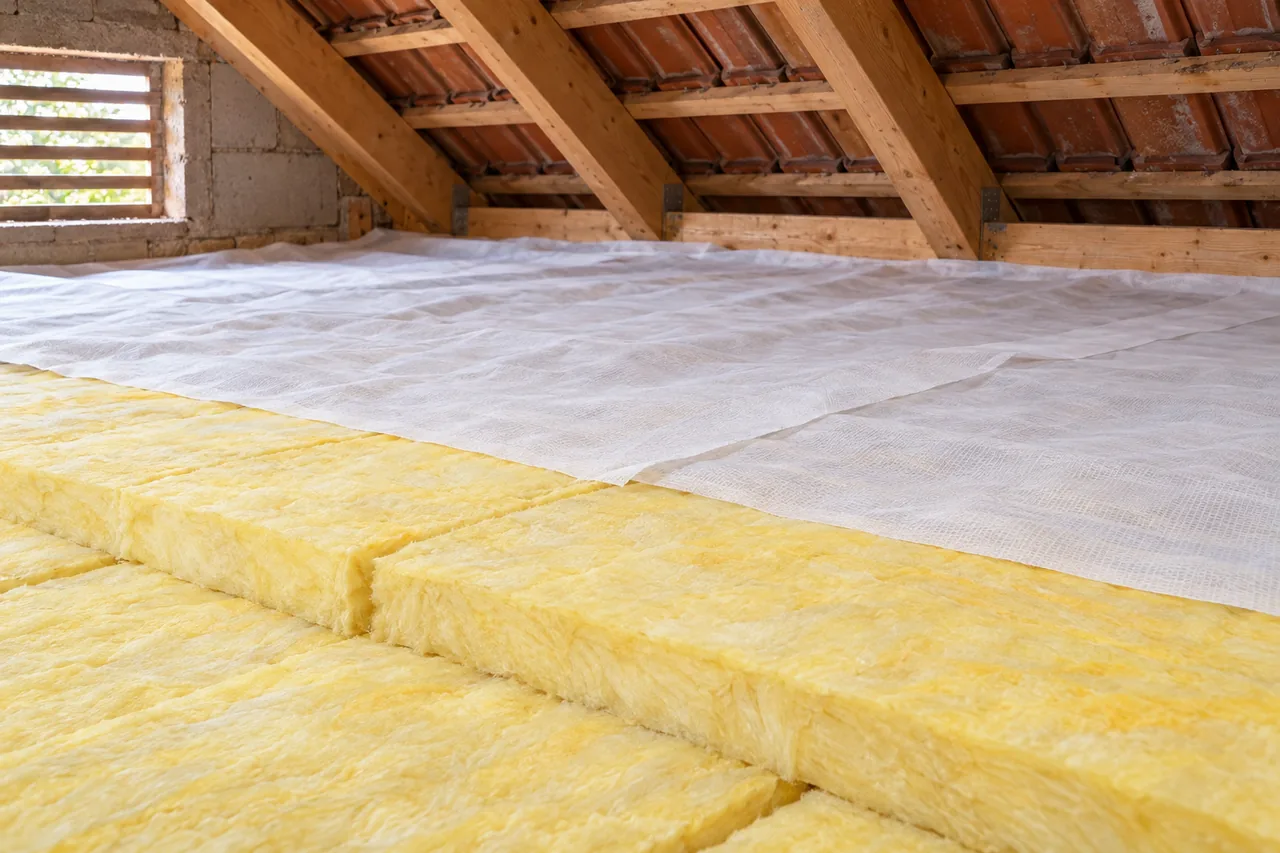
For the insulation, state the product name, declared thermal conductivity (λD), total thickness, number and thickness of layers, and that the second layer is cross-laid. Cross-laying keeps the joints of the top layer off the joints of the bottom layer, so no gap runs through the full depth. ODE Starflex has λD 0.039 W/(m·K); in our build-up it is 2 × 12.5 cm, 25 cm in total.
For each membrane, give the product name, the Sd value and the role: vapour control below, breathable above. Add the reference limit as well, so whoever receives the goods knows what to check against. For all three items, require a Declaration of Performance (DoP) with the delivery and reference the DoP in the spec.
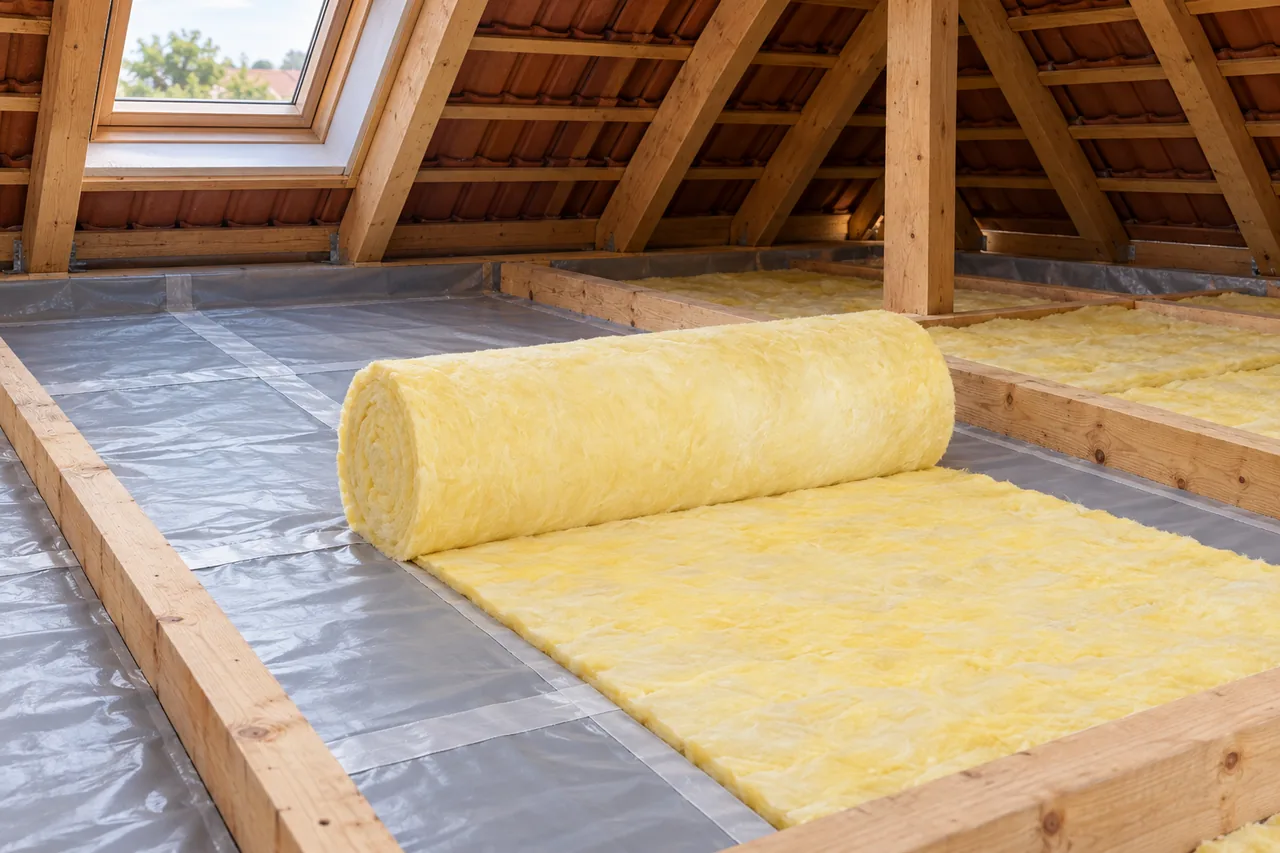
A vapour control layer only works if it is continuous. So the spec should also call for overlaps that are lapped and taped, an upstand at the walls and sealed penetrations. These are workmanship details, but the design decides whether they can be enforced at handover. We put a vapour control layer on every ceiling, whatever the ceiling type.
The thermal check
Thickness comes from the consultant's own calculation. The worked example below shows how the 25 cm layer meets Hungary's loft-floor requirement. The table is taken from our U-value calculation guide, with the same assumptions.
| Layer | d (m) | λ (W/mK) | R (m²K/W) |
|---|---|---|---|
| Rsi, room side (upwards) | – | – | 0.10 |
| ODE Starflex glass wool, 2 × 12.5 cm | 0.25 | 0.039 | 6.41 |
| Rsi, loft side | – | – | 0.10 |
| Rtot | 6.61 | ||
| U = 1 / Rtot | ≈ 0.151 W/m²K | ||
| Requirement: floor under a loft or crawl space | U ≤ 0.17 W/m²K: met |
Formula: U = 1 / (Rsi + d/λ + Rsi) = 1 / (0.10 + 0.25 / 0.039 + 0.10). Sources: Rsi from Table 4.1 of the calculation method (MSZ EN ISO 6946), λD from the ODE Declaration of Performance (EN 13162), the requirement from Annex 1 of Decree 9/2023 (V. 25.) ÉKM. Slab and membranes are not counted.
The membranes barely register in the thermal calculation, but they decide moisture performance. A well-calculated thickness is worth little if the wool gets wet. That is why the membranes belong on the same spec line as the insulation.
How to check what was delivered
At handover, the DoP is compared with the spec: product name, λD, thickness and the Sd of each membrane. With a precise spec this takes minutes. With a vague one it becomes an argument. Our Wekerle+ material checklist lists the data to check line by line.
The EuConX BK45 Declaration of Performance declares Sd 20 m; the EuConX BD70 Declaration of Performance declares Sd 0.02 m. Both can be downloaded, so the spec can reference them at design stage. The invoice should also itemise product name, thickness and quantity so it can be matched against the DoP.
Where EuConX fits
In Hungary's EKR loft programme we supplied materials to contractors, with the paperwork for every delivery. In 2024 that was 500,000 m² of glass wool; in 2025–26, 1.1 million m² of glass wool and 4.3 million m² of membranes, with 98% of deliveries on time. The free EKR loft programme has been paused at most contractors since spring 2026, with no restart date announced. We track its status on EKR programme 2026 and the buyer risk in EKR buyer risk before 2027.
The Wekerle+ Energetikai Felújítási Támogatás és Hitel (energy renovation grant and loan) starts in February 2027 for family houses and in March 2027 for multi-unit and panel buildings, and runs to 2030. Portfolio reports a budget of more than HUF 600 billion; Economx reports HUF 633 billion. The official call has not been published. Supply for the programme is covered in our material supply brief (in Hungarian), and the per-m² pack in the loft insulation supply pack.
What we do not do: we are not a Wekerle+ programme partner and not a HEM partner. We do not write grant applications or promise eligibility. We supply materials with DoPs anywhere in Hungary; a contractor partner does the installation. When material is not in stock, order to site is typically 1–2 weeks, and transit from Türkiye to Hungary takes 3–5 days, about 5 on average.
Send us your spec
Send the specification (λ, thickness, number of layers, membrane Sd values), m² per project, delivery points and timing: partner enquiry · contact · +36 30 485 0258 · info@euconx.com. We reply the same working day. More on glass wool supply is on the glass wool product page.
Frequently asked questions
Which side of a loft floor does the vapour control layer go on?
The warm side, directly on the ceiling under the insulation. There it slows vapour coming from the room. A breathable membrane goes over the wool on the cold side and lets vapour escape.
What Sd value should I specify for the vapour control layer?
The EKR reference requires at least Sd 20 m for the vapour control layer under the insulation (Decree 18/2025 (VII. 31.) EM, annex 1.3.1.1. g) and 1.5.1.1. g)). EuConX BK45 declares Sd 20 m. Wekerle+ values are not yet known.
What Sd value should I specify for the top membrane?
The EKR reference for a breathable membrane over fibrous insulation is at most Sd 0.03 m. EuConX BD70 declares Sd 0.02 m.
What belongs in a glass wool specification?
Product name, λD, total thickness, number and thickness of layers, cross-laid second layer, and the DoP reference. ODE Starflex has λD 0.039 W/(m·K); our build-up uses 2 × 12.5 cm = 25 cm.
Will Wekerle+ require this build-up?
Nobody can say yet, because the official call and its technical requirements have not been published. We cite the EKR values as an existing reference, not as Wekerle+ conditions.
Does EuConX install or write grant applications?
No. We supply materials with DoPs, and a contractor partner installs. We are not a programme partner or a HEM partner, and we do not write applications.
Sources
1. Decree 18/2025 (VII. 31.) EM, annex points 1.3.1.1. g) and 1.5.1.1. g): National Legislation Database (in Hungarian)
2. Decree 9/2023 (V. 25.) ÉKM, Annex 1: National Legislation Database (in Hungarian)
3. Declarations of performance: EuConX BK45, EuConX BD70, ODE glass wool (EN 13162)
4. Government of Hungary: Otthonteremtés, felújítás, bérlakás: elindítjuk az átfogó Wekerle Programot, 27 October 2026; Wekerle Plusz information page (in Hungarian)
5. Portfolio: Lakásfelújítási támogatás 2027: igénylési feltételek, elvárások, tudnivalók egy helyen, 27 October 2026 (in Hungarian)
6. Economx: Kiderültek a részletek a Wekerle-programról, 27 October 2026 (in Hungarian)
7. EuConX: U-value calculation, EKR programme 2026, Wekerle+ partner page, delivery and company data (volumes, on-time rate, transit, lead time, reply time)
Planning a project? Let’s talk.
Send the material schedule or project requirements. We’ll help match the product and prepare a clear quotation.