

Ahmet Alptekin Kasar
Founder, Managing Director
Updated: 2026-11-26
This page is for contractors, renovation groups, energy consultants, designers and building-material wholesalers in Hungary: whoever assembles, prices or resells the build-up.
What is the difference between the two?
The two membranes differ in vapour resistance. The Sd value expresses it: the thickness of still air, in metres, that resists vapour diffusion as much as the membrane does. The higher the value, the tighter the layer. Our Sd value explainer covers it in detail.
A vapour barrier stops most of the indoor vapour before it reaches the insulation. A breathable membrane protects the insulation on the other side from dust, wind-washing and driven water while letting vapour out. The rule: tight inside, open outside.
| Aspect | Vapour barrier | Breathable membrane |
|---|---|---|
| Role | Stops indoor vapour before the insulation | Protects the insulation, lets vapour out |
| Position in the build-up | Warm, inner side: under the insulation, behind the interior lining | Cold, outer side: over fibrous insulation, under the roof covering |
| Sd (DoP) | EuConX BK45: 20 m | EuConX BD70: 0.02 m |
| Typical material | EuConX BK45: 45 g/m², W1, CE, TS EN 13859-1/2 | EuConX BD70: 70 g/m², 259 mm H₂O, CE, TS EN 13859-1/2 |
| Fault if swapped | Vapour passes freely into the insulation and can condense on the cold side | Vapour that gets into the insulation is trapped and can wet it |
The two columns are the two faces of one build-up. Neither replaces the other: a vapour barrier does not keep out dust and water from above, and a breathable membrane does not hold back indoor vapour.
Where does each one go?
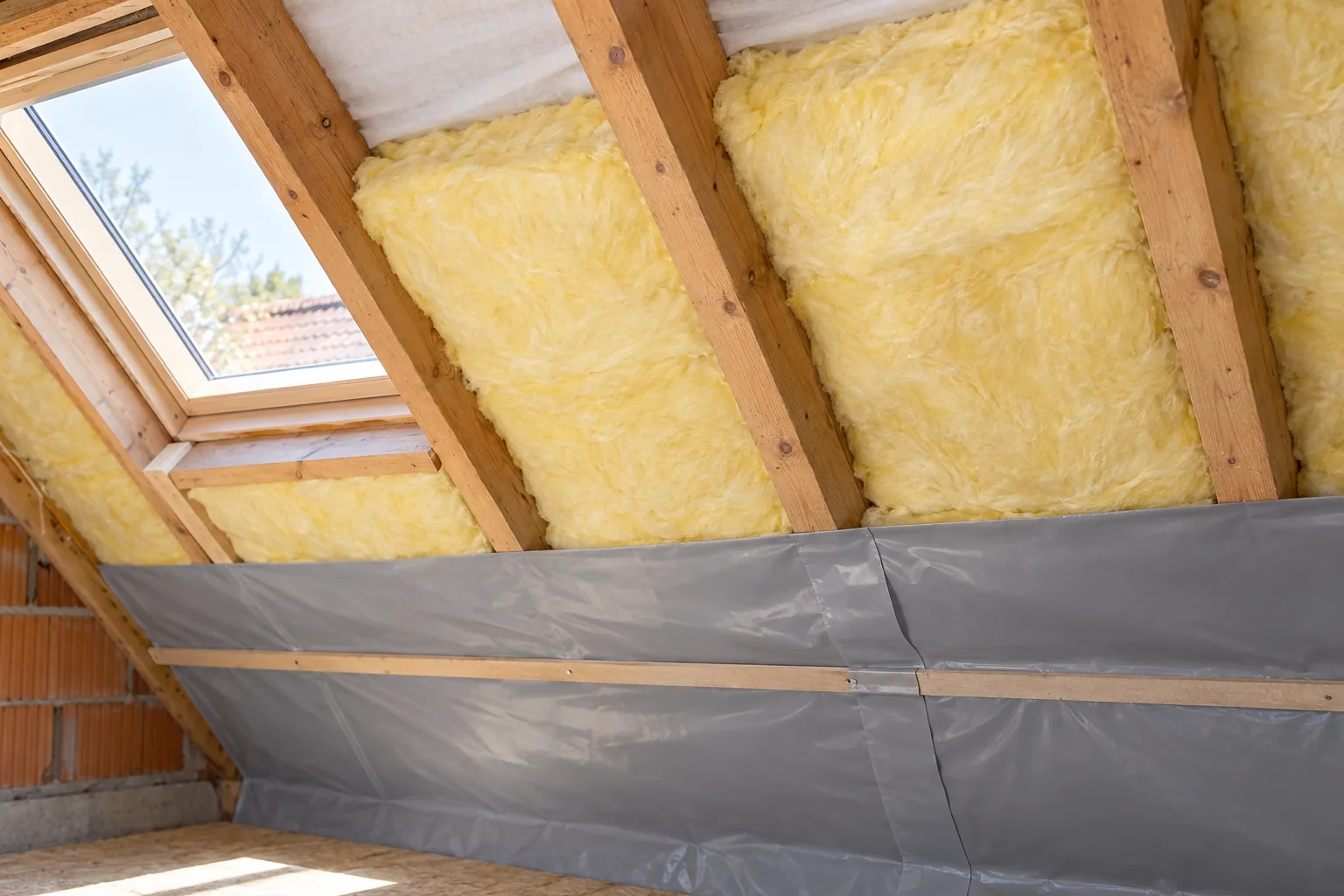
On a loft floor, bottom to top: ceiling structure, BK45 vapour barrier, glass wool, BD70 breathable membrane. The vapour barrier lies on the ceiling slab under the insulation, with taped overlaps and turned up and sealed at the walls. Whether a loft floor needs a vapour barrier, and which floors do, is covered in vapour barrier on a loft floor.
In a pitched-roof attic, inside to outside: interior lining, BK45 vapour barrier, glass wool between the rafters, BD70 breathable membrane, roof covering. The vapour barrier runs behind the lining, the breathable membrane under the roof covering.

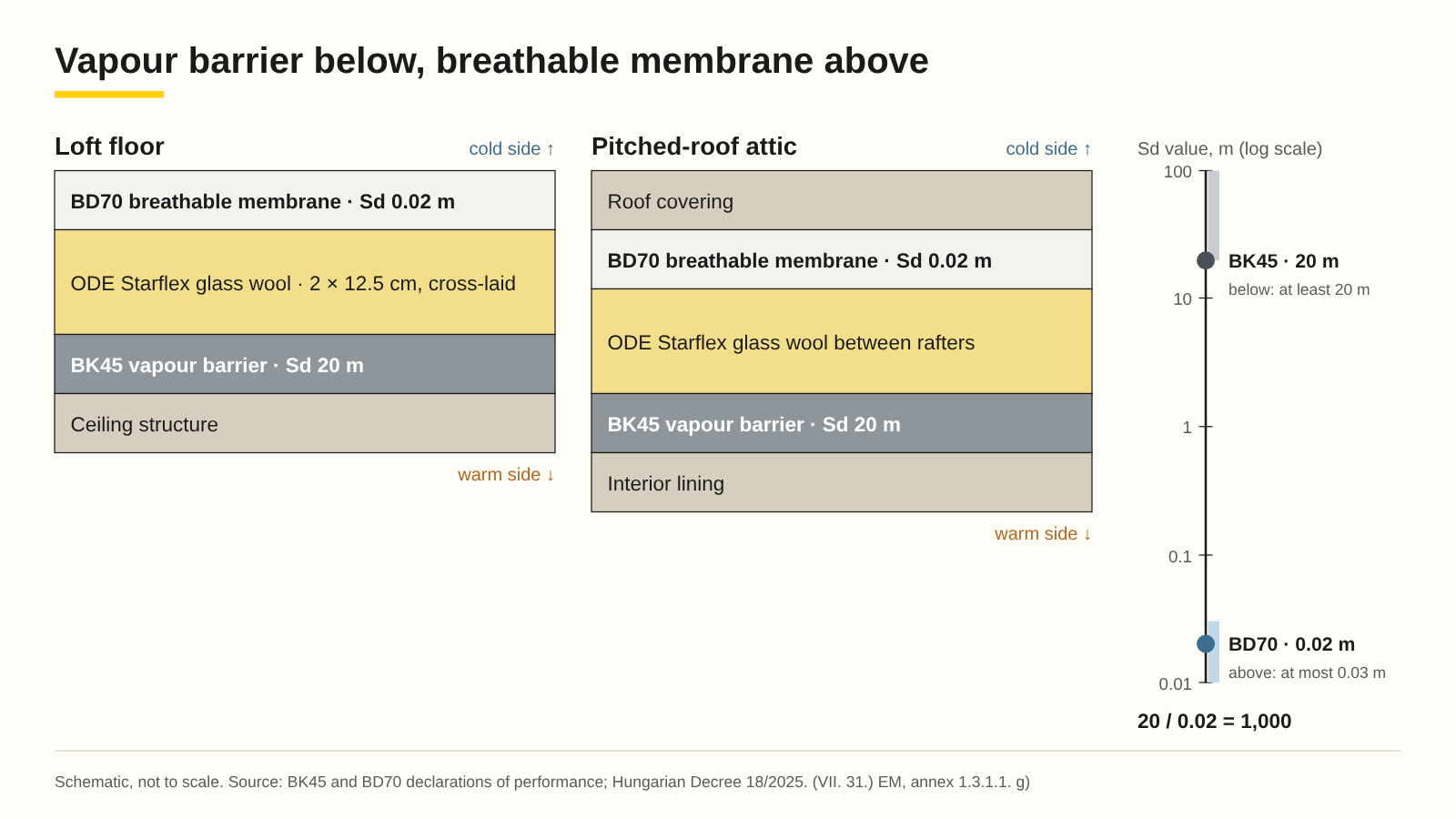
| Vapour barrier below, breathable membrane above | Cold side ↑ … warm side ↓ |
|---|---|
| Loft floor | BD70 breathable membrane · Sd 0.02 m; ODE Starflex glass wool · 2 × 12.5 cm, cross-laid; BK45 vapour barrier · Sd 20 m; Ceiling structure |
| Pitched-roof attic | Roof covering; BD70 breathable membrane · Sd 0.02 m; ODE Starflex glass wool between rafters; BK45 vapour barrier · Sd 20 m; Interior lining |
| Sd value, m (log scale, 0.01–100) | BK45 · 20 m: below: at least 20 m; BD70 · 0.02 m: above: at most 0.03 m; 20 / 0.02 = 1,000 |
Source: BK45 and BD70 declarations of performance; Hungarian Decree 18/2025. (VII. 31.) EM, annex 1.3.1.1. g).
Why at least 20 m below and at most 0.03 m above?
For attic-floor insulation the annex of the Hungarian decree sets two numerical conditions: a vapour control layer of at least Sd 20 m under the insulation, and a breathable dust-protection membrane of at most Sd 0.03 m over fibrous or blown insulation (Decree 18/2025 (VII. 31.) EM, Annex, points 1.3.1.1 g) and 1.5.1.1 g), in Hungarian).
BK45 at Sd 20 m meets the lower limit. BD70 at Sd 0.02 m sits under the upper limit. The two differ by a factor of a thousand, so swapping them is not a minor deviation: it turns the build-up upside down. The EKR background of these limits is covered in BD70 and BK45 membranes in EKR insulation (in Hungarian); EKR is currently suspended.
What happens if they are swapped?
If the breathable membrane goes underneath and there is no vapour barrier, indoor vapour passes freely into the insulation, cools on its way to the cold side and can condense there. If the vapour barrier goes on top, vapour that does get into the insulation cannot escape and the insulation can get wet. Damp fibrous insulation insulates less well, and mould can appear on the ceiling and the timber.
On site the two rolls look and feel different, but on the delivery note and the DoP the product name and the Sd value decide. Store the rolls separately and by name.
The EuConX BK45 vapour barrier is 45 g/m², Sd 20 m, W1, CE, TS EN 13859-1/2. It goes on the warm side of the insulation, on every ceiling. The declaration of performance is a PDF download.
The EuConX BD70 breathable membrane is 70 g/m², Sd 0.02 m, 259 mm H₂O, CE, TS EN 13859-1/2. It protects the insulation on the cold side and lets vapour out. The declaration of performance is a PDF download.
Between the two sits ODE Starflex glass wool: λD 0.039 W/(m·K), 2 × 12.5 cm with the second layer cross-laid so the joints do not line up, CE and EUCEB marked. Specifying glass wool and vapour control is covered in our article for energy consultants.
Supply for contractors and wholesalers
We deliver BK45, BD70 and ODE glass wool in one shipment, with the DoPs. In the EKR programme we supplied contractors with material for this build-up, with the documents for every shipment.
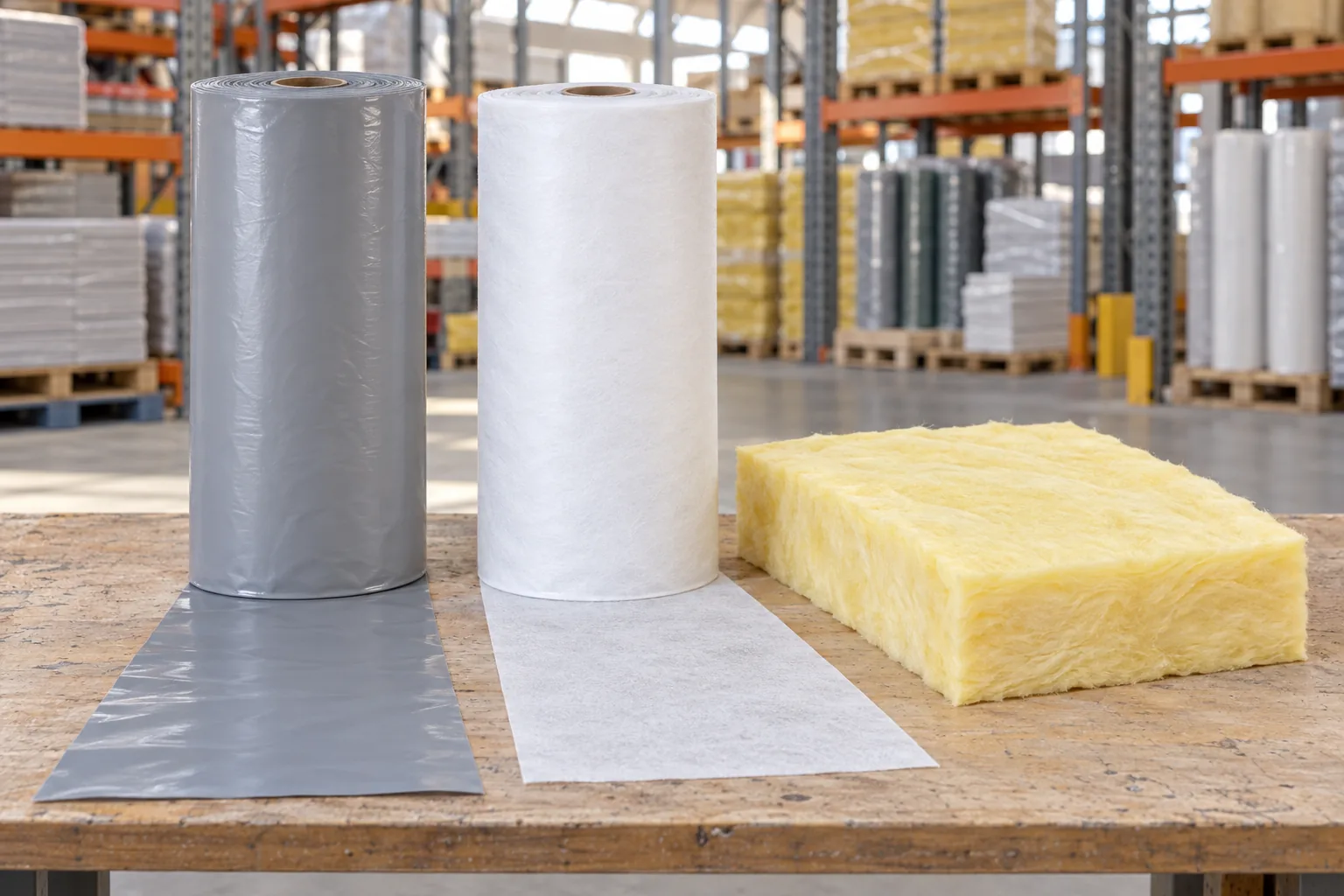
Material travels from Turkey to Hungary in 3–5 days (about 5 on average), and we deliver nationwide. For loft floors in Hungary we also have our own offer: 12,700 HUF/m² gross, with BK45 vapour barrier (Sd 20 m) on every ceiling, 25 cm of glass wool and BD70 breathable membrane (Sd 0.02 m). Walkways are extra on request; clearing, repairs and difficult access are also extra; the final price follows a survey. We supply the material and a contractor partner installs it. The full build-up is on our attic floor insulation page (in Hungarian); Wekerle+ work goes through the Wekerle+ partner page.
Quotes: contact · +36 30 485 0258 · info@euconx.com. We reply the same working day.
Frequently asked questions
What is the difference between a vapour barrier and a breathable membrane?
Vapour resistance. The vapour barrier (BK45) has an Sd of 20 m, the breathable membrane (BD70) 0.02 m. The first closes the warm side, the second opens the cold side.
Where does the vapour barrier go on a loft floor?
On the ceiling slab, under the insulation, on the warm side. Tape the overlaps and turn the membrane up and seal it at the walls.
Where does the breathable membrane go?
Over the fibrous insulation: on top of the insulation on a loft floor, under the roof covering in a pitched-roof attic.
What happens if the two are swapped?
The insulation can get wet: nothing stops vapour below, and the vapour that gets in cannot leave above.
Does a loft floor need both membranes?
For fibrous insulation the annex of Hungarian Decree 18/2025. (VII. 31.) EM defines both by number: at least Sd 20 m below, at most Sd 0.03 m above. Our own offer includes both.
How can I tell a vapour barrier from a breathable membrane?
From the Sd value in the declaration of performance, not from colour or g/m². The BK45 DoP and the BD70 DoP are downloadable.
Sources
1. EuConX: BK45 declaration of performance (PDF) (Sd 20 m)
2. EuConX: BD70 declaration of performance (PDF) (Sd 0.02 m)
3. Decree 18/2025. (VII. 31.) EM, Annex, points 1.3.1.1 g) and 1.5.1.1 g) (Magyar Közlöny, in Hungarian): https://magyarkozlony.hu/dokumentumok/665fad784d41c3417b9f5eeeb2bab1fe61474464/letoltes
4. ODE Yalıtım: ODE Starflex glass wool product data (λD 0.039 W/(m·K))
5. EuConX: product data, delivery data and company data
Planning a project? Let’s talk.
Send the material schedule or project requirements. We’ll help match the product and prepare a clear quotation.