
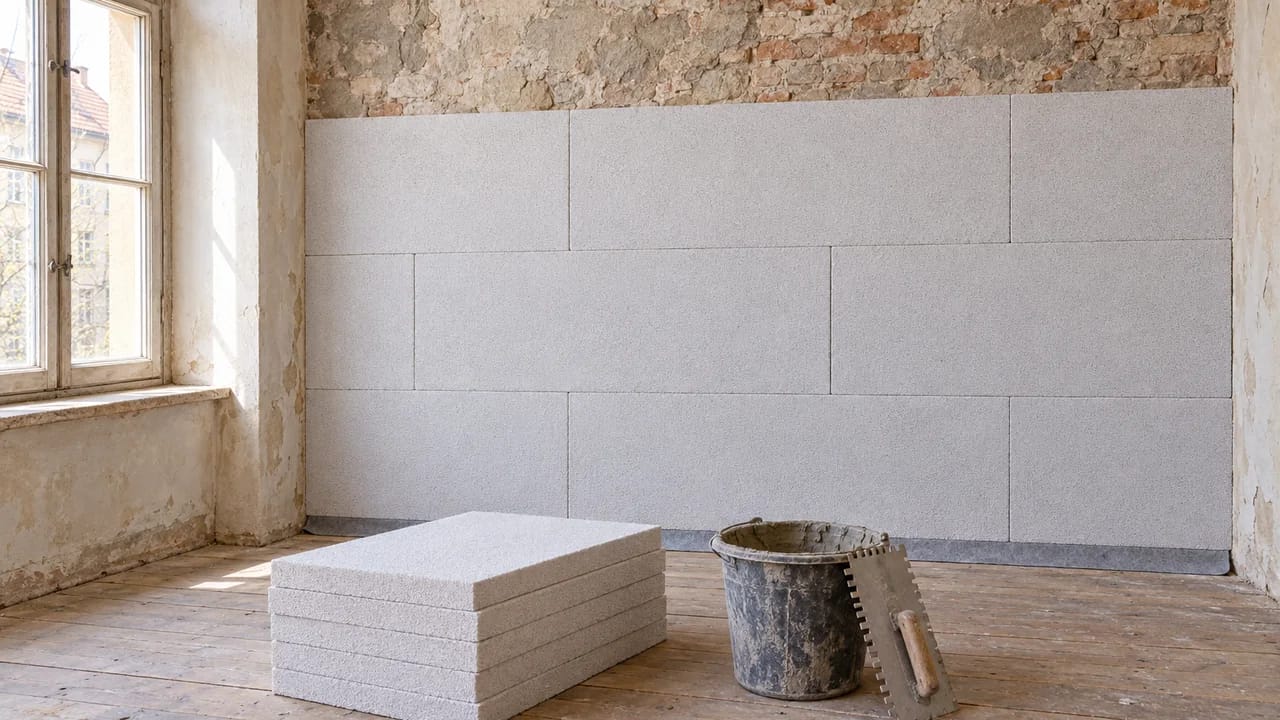
Ahmet Alptekin Kasar
Founder, Managing Director
Updated: 2026-10-23
This guide is for developers, renovation contractors, specifiers and importers working on existing buildings in Hungary and the wider CEE region: listed buildings, street-line buildings and apartments in multi-owner blocks. The data come from Xella Hungary's Multipor brochure (2024/01, cited by printed page number), the DIBt European Technical Assessment ETA-05/0093 and Türk Ytong's product page.
When internal insulation is the option
Internal insulation is used where a wall cannot be insulated from the outside. Xella's brochure (p. 13) names three typical cases:
- Listed facades. The original facade has to be kept, so no insulation can go on the outside.
- Building-line limits. Planning rules, such as a street building line, leave no room for an external layer.
- Condominium facades. For ownership reasons the facade is not one flat owner's decision, but the inside of the flat's own wall can be insulated.
With internal insulation the insulating layer sits on the warm side and the old wall runs colder than before. Moisture behaviour therefore matters more than with external insulation.
How a mineral, capillary-active board behaves
According to ETA-05/0093 (DIBt, 30 October 2024, holder Xella Baustoffe GmbH), Multipor is made of quartz powder, calcium hydrate, cement and aggregates, with aluminium as the pore former, and is autoclaved. The ETA covers five types: M0, M2, M3, M4 and M4 light. Türk Ytong offers M2 and M3; the board in the Hungarian brochure (p. 11) is listed with λ 0.045 W/(mK) and at least 350 kPa.
Key data for M2 and M3 from the ETA:
- Thermal conductivity: λD (23/50) M3 0.043, M2 0.045 W/(m·K).
- Reaction to fire: A1 (EN 13501-1).
- Water vapour resistance factor: μ 3.
- Density: 100–115 kg/m³; the Hungarian brochure gives about 115 kg/m³ (p. 6).
- Compressive strength: M2 at least 350, M3 at least 300 kPa.
- Water absorption: at most 2 kg/m² (EN 1609); Xella calls the board water-repellent (pp. 4–5).
Xella describes the board as capillary-active: moisture that forms in the wall and the board is spread by the capillary structure and dries out towards the room. The alkaline adhesive mortar inhibits mould. Because of the low vapour resistance and the capillary structure, Xella states that no separate vapour barrier is needed on the inside (pp. 6 and 13).
What μ 3 means in practice: Sd = μ × d. For an 8 cm Multipor board that is 3 × 0.08 = 0.24 m; an EPS board with μ 20–40 gives 1.6–3.2 m at the same thickness. Our Sd value guide explains the concept.
The ETA also sets two limits. Boards must be protected from wetting in storage and during the works. The assessment does not cover ETICS; its intended uses include internal insulation of walls, ceilings (cellars, underground garages), floors under screed and roofs.
What changes for comfort
Xella's brochure (p. 15) uses an old 38 cm solid brick wall as the example. With 20 °C room air, the inner wall surface is about 17 °C on the coldest days. The cold surface reduces comfort; Xella notes that the air then has to be heated to about 23–24 °C for the room to feel comfortable. With Multipor internal insulation the same surface is at 19–19.5 °C.
Xella states that the higher inner surface temperature helps avoid surface condensation and mould (pp. 4–5). The figures belong to one specific wall; other walls give other values.

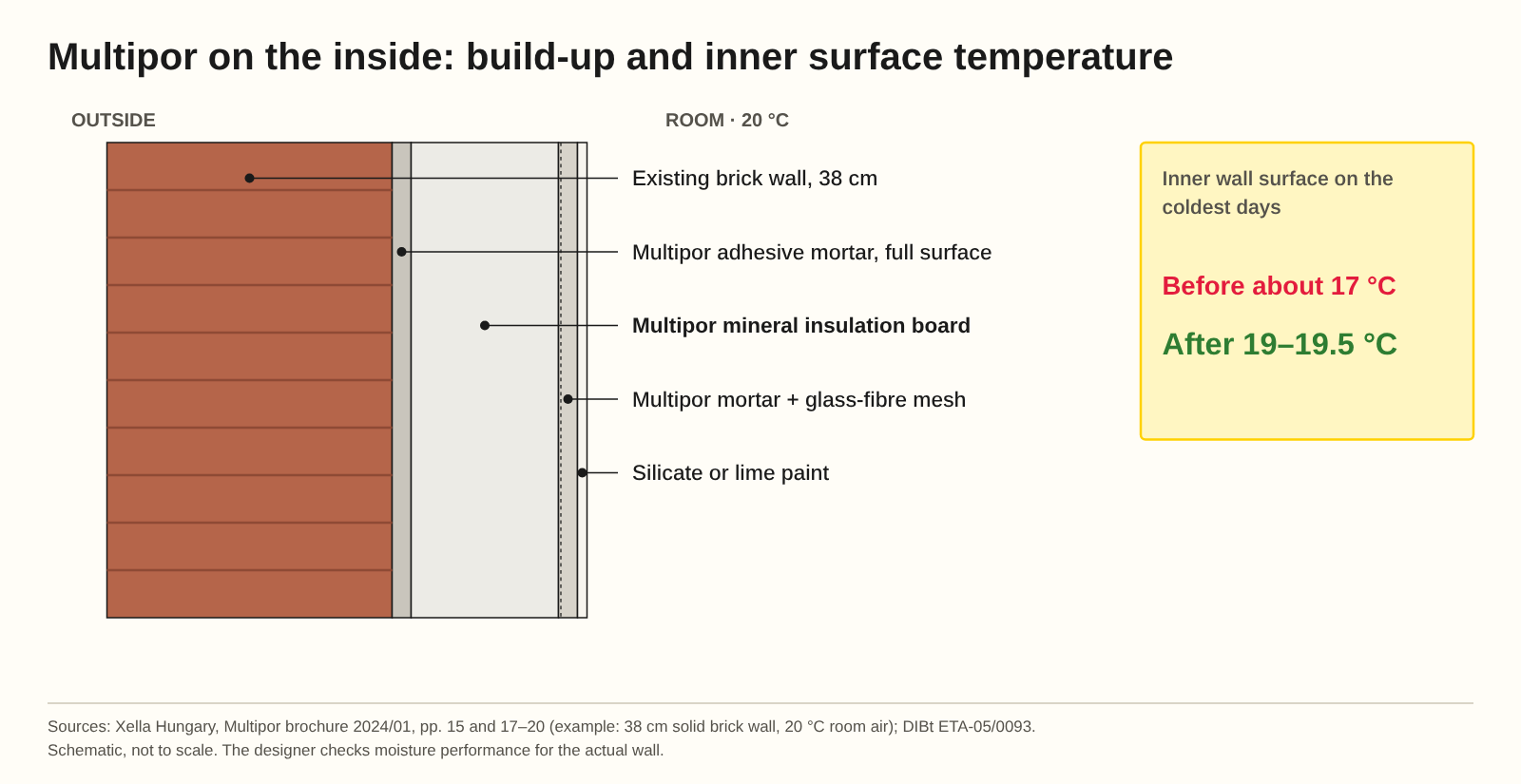
| Layer, outside to room | Data | Source |
|---|---|---|
| Existing brick wall | 38 cm (Xella's example) | brochure p. 15 |
| Multipor adhesive mortar | full surface | brochure pp. 17–18 |
| Multipor mineral insulation board | λD 0.043–0.045 W/(m·K), μ 3, A1 | ETA-05/0093 |
| Multipor mortar + glass-fibre mesh | embedded over the full surface | brochure p. 19 |
| Silicate or lime paint | mineral, vapour-open | brochure p. 20 |
| Inner wall surface on the coldest days, 20 °C room air | about 17 °C before, 19–19.5 °C after | brochure p. 15 |
Source: Xella Hungary, Multipor brochure 2024/01; DIBt ETA-05/0093 (30 Oct 2024). Schematic build-up; the designer checks moisture performance for the actual wall.
What to check before starting
- Rising damp. Xella requires the insulated wall to be protected against rising damp (p. 15).
- Driving rain. The facade needs a water-repellent render or paint, or failing that a clear impregnation (p. 15).
- Old finishes. Wallpaper, paint and loose plaster must be removed (p. 17).
- Evenness. The adhesive mortar takes up about 5 mm of unevenness; anything more is repaired before insulating (p. 18).
- Setting out. The line of the first course is set from the wall dimensions and the floor level (p. 17).
- Storage. Keep boards dry; the ETA requires protection from wetting.
Build-up and work steps
Xella's brochure (pp. 17–20) gives this sequence:
1. Separation strip. A polyfoam strip or hemp felt goes between the first course and the floor.
2. Full-surface bonding. Multipor mortar is applied over the whole back of the board with a 10–14 mm notched trowel. Full-surface bonding is required for adhesion and so that no condensation forms between wall and board.
3. Placing. The board is pressed on and slid about 4–5 cm sideways into position so the mortar ribs spread.
4. Joints. Boards are butt-jointed without mortar, in half-bond course by course.
5. Mesh. The surface is sanded, then a glass-fibre mesh is embedded in Multipor mortar over the full surface. For higher loads, dowels go through the mesh.
6. Finish. Only mineral, vapour-open silicate or lime paints. Coatings that seal the surface are not suitable because they restrict vapour flow.
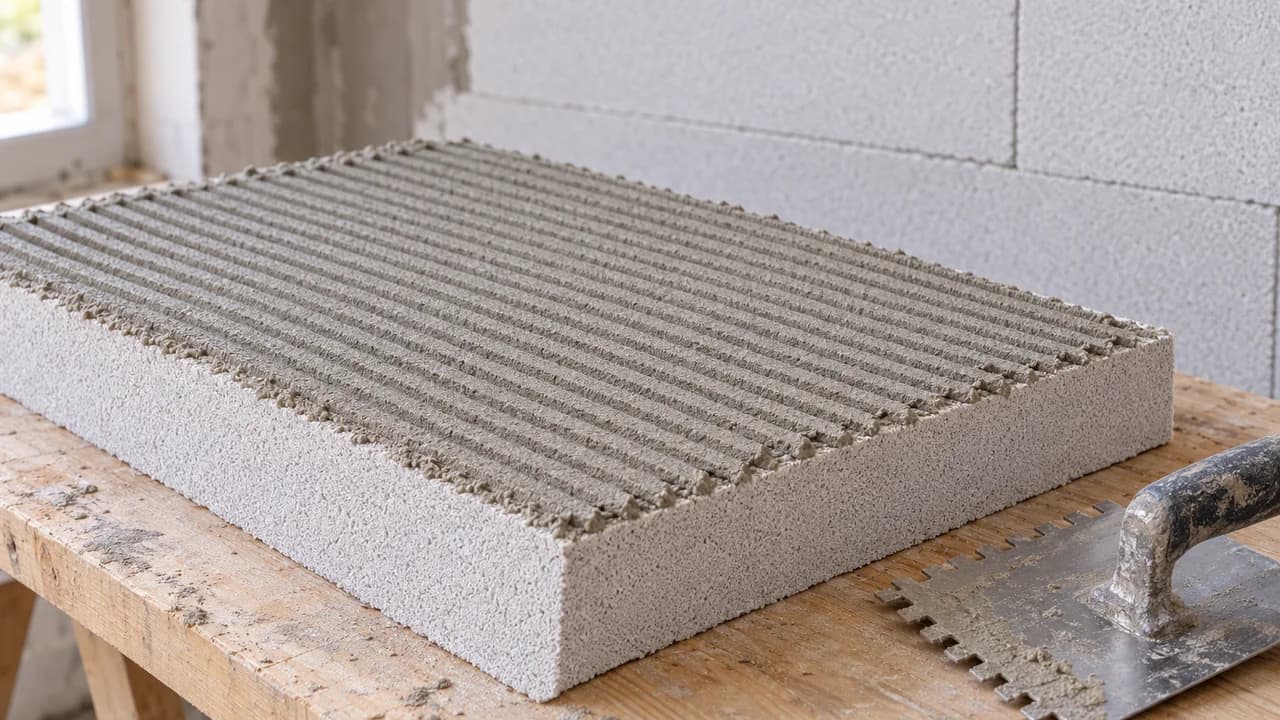
Product data in the brochure (p. 11): Multipor light mortar about 770 kg/m³, λ 0.18 W/(mK), μ at most 10, reaction to fire A2; consumption 3.5–4.5 kg/m² per layer, 20 kg bags. Hungarian board sizes are 600 × 400 mm in 60, 80, 100, 120 and 150 mm (4.16 boards/m²), plus 600 × 390 mm boards in 180–260 mm. Türk Ytong lists 600 × 400 and 500 × 400 mm boards in 6, 7, 8, 9, 10, 12, 13, 14 and 15 cm.
Limits: tiles and point loads
- Tiles. Xella allows bonded tiles on at most 2/3 of the insulated wall surface, at no more than 25 kg/m² including adhesive, with 1 dowel per board through the full-surface mesh (p. 20).
- Point loads. Depending on the fixing, the board takes point loads of up to 3 kg, such as pictures (pp. 4–5).
Multipor vs EPS on the inside
The table compares both materials. The EPS column is the manufacturer range for white EPS; our graphite vs white EPS comparison covers EPS in more depth.

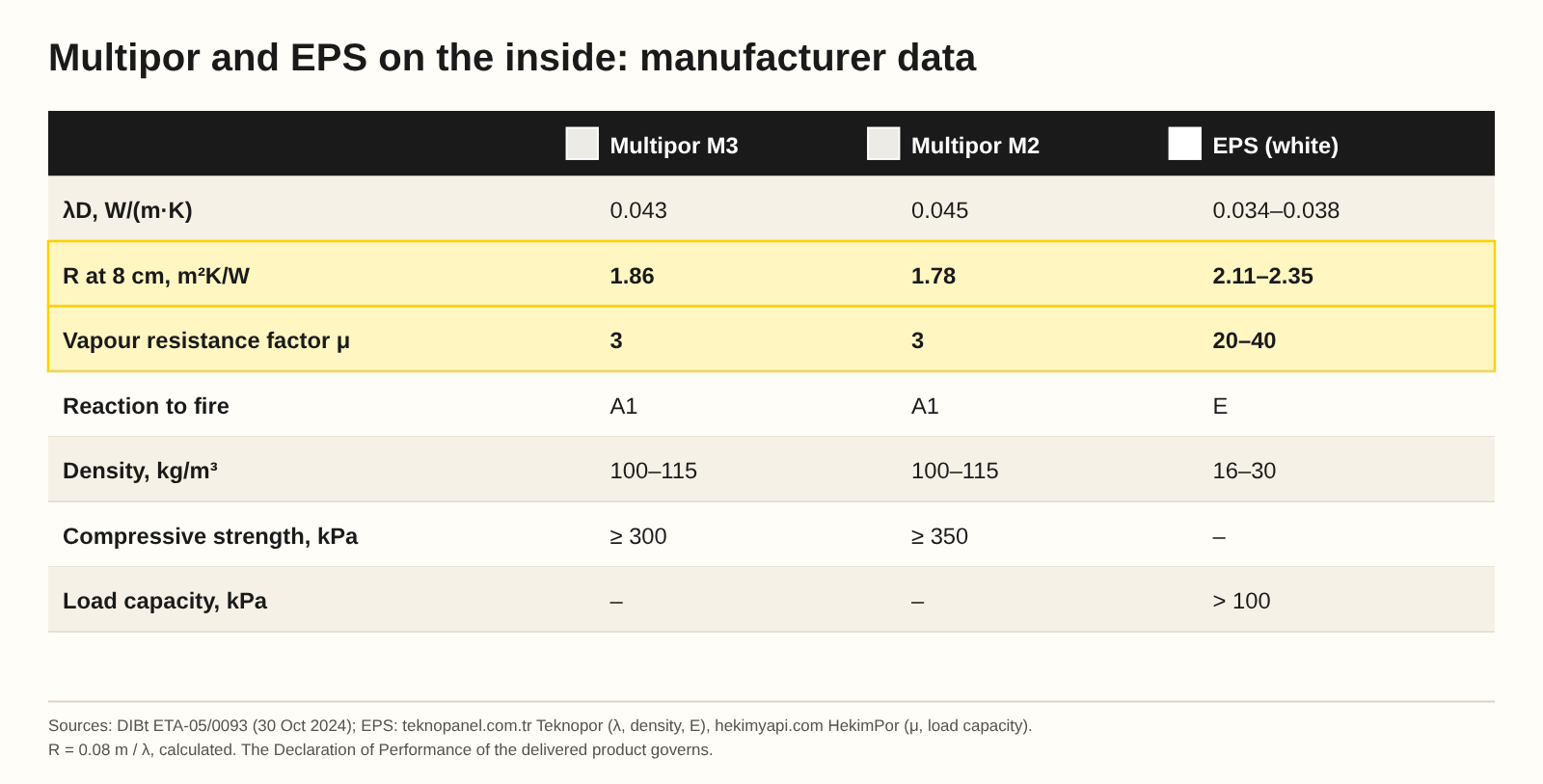
| Property | Multipor M3 | Multipor M2 | EPS (white) |
|---|---|---|---|
| λD, W/(m·K) | 0.043 | 0.045 | 0.034–0.038 |
| R at 8 cm, m²K/W | 1.86 | 1.78 | 2.11–2.35 |
| Vapour resistance factor μ | 3 | 3 | 20–40 |
| Reaction to fire | A1 | A1 | E |
| Density, kg/m³ | 100–115 | 100–115 | 16–30 |
| Compressive strength, kPa | ≥ 300 | ≥ 350 | – |
| Load capacity, kPa | – | – | > 100 |
Sources: Multipor: DIBt ETA-05/0093 (30 Oct 2024). EPS: Teknopanel Teknopor (λ, density, class E), HekimPor (μ, load capacity). R = 0.08 m / λ, calculated; the method is in our U-value calculation guide. The Declaration of Performance of the delivered product governs.
What the table shows:
- EPS insulates better per centimetre. 8 cm of EPS gives 2.11–2.35 m²K/W, 8 cm of Multipor 1.78–1.86 m²K/W.
- Multipor is A1, the EPS board is class E. Multipor is a non-combustible mineral material; Türk Ytong states it emits no toxic gas or smoke in a fire.
- Multipor is vapour-open and capillary-active. Xella states that it therefore needs no separate vapour barrier. For EPS, the designer decides the vapour control, including whether a vapour retarder is needed.
Where every centimetre of room depth counts, EPS reaches the same thermal resistance with less thickness. Where A1, a vapour-open build-up and a mineral surface matter more, Multipor is the candidate. We recommend a moisture check of both options before deciding.
What the designer has to decide
Internal insulation behaves differently on every wall, so two questions belong to the designer:
- Hygrothermal check. Based on the wall's material, thickness and moisture condition and on the room's use, the designer checks that the build-up dries properly across the whole wall section.
- Thermal bridges. At floor slab and partition junctions the internal insulation is interrupted. The designer decides how these junctions are treated and how thick the insulation should be.
When a building needs an energy performance certificate is covered in a separate article (in Hungarian). Multipor is a thermal insulation board; for noise problems in flats, see our overview of acoustic solutions (in Hungarian).
Multipor and Hungary's EKR catalogue
In Hungary's Energy Efficiency Obligation Scheme (EKR), the measure catalogue in annex 1 of Decree 41/2025 (XII. 30.) EM sets λ ≤ 0.039 W/(m·K) for non-blown insulation in the normative family-house insulation datasheet (measure 1.3, point 1.3.1.1 eb). Multipor's λD is 0.043–0.045 W/(m·K), so it does not fit that datasheet. The normative datasheet for apartment blocks (1.5) has the same material condition. Our guide to the EKR catalogue insulation measures lists the measures and their conditions.
Sourcing
Multipor is a Xella brand. In Hungary, Xella sells it directly; we do not represent Xella or Ytong. The Turkish producer, Türk Ytong, is a potential partner of ours: we offer Multipor boards as sourcing on request. We hold no stock and make no availability or lead-time commitment.
For a request, give the type (M2 or M3), board size, thickness and quantity, and ask for the Declaration of Performance (DoP). Türk Ytong lists TS 13729, an Environmental Product Declaration (EPD) and the ETA for the product.
Frequently asked questions
Does Multipor internal insulation need a vapour barrier?
Xella states that no separate vapour barrier is needed, because the board has low vapour resistance (μ 3) and a capillary-active structure. Conditions are full-surface bonding with Multipor mortar and a mineral, vapour-open paint. The designer checks moisture performance for the actual wall.
How much warmer does the inner wall surface get?
In Xella's example, the inner surface of an old 38 cm brick wall with 20 °C room air is about 17 °C on the coldest days, and 19–19.5 °C with Multipor internal insulation. Other walls give other values.
Can Multipor internal insulation be tiled?
Yes, per Xella, on at most 2/3 of the insulated wall surface and at no more than 25 kg/m² including adhesive. Each board then needs 1 dowel through the full-surface mesh.
Multipor or EPS for internal insulation?
EPS has the lower λ (0.034–0.038 against 0.043–0.045), so it gives more thermal resistance from the same thickness. Multipor is A1, vapour-open (μ 3) and capillary-active per Xella, so it needs no separate vapour barrier. For EPS, the designer decides the vapour control.
Does Multipor qualify under the EKR family-house normative datasheet?
No. Datasheet 1.3 requires λ ≤ 0.039 W/(m·K) for non-blown insulation, and Multipor's λD is 0.043–0.045 W/(m·K). The apartment-block datasheet 1.5 has the same condition.
Can EuConX supply Multipor boards?
Türk Ytong is a potential partner; we offer Multipor boards as sourcing on request. We hold no stock and make no availability or lead-time commitment. In Hungary, Xella sells the product directly.
Sourcing, quotes, documents: contact us · +36 30 485 0258 · info@euconx.com. We reply the same working day.
Sources
1. Xella Hungary: Multipor brochure 2024/01 (pp. 4–6, 11, 13, 15 and 17–20): https://storefrontapi.commerce.xella.com/medias/sys_master/images/he6/h97/9196605079582/Multipor_2024-01_V3_WEB/Multipor-2024-01-V3-WEB.pdf
2. DIBt: ETA-05/0093, Multipor mineral insulation boards, 30 October 2024: https://dibt.de/pdf_storage/2024/ETA-05!0093(8.12.01-25!24)e.pdf
3. Türk Ytong: Multipor ısı yalıtım levhası, product page and technical table: https://www.ytong.com.tr/multipor-isi-yalitim-levhasi
4. Teknopanel: Teknopor EPS product page: https://www.teknopanel.com.tr/tr-tr/urun-detay/teknopor-eps-urunleri-teknopor-isi-yalitim-levhasi
5. Hekim Yapı: HekimPor EPS insulation boards: https://www.hekimyapi.com/hekimpor/eps-yalitim-levhalari/
6. Decree 41/2025 (XII. 30.) EM, annex 1, point 1.3.1.1 eb), Magyar Közlöny 2025 issue 160, p. 11489: https://magyarkozlony.hu/hivatalos-lapok/p1UZBNSoHiBBftW595F66949b7f7ae914/dokumentumok/5858f900426cb56e532a468a989dbb1417d9aef0/letoltes
7. EuConX: Hungary's EKR catalogue: insulation measures
8. EuConX: Sd value explained
9. EuConX: U-value calculation
10. EuConX: Graphite EPS vs white EPS
Planning a project? Let’s talk.
Send the material schedule or project requirements. We’ll help match the product and prepare a clear quotation.