
Ahmet Alptekin Kasar
Founder, Managing Director
Updated: 2026-10-22
This article is for developers, ETICS contractors and specifiers working in Hungary and the wider CEE region. It compares the two board types on manufacturer data, shows how much thinner graphite EPS can be for the same U-value, and lists what the choice does not change. The calculation method behind the numbers is in our U-value calculation guide (example 3 uses the same figures). Our general comparison of EPS and stone wool facades is available in Hungarian, as is our article on facade system prices in Hungary (in Hungarian). We quote no prices here.
How graphite EPS differs from white EPS
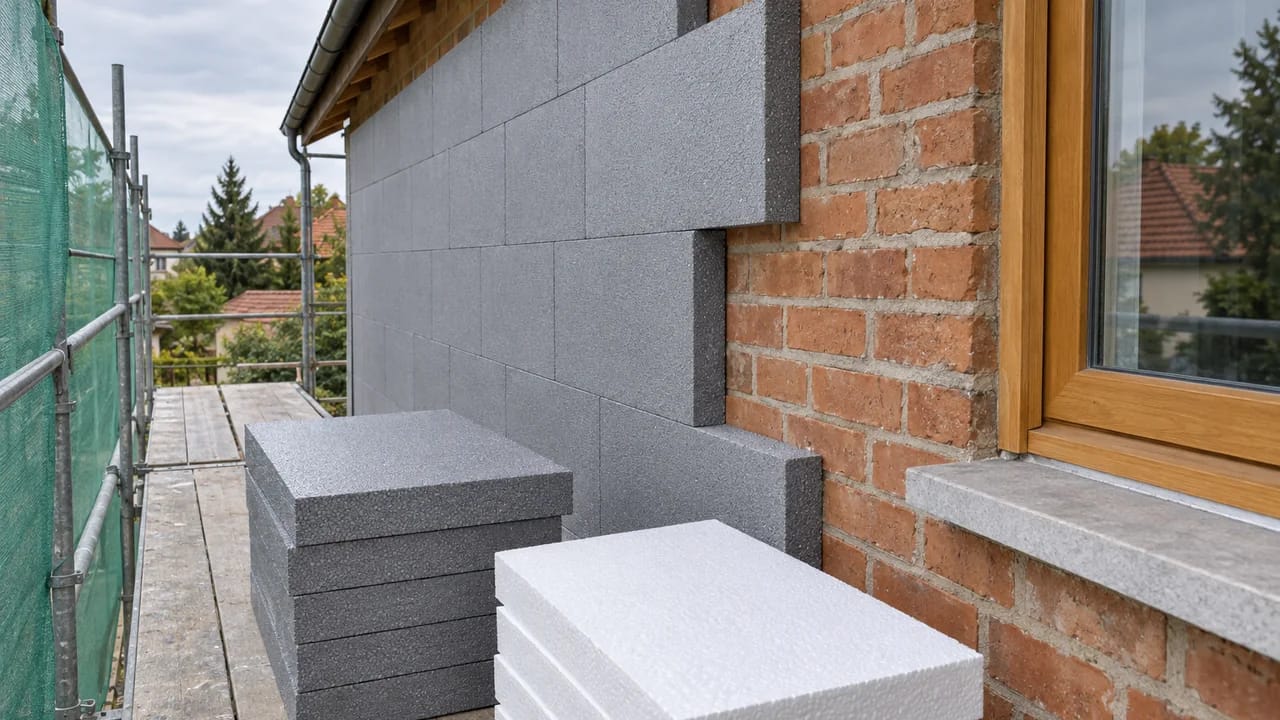
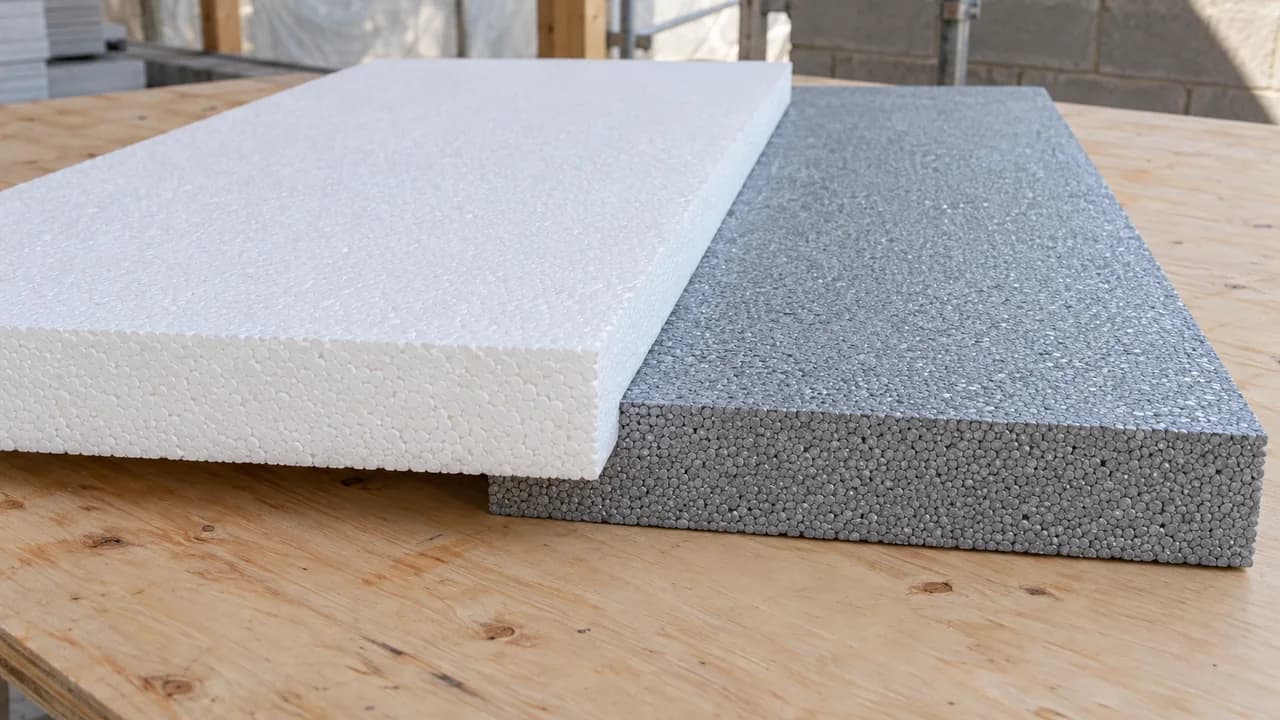
Both are expanded polystyrene (EPS) insulation boards. Teknopanel describes Teknopor EPS as a closed-cell material made of 98 % air and 2 % polystyrene. Grafit Teknopor is the same board with a graphite additive, which turns it grey and lowers its thermal conductivity.
What the manufacturer states for each product:
- Teknopor EPS (white): λ 0.038–0.034 W/(m·K) depending on density (TS ISO 8302); produced at 16–30 kg/m³; white and pink options. Recommended for ETICS, roofs and cold stores at densities of 16 kg/m³ and above.
- Grafit Teknopor (graphite): λ 0.031 W/(m·K) (TS ISO 8302); 16–20 kg/m³; grey. Recommended for the same uses: ETICS, roofs and cold stores.
- Common to both: thicknesses of 20, 25, 30, 40, 50, 60, 80 and 100 mm; 50 × 100 cm boards; at least 40 mm recommended in ETICS; ISO, TSE and CE quality documents. Both are produced at four plants: Mersin, Sakarya, İzmir and İstanbul.
Teknopanel states that the graphite board gives "20 % better thermal insulation performance than Teknopor EPS boards". That is the manufacturer's own claim. Worked out from the declared λ values, the gain depends on which white board you compare against: it is larger against λ 0.038 and smaller against λ 0.034. The thickness section below puts numbers on both.
Manufacturer data side by side
For comparison, the third column shows the white EPS board of a second Turkish producer, Hekim Yapı. According to its product page, HekimPor EPS comes as boards and blocks, with flat, grooved or shiplapped edges.

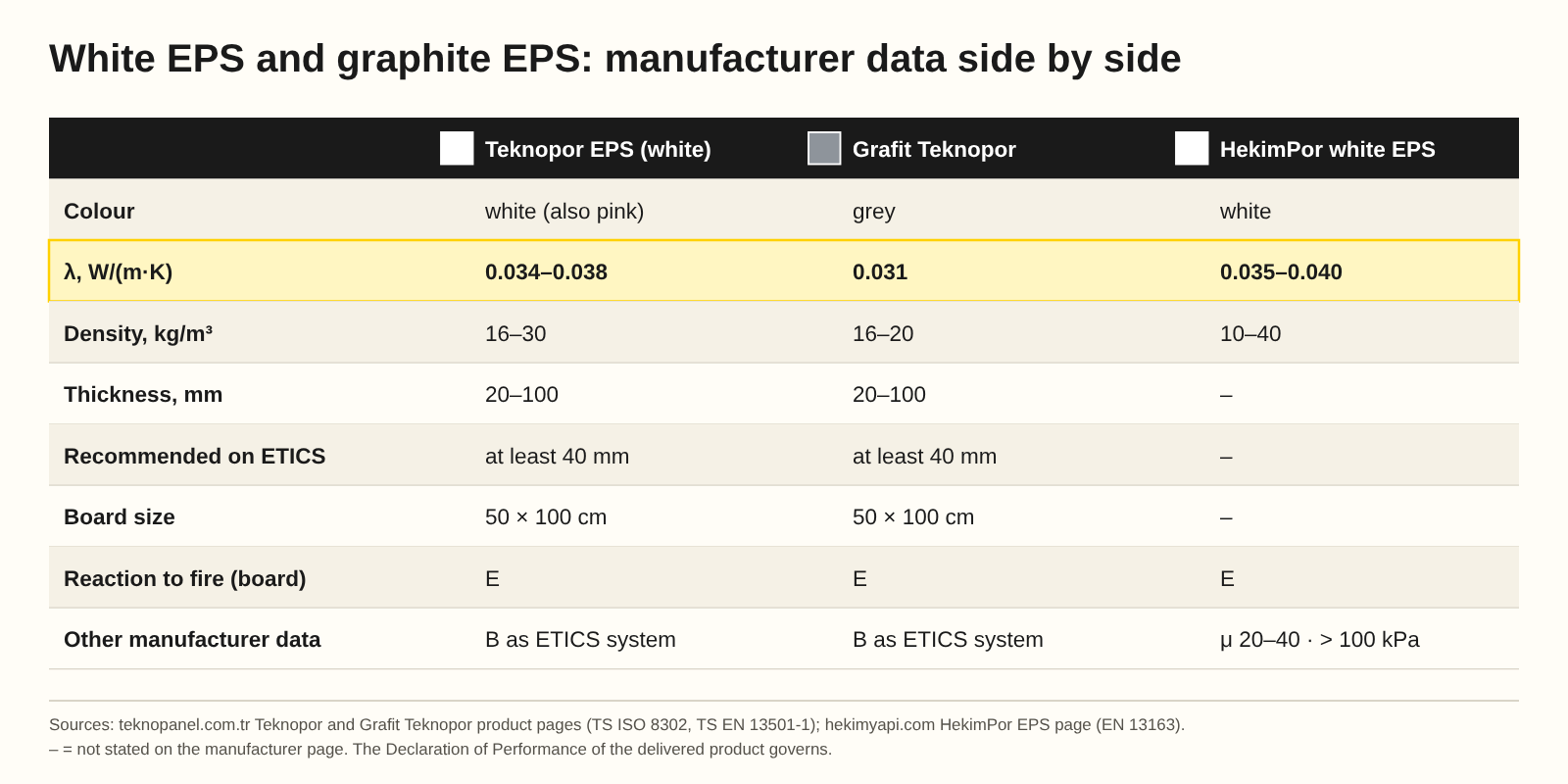
| Property | Teknopor EPS (white) | Grafit Teknopor | HekimPor white EPS |
|---|---|---|---|
| Colour | white (also pink) | grey | white |
| λ, W/(m·K) | 0.034–0.038 | 0.031 | 0.035–0.040 |
| Density, kg/m³ | 16–30 | 16–20 | 10–40 |
| Thickness, mm | 20–100 | 20–100 | – |
| Recommended in ETICS | at least 40 mm | at least 40 mm | – |
| Board size | 50 × 100 cm | 50 × 100 cm | – |
| Reaction to fire (board) | E | E | E |
| Other manufacturer data | class B as an ETICS | class B as an ETICS | μ 20–40 · > 100 kPa |
Sources: Teknopanel Teknopor EPS and Grafit Teknopor product pages (λ to TS ISO 8302, reaction to fire to TS EN 13501-1); HekimPor EPS (EN 13163). "–" means the manufacturer's page does not state it. All three checked on 22 October 2026.
Reading the table:
- λ is the main difference. The graphite board declares 0.031; the white boards range from 0.034 to 0.040, depending on density and producer.
- The density bands differ. Graphite EPS is 16–20 kg/m³, white Teknopor 16–30 kg/m³. Specify density as well as thickness when you order.
- Reaction to fire is the same. All three boards are class E. For both Teknopor products, Teknopanel also states that the EPS raw material is B1 and the EPS ETICS is class B.
- HekimPor publishes different data. It gives a water vapour diffusion resistance factor (μ 20–40) and a load capacity (> 100 kPa), but no thickness range or board size. Hekim Yapı also lists a carbon-reinforced EPS; its page gives no λ for it, so we give no figure either.
Teknopanel and Hekim Yapı are potential partners for us: we offer their boards as sourcing on request, hold no stock and make no lead-time commitment.
How much thinner is graphite EPS for the same U-value?
Under Annex 1 of Hungarian Decree 9/2023 (V. 25.) ÉKM, an external wall may have a U-value of at most 0.24 W/m²K. For a wall, heat flows horizontally, so the surface resistances are Rsi = 0.13 and Rse = 0.04 m²K/W. The total resistance needed is 1 / 0.24 = 4.17 m²K/W, which leaves 4.17 − 0.13 − 0.04 = 4.00 m²K/W for the insulation layer if the masonry is ignored. The required thickness is d = 4.00 × λ.

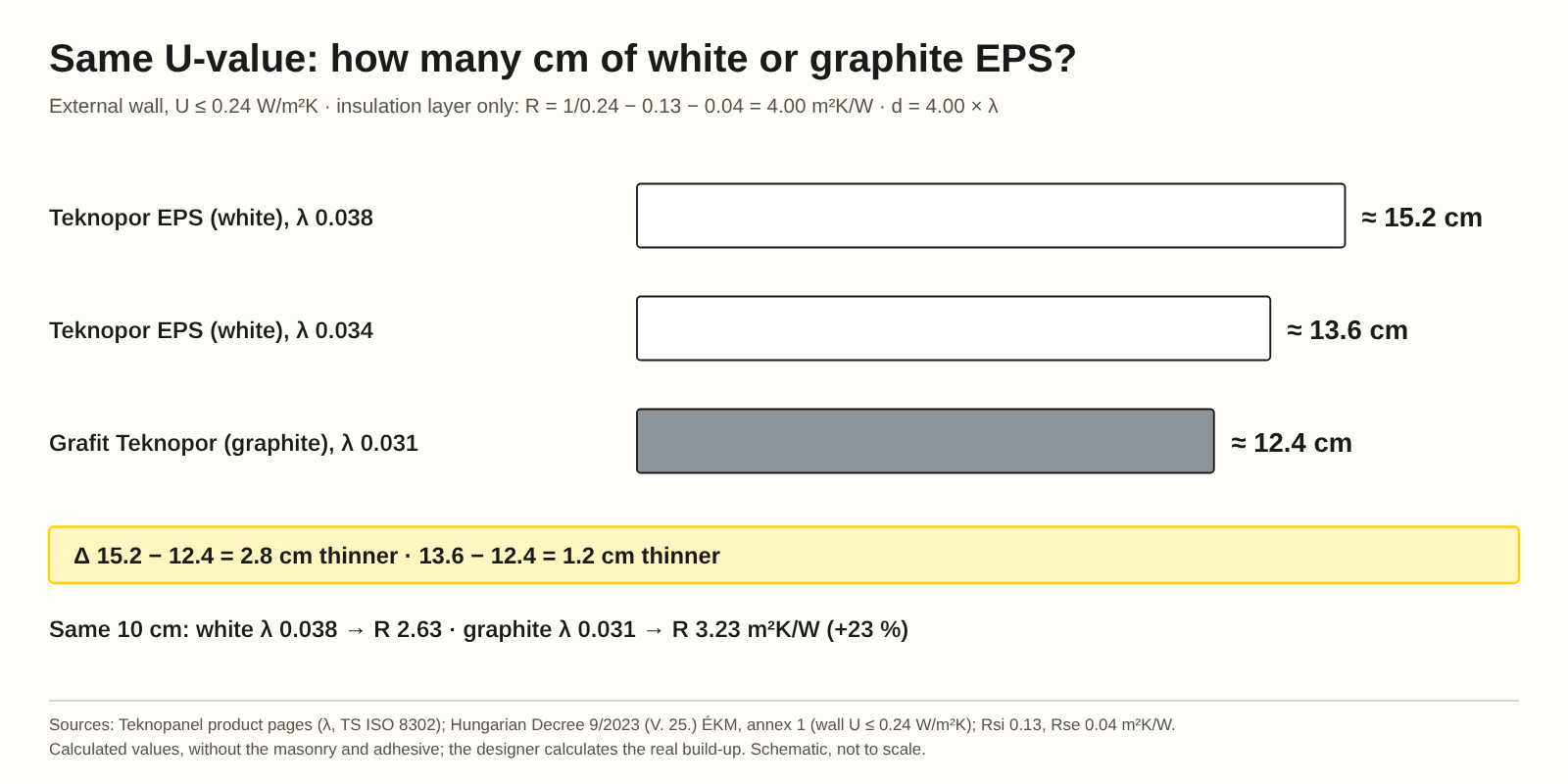
| Board | λ, W/(m·K) | Required d = 4.00 × λ | Extra vs graphite | R at 10 cm = 0.10 / λ |
|---|---|---|---|---|
| Teknopor EPS (white), top of the declared range | 0.038 | ≈ 15.2 cm | + 2.8 cm | 2.63 m²K/W |
| Teknopor EPS (white), bottom of the declared range | 0.034 | ≈ 13.6 cm | + 1.2 cm | 2.94 m²K/W |
| Grafit Teknopor (graphite) | 0.031 | ≈ 12.4 cm | – | 3.23 m²K/W (+23 % vs 0.038) |
Source: λ from the Teknopanel product pages; U ≤ 0.24 W/m²K from Decree 9/2023 (V. 25.) ÉKM, Annex 1; Rsi 0.13 and Rse 0.04 m²K/W as in our U-value calculation guide. Calculated values for the insulation layer only, without the masonry and the adhesive.
What the numbers mean:
- About 18 % less thickness for the same R. 0.031 / 0.038 ≈ 0.82, so against a λ 0.038 white board, graphite EPS reaches the same thermal resistance with roughly 18 % less thickness.
- Against λ 0.034 the gain is smaller. The difference is 1.2 cm. Always compare against the λ of the actual white board on offer, not an average.
- More R in the same thickness. 10 cm of graphite EPS gives 3.23 m²K/W, 10 cm of λ 0.038 white EPS 2.63 m²K/W; 3.23 / 2.63 ≈ 1.23, about 23 % more.
- With the HekimPor range. The same method gives 14.0 cm at λ 0.035 and 16.0 cm at λ 0.040.
- A real wall gives a different answer. Brick, concrete or adobe adds its own resistance and reduces the insulation needed. The designer calculates the actual build-up with the masonry data.
The calculated 12.4–15.2 cm is more than the largest board thickness Teknopanel lists (100 mm). If the design calls for a thicker layer, agree the board thickness and the build-up with the manufacturer and the system supplier at enquiry stage.
What the choice does not change
- Reaction to fire. Graphite and white boards are both class E, and the manufacturer gives class B for both as an ETICS. The fire requirements for a given facade follow from the Hungarian fire code (OTSZ) and are set by the designer, not by the colour of the board.
- The plinth. Neither EPS belongs in the splash zone or in contact with soil; we recommend XPS there. The reasons are in our XPS vs EPS for plinths and basement walls article.
- The system. An EPS board is one component of an ETICS, together with adhesive, fixings, reinforced base coat and finish. The system holder's instructions define the components and the installation, whichever board goes on the wall.
Where the designer specifies non-combustible, class A1 insulation, stone wool is the option to look at. Our article on stone wool boards for industrial insulation covers ODE Rockflex data (A1, λ 0.036 W/(m·K) at 10 °C); ODE lists facades among its applications.
Site practice with graphite boards
Graphite boards are darker and absorb more solar heat than white ones. Recommended practice is to shade them during installation and until they are rendered: shade netting on the scaffold, and no long periods of direct sun on unrendered boards. Detailed rules, for example on bonding, anchoring and applying the base coat, come from the ETICS system holder; follow them.
For storage, Hekim Yapı advises keeping EPS boards in a cool, ventilated place, away from solvents, out of direct sunlight and away from heat sources, with any tarpaulin cover ventilated. That is a sensible baseline for graphite boards as well.
How to decide
Graphite EPS earns its place where thickness is the constraint:
- Shallow window reveals. Where there is little room between the window frame and the face of the insulation, a thinner layer fits more easily.
- Short eaves overhang. If the eaves barely project beyond the wall, thinner insulation takes less of that cover.
- The same U-value with less thickness. If the design fixes a U-value and there is no room for a thicker layer, graphite EPS at λ 0.031 gets there with about 12.4 cm where white board needs 13.6–15.2 cm.
White EPS makes sense where the thickness fits and budget is the main driver. We do not compare board prices here. Ask for quotes on both boards for the same target U-value and compare complete systems, not just the boards.
What to include in an enquiry
- The exact product and λ. Grafit Teknopor or Teknopor EPS; for white board, state the density, because λ depends on it.
- Thickness and quantity. The manufacturer's steps run from 20 to 100 mm, on 50 × 100 cm boards.
- Documents. The Declaration of Performance (DoP) and CE marking of the delivered product. For Teknopor EPS the manufacturer has also published Environmental Product Declarations (EPDs). Our CE marking guide explains how to read a DoP.
- The system. Which ETICS the board will be part of, and what the system holder requires.
When an order goes ahead, we check the goods before sealing and loading, and you have one contact at EuConX from purchase through customs.
Frequently asked questions
How much better is graphite EPS than white EPS?
Grafit Teknopor declares λ 0.031 W/(m·K); white Teknopor EPS 0.034–0.038. At the same 10 cm, the graphite board gives R 3.23 and a λ 0.038 white board R 2.63 m²K/W, about 23 % more. The manufacturer's own claim is 20 % better thermal performance.
How thick does graphite EPS need to be for a wall U-value of 0.24?
About 12.4 cm, counting the insulation layer only (4.00 m²K/W × 0.031). White EPS needs 13.6–15.2 cm. On a real wall the masonry counts too, so the designer sets the final thickness.
Does graphite EPS have a better fire class?
No. The manufacturer gives class E for both boards and class B for both as an ETICS. Fire design of the facade under the Hungarian fire code (OTSZ) is the designer's job.
Can graphite EPS be used at the plinth?
We do not recommend any EPS in the splash zone or in contact with soil; use XPS there. Above the plinth, on the facade, both graphite and white EPS can be used.
Do graphite boards need shading during installation?
Recommended practice is yes: the darker board absorbs more solar radiation, so shade netting goes on the scaffold and unrendered boards are not left in direct sun for long. Follow the system holder's instructions.
Can EuConX supply Grafit Teknopor?
Teknopanel is a potential partner for us. We offer Grafit Teknopor and Teknopor EPS as sourcing on request; we hold no stock and make no lead-time commitment. For an enquiry, state the product, thickness and quantity.
Material supply, quotes and DoPs: contact form · +36 30 485 0258 · info@euconx.com. We reply on the same working day.
Sources
1. Teknopanel: Teknopor EPS insulation board product page (checked 2026-10-22): https://www.teknopanel.com.tr/tr-tr/urun-detay/teknopor-eps-urunleri-teknopor-isi-yalitim-levhasi
2. Teknopanel: Grafit Teknopor insulation board product page (checked 2026-10-22): https://www.teknopanel.com.tr/tr-tr/urun-detay/teknopor-eps-urunleri-grafit-teknopor-isi-yalitim-levhasi
3. Hekim Yapı: HekimPor EPS insulation boards (checked 2026-10-22): https://www.hekimyapi.com/hekimpor/eps-yalitim-levhalari/
4. Decree 9/2023 (V. 25.) ÉKM, Annex 1, U-value requirements (Hungarian legal database): https://njt.jog.gov.hu/jogszabaly/2023-9-20-8X
5. EuConX: U-value calculation: method, limits and examples
6. EuConX: XPS vs EPS for plinths and basement walls
7. EuConX: Facade insulation, EPS or stone wool (in Hungarian): https://euconx.com/resources/homlokzati-hoszigetelo-rendszerek-osszehasonlitasa-eps-vs-kozetgyapot
8. EuConX: Facade insulation system prices in Hungary in 2026 (in Hungarian): https://euconx.com/resources/homlokzatszigetelesi-rendszerek-ara-magyarorszagon-2026-ban
9. EuConX: Stone wool board for industrial insulation
10. EuConX: CE marking for construction materials: a complete guide
Planning a project? Let’s talk.
Send the material schedule or project requirements. We’ll help match the product and prepare a clear quotation.