
Ahmet Alptekin Kasar
Founder, Managing Director
Updated: 2026-10-21
This article is narrower than our general XPS and EPS comparison (in Hungarian). It only deals with the plinth and with perimeter insulation on basement walls, using manufacturer data and a schematic section. The wider range of ODE Isıpan XPS applications (under slabs, green roofs, inverted roofs) is covered in our ODE Isıpan XPS product article.
Why the plinth and the basement wall are different
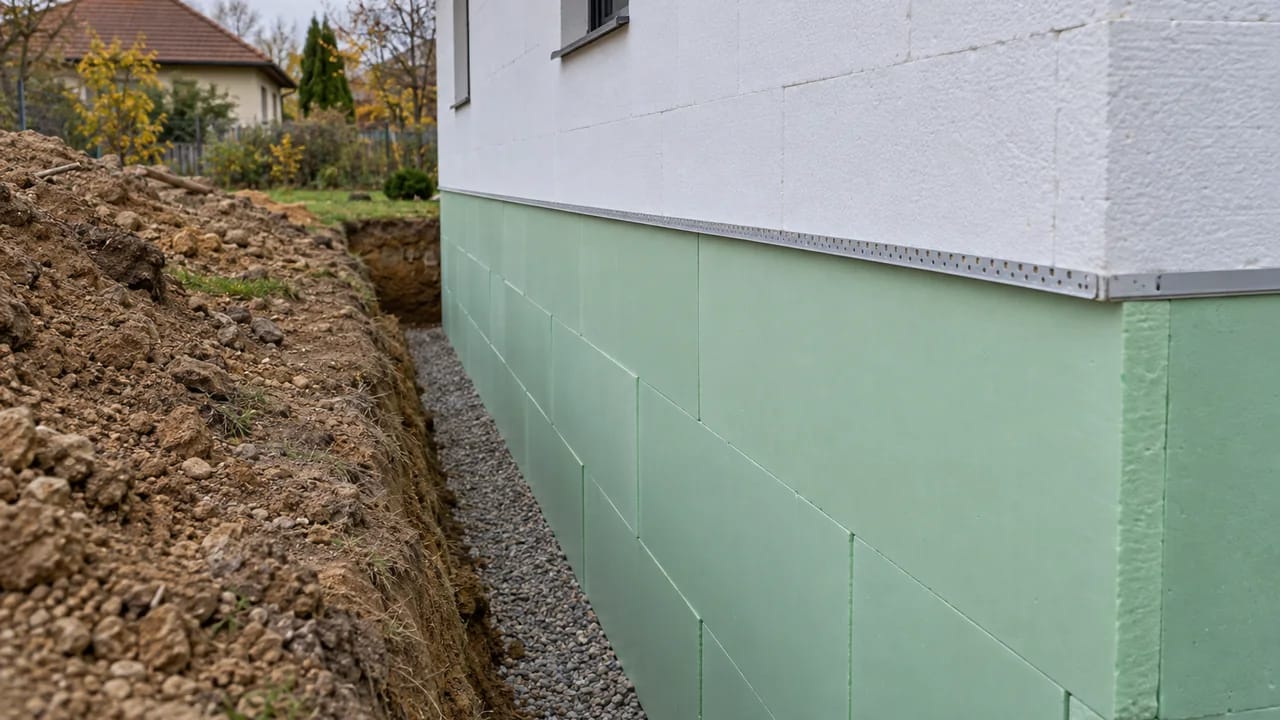
On the facade, the render protects the insulation and most of the wall stays dry. The bottom band of the building is a different environment, because here the insulation meets water and soil directly.
- Plinth, splash zone: rain bounces back off paving and ground, snow melts against the wall, and the plinth is exposed to increased mechanical wear. The insulation has to keep its shape and performance while wet and under mechanical load.
- Basement wall in soil: ground moisture is permanent, the backfill presses on the boards, and once the trench is closed the insulation can neither be dried out nor replaced without excavation.
So the question here is not which material has the lower λ, but which one tolerates water and load over the long term. XPS is an extruded polystyrene foam with a closed-cell structure. Thanks to its closed cells, XPS takes up little water and its compressive strength is declared, so wherever water, ground moisture, backfill pressure or splash water reaches the insulation, we recommend XPS. Above the splash zone, on a rendered and dry facade, EPS is a sound choice.

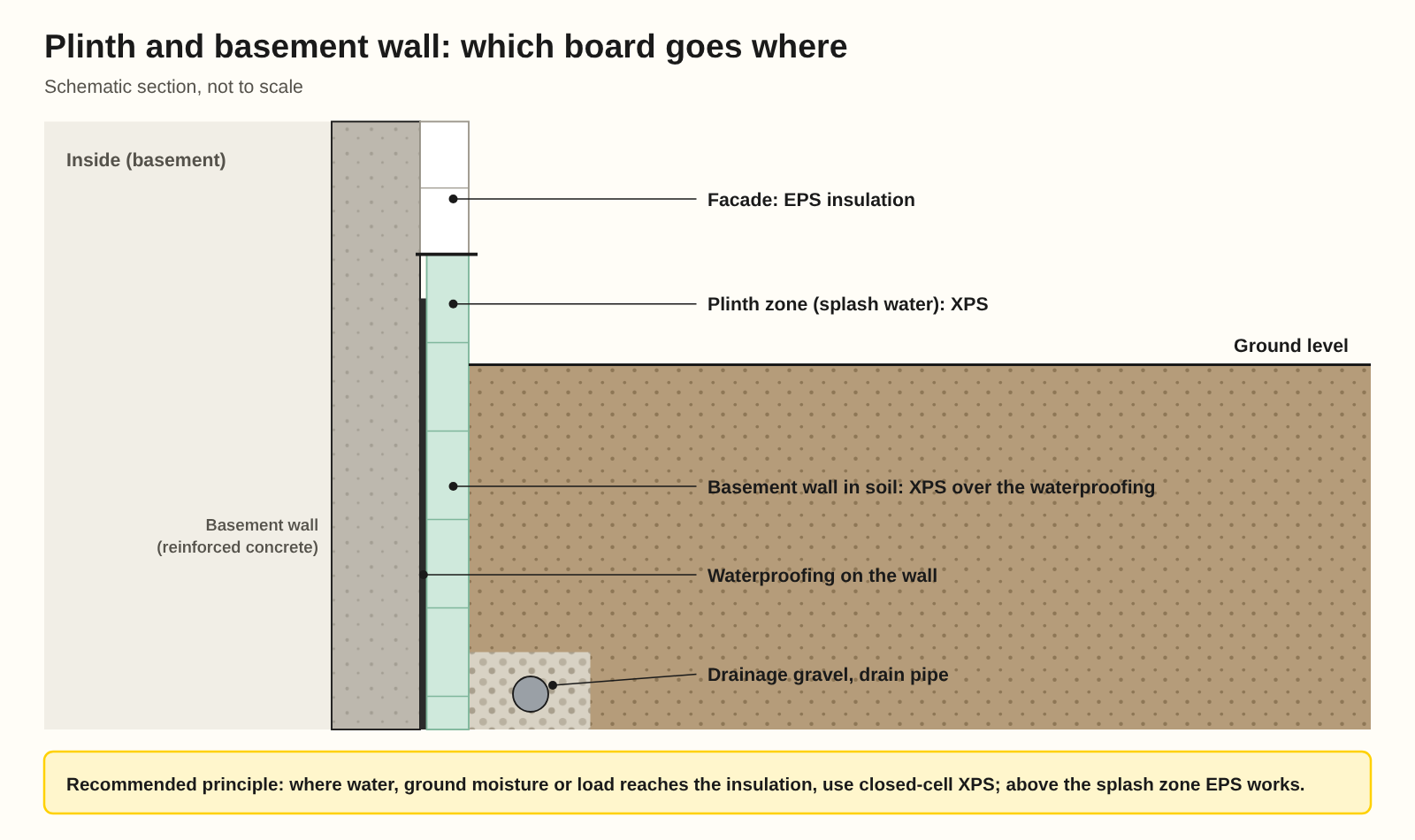
What goes where: the section step by step
Read the drawing from the bottom up:
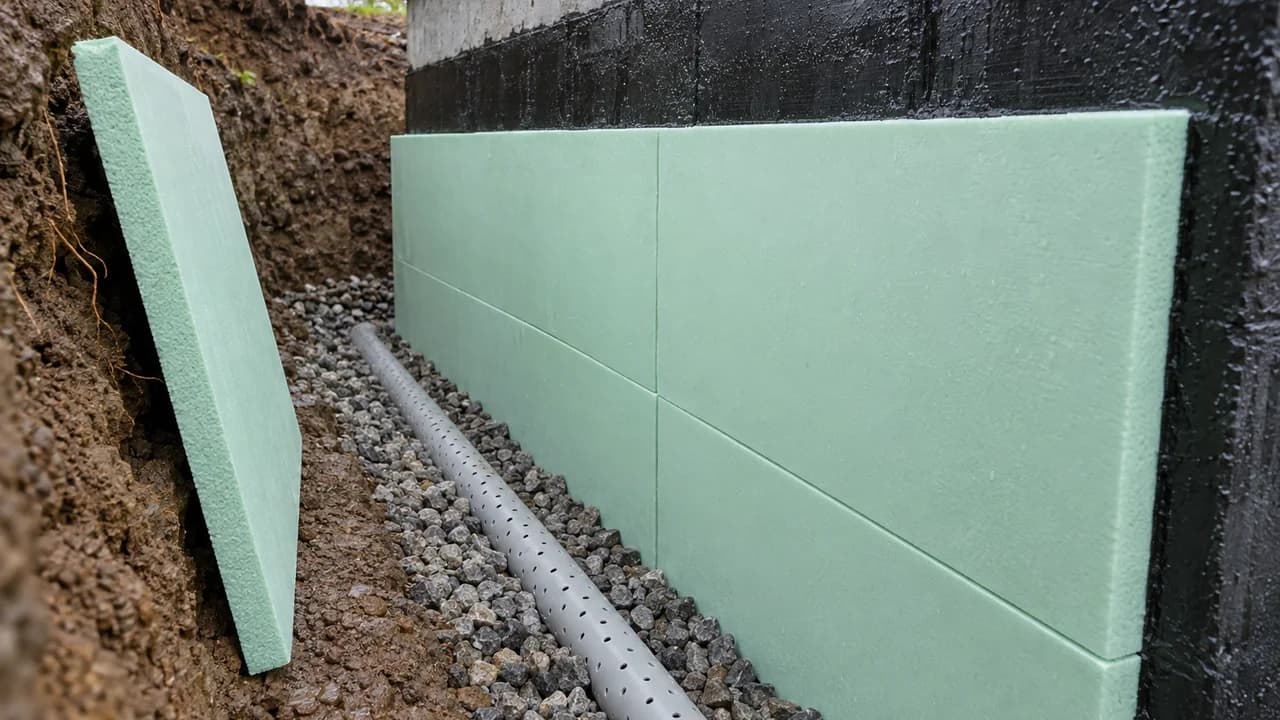
1. Basement wall in soil. The waterproofing goes on the wall first, the XPS perimeter insulation over it. The order matters: the waterproofing deals with water, the XPS with heat loss, and it also covers the waterproofing during backfilling. XPS does not replace the waterproofing; its specification is the designer's call.
2. Drainage gravel and drain pipe. It is good practice to lead water away from the foot of the wall so that it does not stand against the insulation. Its design is also a matter for the designer.
3. Plinth zone. The XPS continues above ground level through the splash zone. Its height depends on the design and the site, so we give no figure here.
4. Facade. The EPS facade insulation starts above the plinth. It is good practice to make the junction between the two materials gap-free, as this is a typical thermal-bridge spot.
At the plinth, and on any wall where adhesive and render go onto the board, ODE recommends the channelled (MD) or embossed (BD) Isıpan surface; the smooth version is designated DT. When ordering, specify the surface as well as the type.
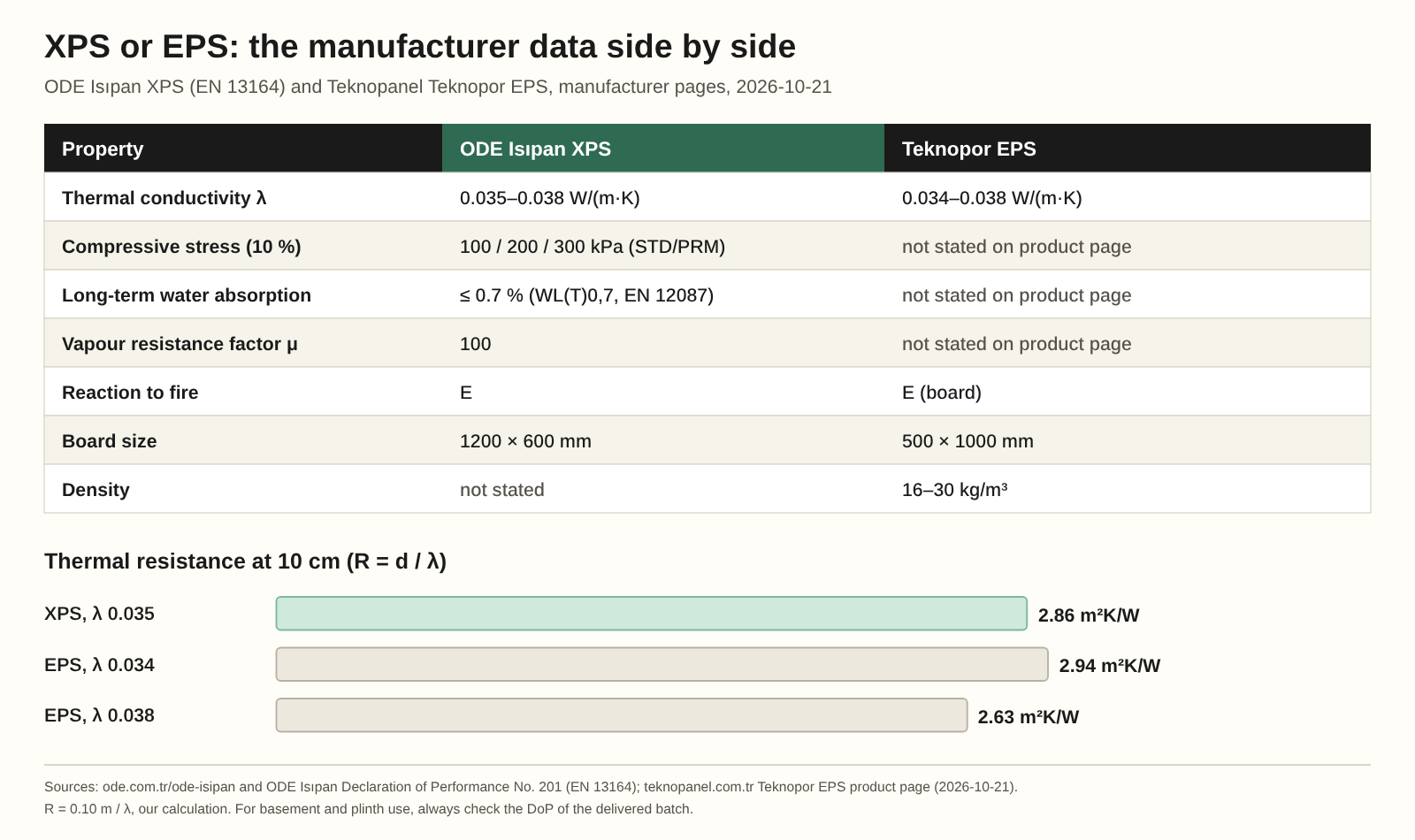
The manufacturer data side by side

| Property | ODE Isıpan XPS | Teknopor EPS |
|---|---|---|
| Thermal conductivity λ | 0.035–0.038 W/(m·K) (STD 100 and PRM 300: 0.035; STD 200: 0.038) | 0.034–0.038 W/(m·K), depending on density (TS ISO 8302) |
| Compressive stress at 10 % deformation | 100 / 200 / 300 kPa (STD 100 / STD 200 / PRM 300) | not stated on the product page |
| Long-term water absorption by total immersion | ≤ 0.7 % (WL(T)0,7, EN 12087) | not stated on the product page |
| Water vapour resistance factor μ | 100 (EN 12086) | not stated on the product page |
| Reaction to fire | Euroclass E | Euroclass E (boards) |
| Board size | 1200 × 600 mm | 500 × 1000 mm |
| Density | not stated on the product page | 16–30 kg/m³ |
| Thickness | specified per project | 20 / 25 / 30 / 40 / 50 / 60 / 80 / 100 mm |
| R at 10 cm (R = d / λ) | λ 0.035: 0.10 / 0.035 = 2.86 m²K/W | λ 0.034: 2.94 m²K/W; λ 0.038: 2.63 m²K/W |
Sources: ODE Isıpan product page and ODE Isıpan Declaration of Performance No. 201 (EN 13164:2012+A1:2015); Teknopanel Teknopor EPS product page. Both checked on 21 October 2026. R values are our own calculation.
What the table tells a specifier:
- λ does not decide it. At 10 cm, EPS at its best λ (0.034) gives a slightly higher R than XPS (2.94 versus 2.86 m²K/W). XPS is not recommended at the plinth for its thermal performance. For thickness calculations see our U-value calculation guide.
- Water and load decide it. For Isıpan XPS the manufacturer declares water absorption and compressive stress. The Teknopor EPS product page states neither. That does not make the board poor; it means you cannot design on the product page alone. If EPS is considered near the plinth, request the Declaration of Performance of the batch to be delivered.
- The type follows the load. STD 100, STD 200 and PRM 300 declare 100, 200 and 300 kPa respectively at 10 % deformation. Which one a basement wall needs depends on backfill and loading, and is for the designer to set.
- μ matters too. Isıpan XPS has μ 100, so 10 cm gives Sd = 100 × 0.10 = 10 m and 5 cm gives 5 m. The XPS layer is itself a significant vapour retarder, so it is good practice to check the wall's moisture behaviour across the whole build-up. More in our Sd value explainer.
- Temperature and frost. ODE gives a service temperature range of −50 / +75 °C for Isıpan XPS. Freeze–thaw resistance is listed as NPD ("No Performance Determined") in the DoP; if the design calls for a figure, ask the manufacturer for it separately.
Where EPS is fine
Above the splash zone, on the facade, EPS is the usual, economical choice: the rendered insulation system protects the board, it is not permanently wet and it carries no backfill pressure. Our general comparison notes that XPS is usually the more expensive material, which is why EPS makes sense on the facade. Per Teknopanel's product page, Teknopor EPS has λ 0.034–0.038 W/(m·K) depending on density (16–30 kg/m³), boards of 50 × 100 cm in thicknesses from 20 to 100 mm, and Euroclass E. For external thermal insulation composite systems (ETICS), the manufacturer recommends at least 40 mm.
Teknopanel is a potential partner for us: Teknopor EPS is sourced on request, and we make no stock or availability commitment. When asking for a quote, state the density and thickness required and ask for the DoP with the offer.
Where the facade EPS meets the plinth XPS, the two boards may differ in thickness and surface. We recommend fixing the junction in the drawings and either bringing the plinth board flush with the facade system or detailing the step deliberately.
Good practice for specifiers and contractors
- Request the DoP of the delivered batch. The ODE Isıpan Declaration of Performance is No. 201 (EN 13164:2012+A1:2015). Check type (STD 100, STD 200, PRM 300) and surface (DT, MD, BD) against the specification.
- Keep the zones apart. XPS for the part in contact with soil and the splash zone; EPS can go on the facade.
- Waterproofing first. On the basement wall the insulation goes onto the waterproofing; choose adhesive and fixing according to the waterproofing and XPS manufacturers' instructions.
- Drain the water away. Drainage gravel and a drain pipe also protect the insulation over its service life.
- Do not design with data that is not declared. If a value is missing from the product page or the DoP, ask the manufacturer for it; do not estimate it.
On flat roofs, in an inverted build-up, XPS sits above the waterproofing for similar reasons; see our flat-roof article on inverted versus warm roofs. For CE marking and how to read a DoP, see our CE marking guide.
Frequently asked questions
Can EPS be used on the plinth?
For the splash zone and the part in contact with soil we recommend XPS: it is closed-cell, takes up little water and has a declared compressive strength. Above the splash zone, on the facade, EPS works well.
Why XPS on basement walls?
Because ground moisture is permanent, the backfill presses on the boards and the insulation cannot easily be replaced later. ODE Isıpan XPS declares long-term water absorption ≤ 0.7 % (WL(T)0,7) and compressive stress of 100–300 kPa depending on type.
Which XPS type does a basement wall need?
STD 100, STD 200 and PRM 300 declare 100, 200 and 300 kPa respectively at 10 % deformation. The designer sets the type from backfill and loads.
Does XPS insulate better than EPS?
Not necessarily. At 10 cm, XPS at λ 0.035 gives 2.86 m²K/W; EPS gives 2.94 at λ 0.034 and 2.63 at λ 0.038. At the plinth, XPS is recommended for water and load resistance, not for λ.
Does a basement wall still need waterproofing under XPS?
Yes. XPS is insulation and does not replace the waterproofing. The waterproofing goes on the wall and the XPS on top of it.
What should I check in the DoP?
λ, compressive stress at 10 % deformation, long-term water absorption, μ and reaction to fire. Where it says NPD, nothing is declared; in the ODE Isıpan DoP that is the case for freeze–thaw resistance.
Material supply, quotes and DoPs: contact form · +36 30 485 0258 · info@euconx.com. We reply on the same working day.
Sources
1. ODE: Isıpan XPS product page (checked 2026-10-21): https://ode.com.tr/ode-isipan
2. ODE: Isıpan Declaration of Performance No. 201, EN 13164:2012+A1:2015: https://ode.com.tr/_upload/pdf/ODE_ISIPAN_PERFORMANS_BEYANI_-_EN_13164.pdf
3. Teknopanel: Teknopor EPS insulation board product page (checked 2026-10-21): https://www.teknopanel.com.tr/tr-tr/urun-detay/teknopor-eps-urunleri-teknopor-isi-yalitim-levhasi
4. EuConX: XPS and EPS insulation, comparison and applications (in Hungarian): https://euconx.com/resources/xps-es-eps-szigeteles-arosszehasonlitas-es-teljesitmenyvizsgalat
5. EuConX: ODE Isıpan XPS board: plinth and slab applications
6. EuConX: Sd value explained
Planning a project? Let’s talk.
Send the material schedule or project requirements. We’ll help match the product and prepare a clear quotation.