
Ahmet Alptekin Kasar
Founder, Managing Director
Updated: 2026-10-22
This article is for plant engineers, industrial insulation contractors, HVAC and steel-structure contractors, and importers working in Hungary and the wider CEE region. It covers ODE Rockflex in technical and industrial use: product forms, temperature limits, the temperature dependence of λ, and what to specify in an enquiry. For stone wool on building facades, see stone wool vs glass wool on a facade and our EPS vs stone wool facade comparison (in Hungarian). Our overview of A1 and A2 materials is also in Hungarian.
What ODE Rockflex is
According to ODE, Rockflex is made by melting basalt at high temperature and fiberising it, and contains 97 % natural fibre. It provides thermal and acoustic insulation, is non-combustible, and ODE positions it for building services and industrial applications.
Further properties from the brochure:
- Water-repellent and vapour-permeable; it does not hold moisture. The water vapour diffusion resistance factor is μ = 1.
- Inorganic, so bacteria and micro-organisms do not grow in it. It does not rot or corrode.
- Applications listed by ODE: roofs, partition walls, facades, furnaces, steel doors, shipbuilding, household appliances, entertainment venues and cinemas.
ODE started in contracting in 1985 and has been a producer since 1996; its product page lists 8 production plants and more than 4 000 product types. ODE is a verified partner for us.
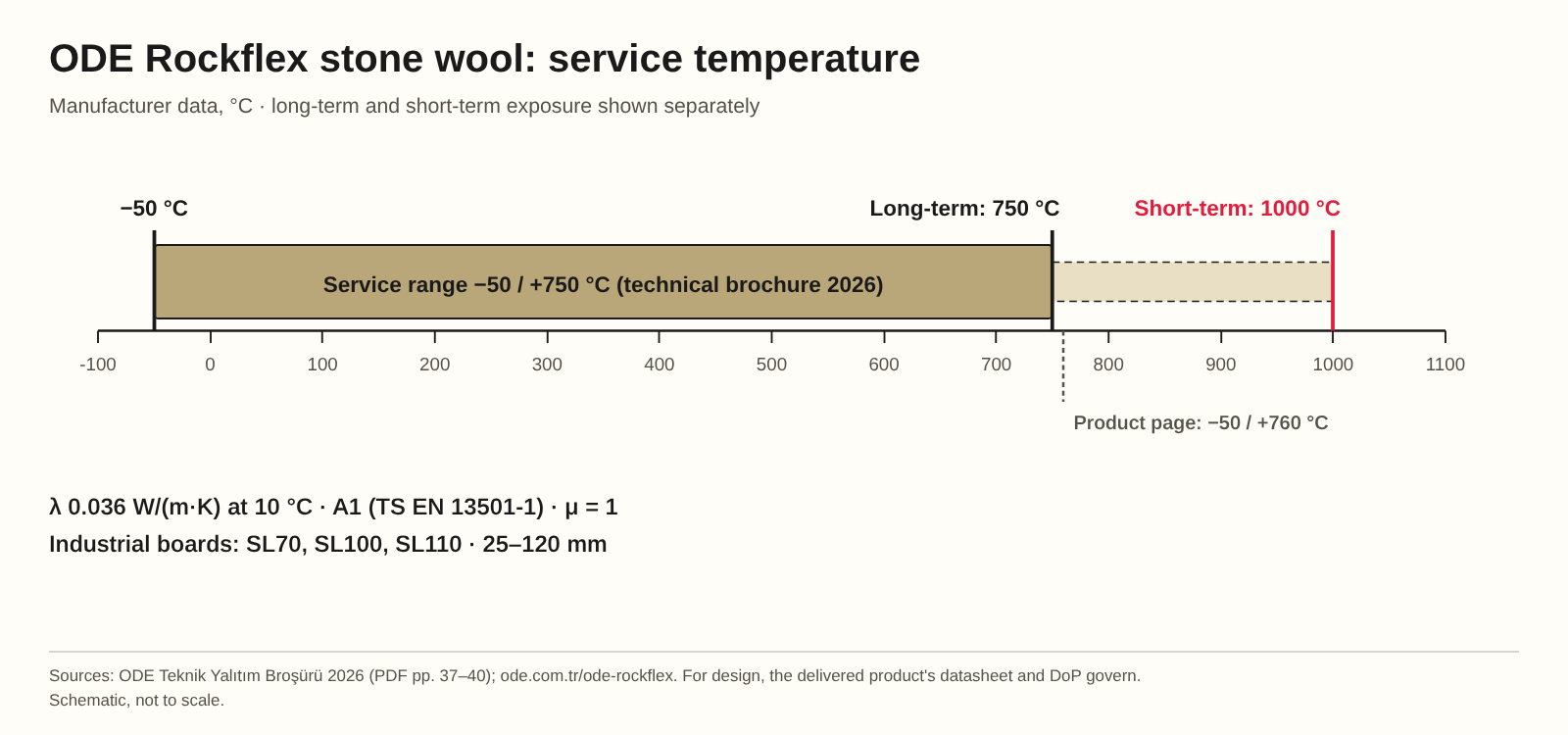
Service temperature: 750 °C long-term, 1000 °C short-term
The technical data table in ODE's 2026 Teknik Yalıtım Broşürü (technical insulation brochure) gives Rockflex a temperature resistance of 750 °C long-term and 1000 °C short-term. The same brochure states a service range of −50 to +750 °C, and elsewhere puts it as "750 °C (special productions 1000 °C)".
The ODE Rockflex product page states a service temperature of −50 / +760 °C, which is also the value on our product card. For design, we recommend working from the datasheet and Declaration of Performance (DoP) of the product type actually delivered. Where the duty is close to 750 °C or includes short peaks, have the manufacturer confirm the limit for that type.

| Item | Value | Source |
|---|---|---|
| Service range | −50 / +750 °C | ODE Teknik Yalıtım Broşürü 2026, PDF p. 37 |
| Temperature resistance, long-term | 750 °C | same, PDF p. 38 |
| Temperature resistance, short-term | 1000 °C | same, PDF p. 38 (p. 37: "special productions 1000 °C") |
| Service temperature on the product page | −50 / +760 °C | ode.com.tr/ode-rockflex |
| Thermal conductivity λ at 10 °C | 0.036 W/(m·K) | PDF p. 38 |
| Reaction to fire | A1 (TS EN 13501-1) | PDF pp. 37–38; product page (EN 13501-1) |
| Water vapour diffusion resistance factor μ | 1 | PDF p. 37 |
| Industrial boards | SL70, SL100, SL110 · 25–120 mm | PDF p. 39 |
Product forms: boards, mattresses, pipe sections
ODE's 2026 technical insulation brochure presents Rockflex in four technical and industrial forms. For the boards and mattresses, ODE gives the thermal resistance R across the thickness range.
| Form | ODE type | Thickness | R, m²K/W | Use according to ODE |
|---|---|---|---|---|
| HVAC board | KL70 | 25–120 mm | 0.69–3.30 | air-conditioning and ventilation ducts; available with different facings |
| Industrial board | SL70, SL100, SL110 | SL70, SL100: 25–120 mm; SL110: 25–90 mm | 0.69–3.30 (given for the family) | thermal, acoustic and fire insulation in industry up to 750 °C; steel structures, process equipment, industrial plants, ready-made panels |
| Wired mattress | RBTSS80, RBTSS90, RBTSS100, RBTSS125 | 30–100 mm | 0.80–2.75 | power plants, cement, sugar and iron-steel plants, shipbuilding; boilers, heat exchangers, furnaces |
| Preformed pipe section | Rockflex Prefabrik Boru | 25–100 mm, Ø 12–370 mm | – (λ by temperature, see below) | thermal and fire insulation of high-temperature industrial and building-services pipes; acoustic and vibration insulation of process equipment; uncoated or aluminium-foil faced; A1 |
Source: ODE Teknik Yalıtım Broşürü 2026, PDF pp. 38–40. "–" means the brochure gives no R for pipe sections.
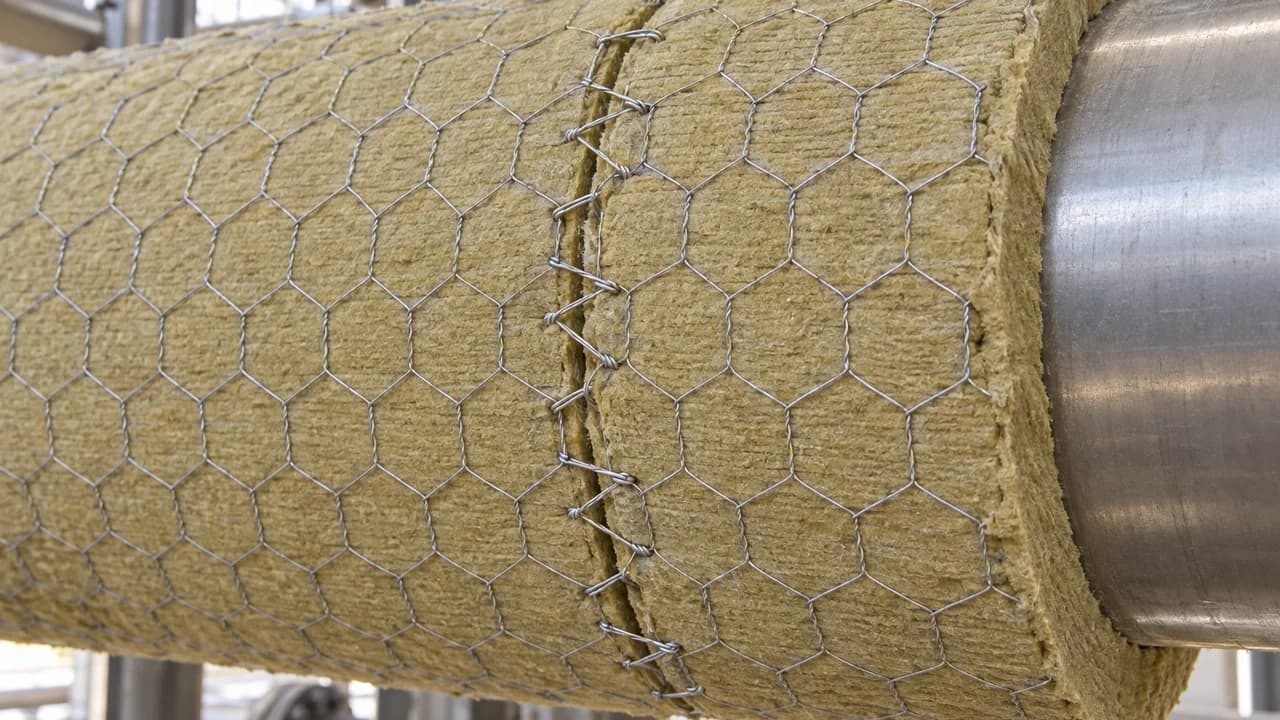
A wired mattress is stone wool with galvanised wire mesh stitched onto it. ODE recommends it for thermal, acoustic and fire insulation of boilers, heat exchangers and furnaces.
Which form for which job?
From ODE's application list, the choice mostly follows from the shape of the surface and the duty:
- Flat or large steel structures, process equipment, ready-made panels: industrial board (SL70, SL100, SL110). SL110 goes up to 90 mm, SL70 and SL100 up to 120 mm, which can matter for thicker layers.
- Air-conditioning and ventilation ducts: KL70 HVAC board, with a facing suited to the duct.
- Boilers, heat exchangers, furnaces, power-plant and heavy-industry equipment: wired mattress (RBTSS80–125), 30–100 mm.
- Industrial and building-services pipes from Ø 12 to 370 mm: preformed pipe sections, uncoated or aluminium-foil faced. ODE also lists acoustic and vibration insulation of process equipment among their uses.
The designer selects the actual type; the list above summarises ODE's own classification and is not a design rule. The brochure lists the board types (for example SL70 and SL100) on separate lines but gives one thickness and R range for the family. If the difference between types matters for the job, ask for the datasheet of each type.
Why λ rises with temperature, and what it means for sizing
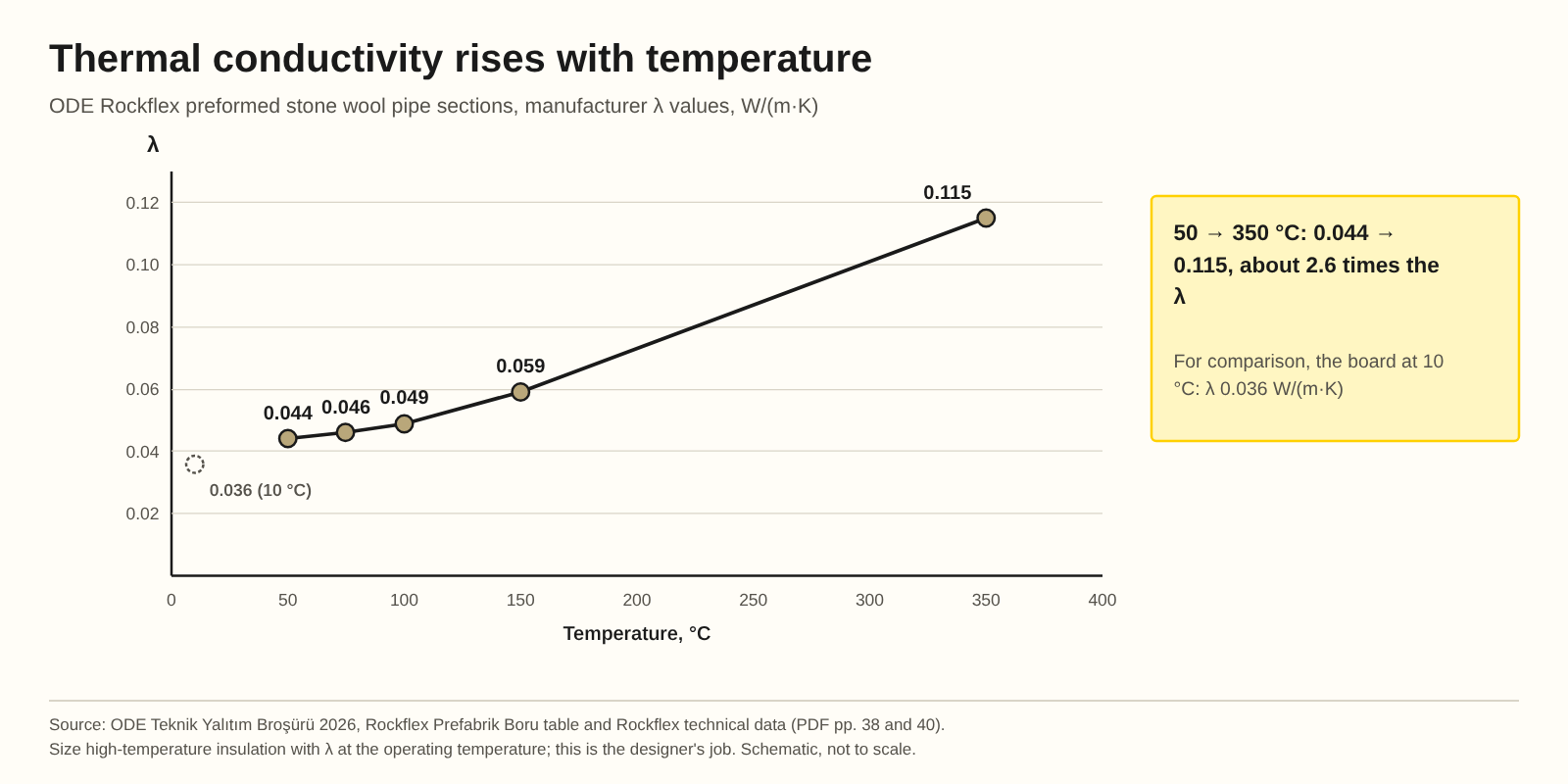
In fibrous insulation, heat travels through the fibres, through the air in the pores and by radiation. At higher temperatures, conduction through the air and radiation increase, so thermal conductivity rises with temperature. ODE publishes λ for its pipe sections at five temperatures.

| Temperature | λ, W/(m·K) | Product |
|---|---|---|
| 10 °C | 0.036 | Rockflex (technical data, for comparison) |
| 50 °C | 0.044 | Rockflex pipe section |
| 75 °C | 0.046 | Rockflex pipe section |
| 100 °C | 0.049 | Rockflex pipe section |
| 150 °C | 0.059 | Rockflex pipe section |
| 350 °C | 0.115 | Rockflex pipe section; 0.115 / 0.044 ≈ 2.6 times the 50 °C value |
Source: ODE Teknik Yalıtım Broşürü 2026, PDF pp. 38 and 40.
What this means in practice:
- The 10 °C λ is not a design value for hot surfaces. At 350 °C the pipe-section λ is about 2.6 times the 50 °C value, so the same layer gives much less resistance in hot service.
- The catalogue R values follow from λ 0.036. 0.025 / 0.036 ≈ 0.69 and 0.120 / 0.036 ≈ 3.33 m²K/W; ODE prints 3.30. They do not describe the operating condition.
- Sizing is the designer's job. The designer calculates the layer from the operating temperature, the permitted heat loss and the surface temperature requirement, using the manufacturer's temperature-dependent λ. We supply the material and the manufacturer's documents; we do not size systems.
Fire performance and moisture
ODE Rockflex is class A1, non-combustible to TS EN 13501-1, and the product page states that it slows the spread of fire. What fire requirement a steel structure or a piece of equipment has to meet, and which system achieves it, is for the designer to decide.
μ = 1 means stone wool offers practically no resistance to vapour. On hot surfaces that helps, because moisture can escape. On cold surfaces, for example chilled lines or near the −50 °C end of the range, a vapour-permeable insulation normally needs a separate vapour barrier; the designer specifies how.
EPS boards are not for hot surfaces: their manufacturer recommends them for ETICS, roofs and cold stores. Our graphite vs white EPS article covers EPS on facades.
Cladding and mechanical protection
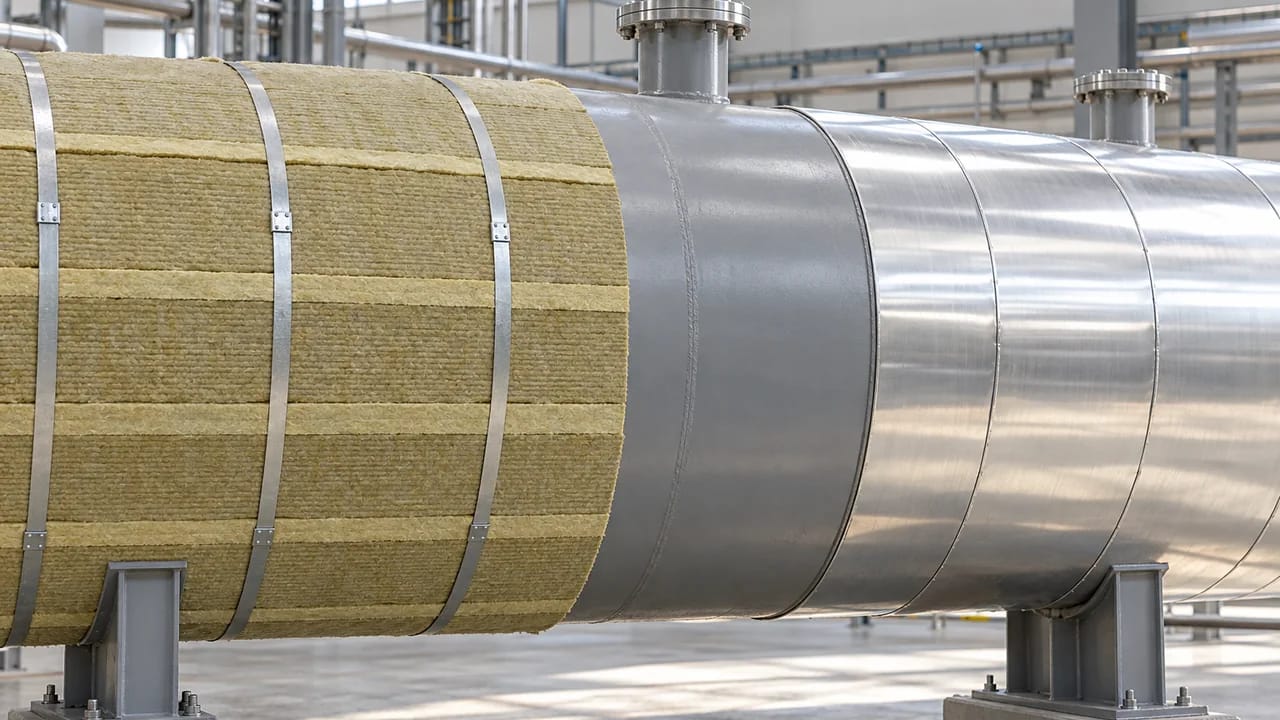
In industrial settings, insulation usually needs protection. Common practice is metal sheet cladding, which protects against mechanical damage and, outdoors, against the weather. Pipe sections are available with an aluminium-foil facing, but that does not replace mechanical protection where it is needed.
The designer specifies the cladding material, thickness, fixing and the weathertightness of the joints. Stone wool is water-repellent and does not hold moisture, yet no insulation is meant to stay wet, so detail the cladding joints with care.
What to specify in an enquiry
- Product type. KL70, SL70, SL100, SL110, RBTSS80–125 or pipe sections, taken from the design; if unclear, check with the designer.
- Thickness and quantity. For boards, m² per thickness; for pipe sections, pipe diameter, insulation thickness and running metres.
- Facing. Pipe sections uncoated or aluminium-foil faced; for HVAC board, the facing type required.
- Operating temperature. The designer needs it for sizing, and we need it to request the right type data from the manufacturer.
- Documents. Datasheet and Declaration of Performance (DoP) of the product type, with CE marking. Our CE marking guide explains how to read a DoP.
We supply ODE Rockflex: we check the goods before sealing and loading, and you have one contact at EuConX from purchase through customs. System design, sizing and installation are for the designer and the insulation contractor.
Receipt and storage on site
On receipt, compare the product type, thickness and facing on the packs with the order and the delivery note, and file the DoP with the job records. Although stone wool is water-repellent, we recommend storing it covered and dry until installation, and fitting the cladding soon after the insulation. Photograph any damaged pack and note it on the delivery note.
Frequently asked questions
What temperature can ODE Rockflex stone wool take?
ODE's 2026 technical brochure gives 750 °C long-term and 1000 °C short-term, with a service range of −50 / +750 °C. The product page states −50 / +760 °C. For design, use the datasheet and DoP of the delivered type.
What is the reaction-to-fire class of Rockflex?
A1, non-combustible (TS EN 13501-1). ODE also gives A1 for the preformed pipe sections.
What is the thermal conductivity of Rockflex?
0.036 W/(m·K) at 10 °C. For pipe sections ODE also gives λ by temperature: 0.044 at 50 °C, 0.049 at 100 °C, 0.059 at 150 °C and 0.115 W/(m·K) at 350 °C.
What is the difference between the SL and KL boards?
KL70 is an HVAC board for air-conditioning and ventilation ducts, available with different facings. SL70, SL100 and SL110 are industrial boards for thermal, acoustic and fire insulation up to 750 °C on steel structures, process equipment and industrial plants.
What is a wired mattress used for?
The RBTSS mattress, stone wool with stitched galvanised wire mesh, insulates boilers, heat exchangers and furnaces in power plants, cement, sugar and iron-steel plants and shipbuilding. It is 30–100 mm thick.
Why is the catalogue R value not enough for a hot pipe?
Because the catalogue R values are worked out with λ 0.036 at 10 °C (0.025 / 0.036 ≈ 0.69 m²K/W). At 350 °C the pipe-section λ is 0.115 W/(m·K), so the same layer gives far less resistance. Sizing needs λ at the operating temperature.
Does EuConX design or install industrial insulation?
No. We supply ODE Rockflex with the manufacturer's documents. The designer sets the thickness and cladding, and the insulation contractor installs.
Material supply, quotes, datasheets and DoPs: contact form · +36 30 485 0258 · info@euconx.com. We reply on the same working day.
Sources
1. ODE: Teknik Yalıtım Broşürü 2026 (technical insulation brochure), ODE Rockflex, PDF pp. 37–40 (downloaded 2026-10-22): https://ode.com.tr/_upload/pdf/teknik-yalitim-brosuru_2026.pdf
2. ODE: ODE Rockflex product page (checked 2026-10-22): https://ode.com.tr/ode-rockflex
3. EuConX: Rock wool vs glass wool on a facade
4. EuConX: A1 and A2 fire-rated building materials (in Hungarian): https://euconx.com/resources/tuzallo-epitoanyagok-a1-es-a2-tuzvedelmi-osztalyu-termekek-kinalata
5. EuConX: Facade insulation, EPS or stone wool (in Hungarian): https://euconx.com/resources/homlokzati-hoszigetelo-rendszerek-osszehasonlitasa-eps-vs-kozetgyapot
6. EuConX: Graphite EPS vs white EPS for facades
7. EuConX: CE marking for construction materials: a complete guide
Planning a project? Let’s talk.
Send the material schedule or project requirements. We’ll help match the product and prepare a clear quotation.