
Ahmet Alptekin Kasar
Founder, Managing Director
Updated: 2026-10-28
This guide is for roofers, renovation contractors and contractor groups, builders' merchants and energy consultants working on pitched roofs in Hungary and the wider CEE region. It covers the underlay decision once the tiles are off: when replacement is due, the correct layer order, when to use BD70 and when ELIT, how the membrane is laid, and how many rolls to order. Insulation between rafters is covered in our pitched roof insulation guide, and the Sd value in the Sd value guide. If you are preparing 2027 home-renovation work, material supply is covered in this article (in Hungarian) and on our Wekerle+ page.
When the underlay is due for replacement
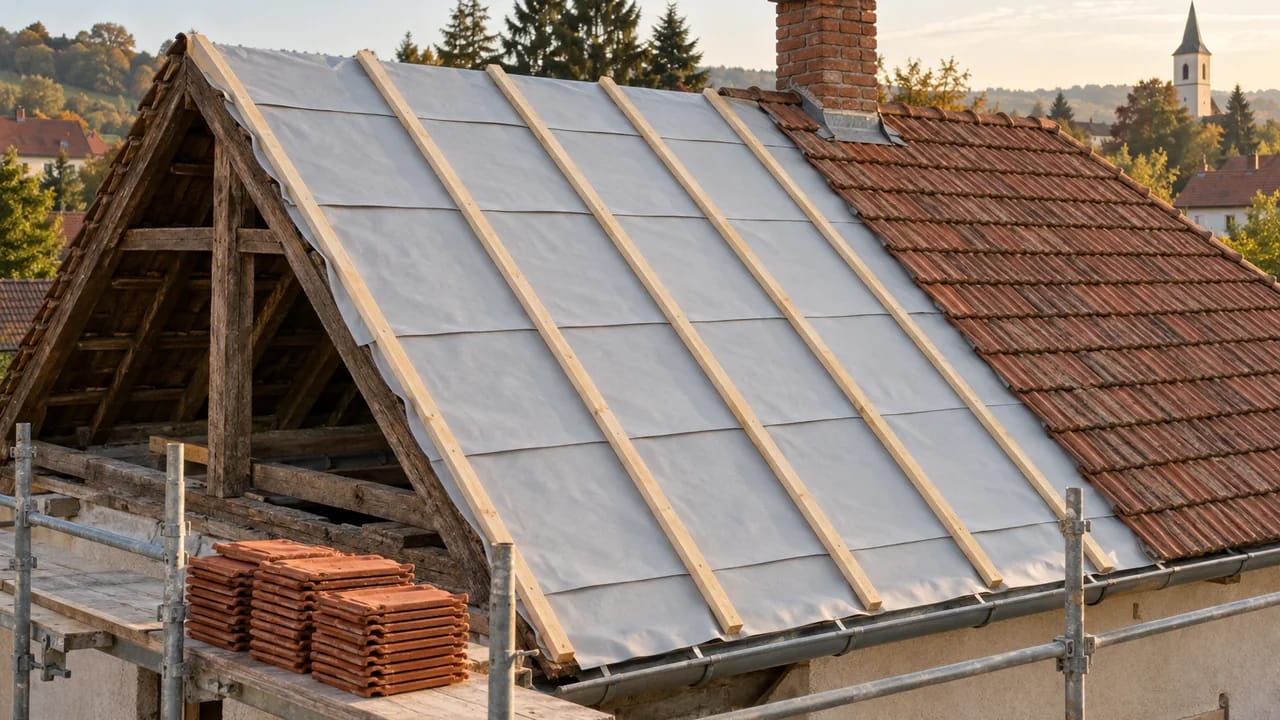
The easiest time to replace the underlay is when the roof covering is coming off anyway. The whole membrane is then exposed, and the decision comes down to a few checks:
- The membrane is torn or brittle. If it is torn, cracks when bent or crumbles in the hand, it no longer protects against wind-driven rain and snow under the tiles.
- There is no underlay. Some older roofs have no membrane under the tiles at all. A renovation is the moment to add one.
- An old, non-breathable sheet sits on the outside. If a vapour-tight sheet lies over the rafters, the roof is tighter outside than inside. That reverses the "closed inside, open outside" principle, and vapour moving outwards can be trapped under the sheet.
- Insulation between the rafters is planned. When the loft becomes living space, insulation goes between the rafters. The outer membrane then has to be vapour-open, and a vapour barrier goes on the inside.
If the existing membrane is intact and suits the planned build-up, it does not have to be replaced. The designer or contractor makes that call on site.
Layer order from outside to inside
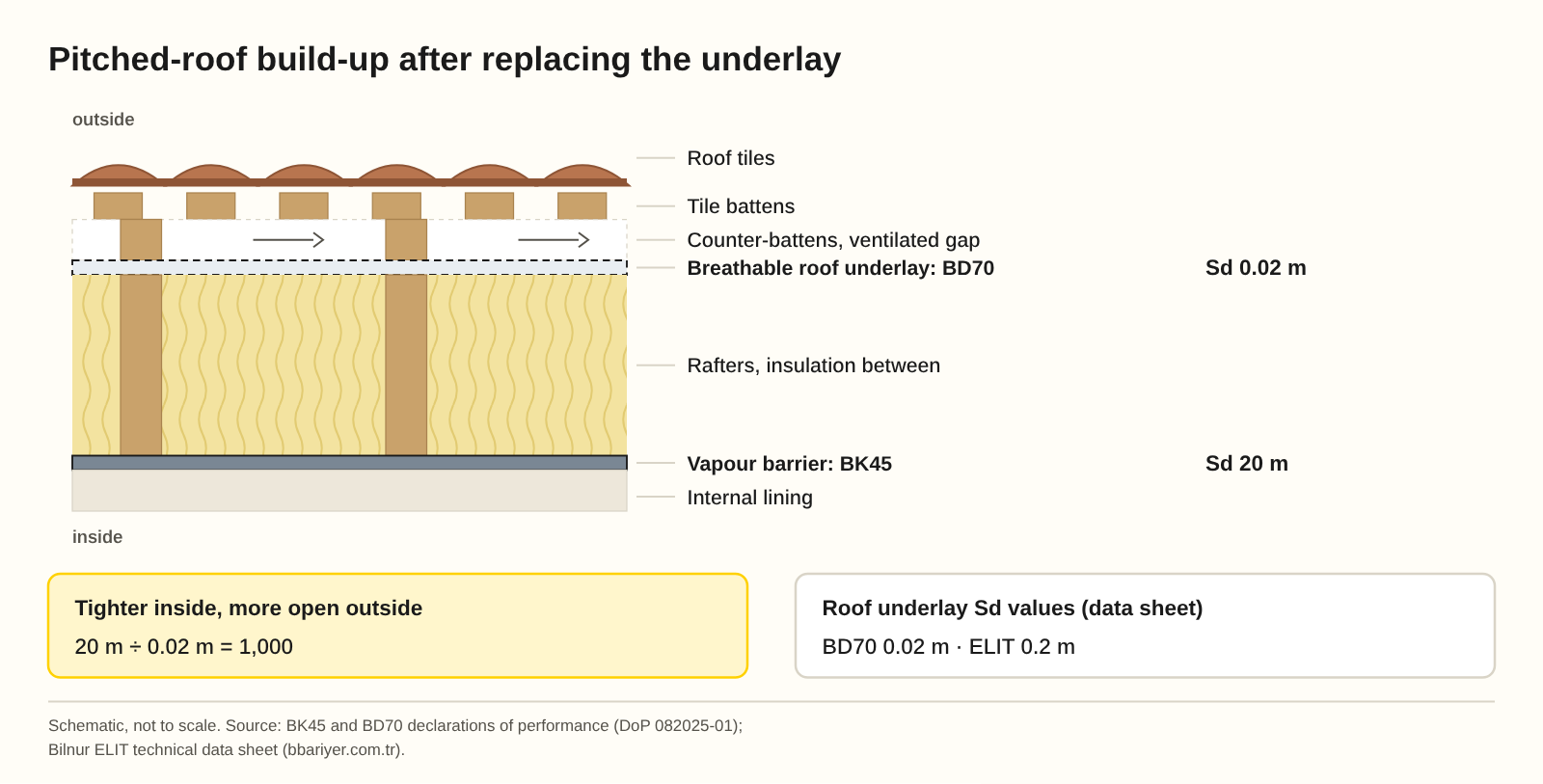
With insulation between the rafters, the build-up from outside to inside is:
1. Roof tiles (covering).
2. Tile battens, which carry the tiles.
3. Counter-battens, running with the rafters, on top of the membrane. Their depth sets the ventilated gap between membrane and tiles.
4. Breathable roof underlay, for example BD70, Sd 0.02 m.
5. Rafters, with insulation between them.
6. Vapour barrier on the warm side, for example BK45, Sd 20 m, sealed airtight.
7. Internal lining.

| Layer (outside to inside) | Role | Product example | Sd |
|---|---|---|---|
| Roof tiles | covering | ||
| Tile battens | carry the tiles | ||
| Counter-battens, ventilated gap | air gap between membrane and tiles | ||
| Breathable roof underlay | sheds water, lets vapour out | BD70 | 0.02 m |
| Rafters, insulation between | thermal insulation | ||
| Vapour barrier | stops vapour on the warm side | BK45 | 20 m |
| Internal lining | inner finish | ||
| Ratio | closed inside, open outside | BK45 ÷ BD70 | 20 m ÷ 0.02 m = 1,000 |
| Alternative roof underlay | sheds water, lets vapour out | ELIT | 0.2 m |
Source: BK45 and BD70 declarations of performance (DoP 082025-01); Bilnur ELIT 90 technical data sheet. The ratio is calculated.
Closed inside, open outside: 20 m ÷ 0.02 m = 1,000
In winter the indoor air is warmer and carries more moisture than the outdoor air, so water vapour moves outwards through the roof. On the inside the vapour barrier slows it before it reaches the insulation. Whatever still gets in has to leave outwards, through the breathable membrane.
According to their declarations of performance, the two membranes have Sd values of 20 m and 0.02 m. The ratio is 20 ÷ 0.02 = 1,000: the inner layer resists vapour a thousand times more than the outer one. That is the "closed inside, open outside" principle in numbers.
If the order is reversed, vapour can be trapped in the insulation or under the outer sheet. So an old vapour-tight sheet should not stay on the outside when the rafters are being insulated. How Sd is calculated and read is covered in the Sd value guide; the BK45 data in the BK45 vapour control layer guide.
BD70 or ELIT?
Both are roof underlays laid over the rafters, but their Sd values differ.
- BD70: 70 g/m², Sd 0.02 m, and per its declaration of performance still 0.02 m after artificial ageing (70 °C, 12 weeks). Water column 259 mm H₂O, tensile strength 175/100 N/5 cm, roll 1.6 m wide, 160 m².
- ELIT: described by the manufacturer as a vapour-control roof underlay. Per its data sheet, Sd 0.2 m and watertightness class W1, made in grades from 90 to 190 g/m² and in rolls 1.5 or 1.6 m wide.
ELIT's Sd is ten times higher (0.2 ÷ 0.02 = 10). Both are far more open than BK45: 20 ÷ 0.2 = 100 and 20 ÷ 0.02 = 1,000. Where the aim is the most vapour-open outer layer, BD70 has the lower Sd. Where the designer asks for a heavier grade or a W1 class, ELIT is an option. Which one fits the roof is the designer's decision, based on the full build-up. ELIT's Sd comes from the ELIT 90 data sheet; for other weights the data sheet of that grade applies.
Laying from the eaves upwards
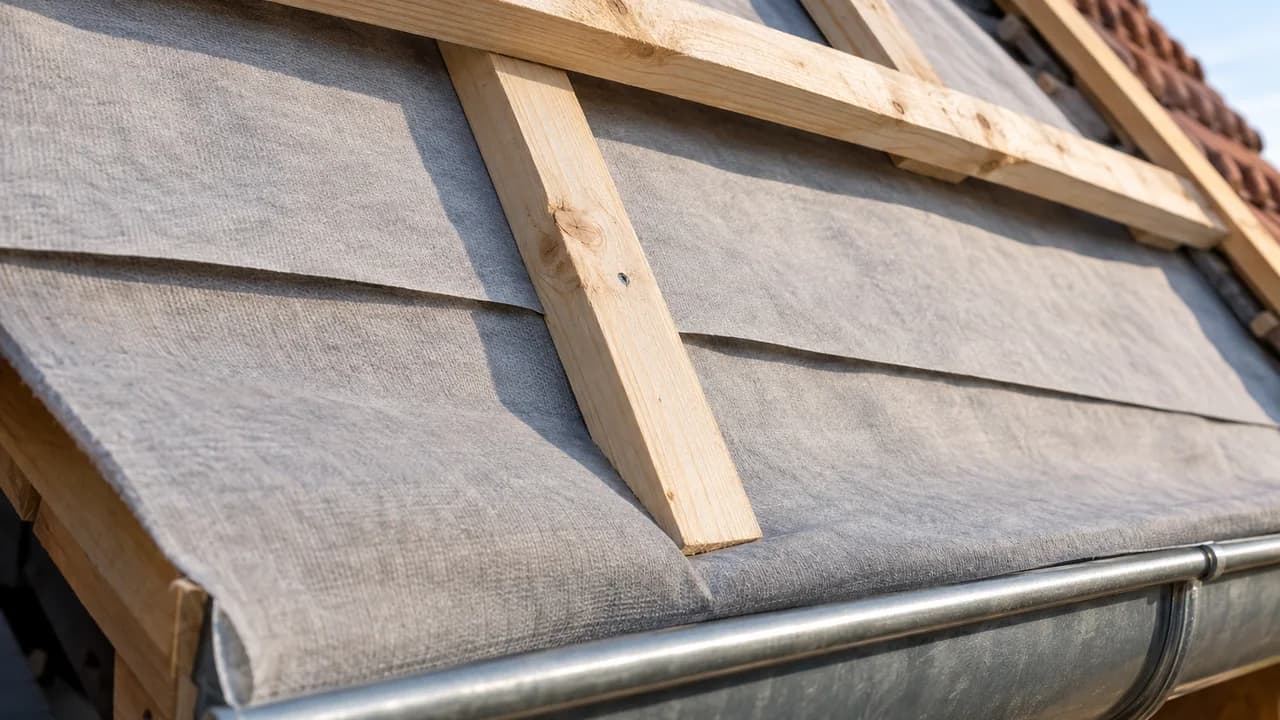
The manufacturer's installation instructions set out how the membrane is laid. The main rules:
- Start at the eaves. The first strip runs along the eaves, and each next strip overlaps the one below from above, so water running down the membrane cannot get under the lap.
- Overlaps per the manufacturer. The overlap width is given in the manufacturer's instructions; follow it.
- Lead it into the gutter. At the eaves the membrane is dressed so that water running off it ends up in the gutter, not behind the fascia or the wall.
- Counter-battens on the rafters. The counter-battens are fixed through the membrane into the rafters and keep the ventilated gap between membrane and tiles. The tile battens go on top.
- Seal laps and penetrations. Laps and the penetrations around chimneys, roof windows and vent pipes are taped or sealed as the manufacturer specifies.
EuConX supplies the materials; it does not carry out roofing or membrane installation. The roofer or contractor installs to the manufacturer's instructions.
How many rolls to order
Per its declaration of performance, a BD70 roll is 1.6 m wide and holds 160 m². The roll count is:
rolls = roof area including overlap allowance ÷ 160 m², rounded up.
The designer or contractor sets the overlap allowance from the manufacturer's overlap and the roof geometry. Example: with 250 m² including the allowance, 250 ÷ 160 = 1.56, so 2 rolls. With 400 m², 400 ÷ 160 = 2.5, so 3 rolls.
A BK45 roll is also 1.6 m × 160 m², so the inner vapour barrier is counted the same way from the internal area and its allowance.
Sourcing through EuConX
BD70 and BK45 come from Türkiye; the manufacturer is Bilnur. Road transit is 3–5 days, about 5 on average. When the material is not in stock, ordering, production and transport together typically take 1–2 weeks, and the quote fixes the actual time. We deliver nationwide within Hungary. For merchants and roofing-system brands we also supply membranes under their own brand, as described in our private label roof membrane guide. The full BD70 and BK45 product description is in this article (in Hungarian).
Request the BD70/BK45 data sheets and a per-roll quote: contact · +36 30 485 0258 · info@euconx.com. We reply the same working day.
Frequently asked questions
When should the roof underlay be replaced during a renovation?
When the covering comes off and the membrane is torn, brittle or missing, or when an old non-breathable sheet lies on the outside. Also when insulation goes between the rafters, because the outer layer then has to be vapour-open.
Which membrane goes over the rafters?
A breathable roof underlay such as BD70, which has an Sd value of 0.02 m according to its declaration of performance. Counter-battens go on top and leave a ventilated gap below the tiles.
What does "closed inside, open outside" mean?
The warm side needs a layer that strongly resists vapour, and the layers become more open towards the outside. BK45 has Sd 20 m, BD70 Sd 0.02 m; the ratio is 20 ÷ 0.02 = 1,000.
Should I use BD70 or ELIT on the roof?
BD70 has Sd 0.02 m; ELIT has 0.2 m per the ELIT 90 data sheet, ten times higher. Where the aim is the most vapour-open outer layer, BD70 has the lower value. The choice is the designer's, based on the full build-up.
How much overlap does a roof underlay need?
The overlap width is set in the manufacturer's installation instructions. The membrane is laid from the eaves upwards, each upper strip covering the one below, with laps and penetrations sealed as the manufacturer specifies.
How many rolls of BD70 does a roof need?
One roll is 1.6 m wide and 160 m². Divide the roof area including the overlap allowance by 160 and round up. For example, 250 m² ÷ 160 = 1.56, so 2 rolls.
Sources
1. BD70 declaration of performance (DoP 082025-01): https://euconx.com/downloads/dop/euconx-bd70-dop.pdf
2. BK45 declaration of performance (DoP 082025-01): https://euconx.com/downloads/dop/euconx-bk45-dop.pdf
3. Bilnur ELIT 90 technical data sheet: https://www.bbariyer.com.tr/dosya/teknik-tablolar/elit90-tds-168b19b1440f27.pdf
4. Bilnur technical documents (ELIT grade weights): https://www.bbariyer.com.tr/en/technical-documents
5. EuConX company data (transit, lead time, reply time, nationwide delivery)
Planning a project? Let’s talk.
Send the material schedule or project requirements. We’ll help match the product and prepare a clear quotation.