
EuConX Editorial
EuConX Editorial
Upgrading the thermal performance of existing buildings is a cornerstone of European energy transition policy. As outlined by the European Commission Energy Performance of Buildings Directive (EPBD, Directive (EU) 2024/1275), Member States must establish pathways towards a decarbonised building stock by 2050. When interpreting these frameworks, it is vital to distinguish between targets for the building stock as a whole and requirements for a single building. The recast directive requires countries to lower average residential primary energy consumption by 16 percent by 2030, directing at least 55 percent of that reduction towards the lowest-performing building segments. This macro target does not impose a uniform mandate on every private residence; it establishes national trajectories. On the jobsite, particularly in attic and ceiling retrofits, high-level objectives become concrete decisions about lambda, layer thickness and moisture-barrier integrity.
How do macro-level EPBD targets translate into attic assembly decisions?
In building engineering, thermal compliance cannot be judged on thermal conductivity (lambda) alone. Fibrous insulation materials often carry a nominal rating such as 0.039 W/mK, but that single value does not state the required installation thickness or guarantee functional compliance. The thermal resistance (R-value) is the quotient of layer thickness and thermal conductivity, and it has to be assessed as part of the whole building envelope. An effective attic retrofit needs a complete assembly: checking the existing substrate, providing an adequate air barrier and vapour control layer, allowing ventilation, and limiting thermal bridging around the roof framing. If a contractor focuses on lambda alone, without calculating the thickness and the condensation risk, the installation risks trapping moisture and developing mould in the roof structure. For a worked calculation, see how to choose insulation by lambda value and thickness and the 25 cm glass wool material specification.
What role do verified EPD metrics play in technical design approvals?
Sustainability metrics in modern construction depend on verified data from third-party assessments. An example is the ODE EPD certificate, published through the International EPD System under EN 15804+A2, which quantifies environmental indicators such as global warming potential in the production stage (A1–A3) and recycled cullet content. However, project teams must separate Environmental Product Declaration (EPD) lifecycle data from project-specific performance parameters, Declarations of Performance (DoP) and local engineering approvals. An EPD discloses environmental footprint indicators, but it is not a structural certificate, not confirmation of the reaction to fire of an assembly, and not a substitute for statutory building permits. Design professionals must use the manufacturer's DoP and the harmonised standard for technical compliance, and use EPD reports mainly for broader lifecycle assessments.
What procurement and supply chain questions must contractors address?
Beyond engineering calculations, contractors managing large retrofit programmes face operational and procurement challenges. They must keep asking basic supply chain questions: how can a cross-border shipment stay consistent with the specification on the data sheet, so that what is delivered matches what was declared? How can customs procedures, transport windows and local delivery schedules be synchronised to avoid downtime on site? Addressing these questions is the daily work of supply chain specialists such as EuConX, which connects producers with the needs of European projects. You can read how structured cross-border procurement works on the how it works page, send specific coordination questions through the contact page, and review the producers and partners involved on the partners page.
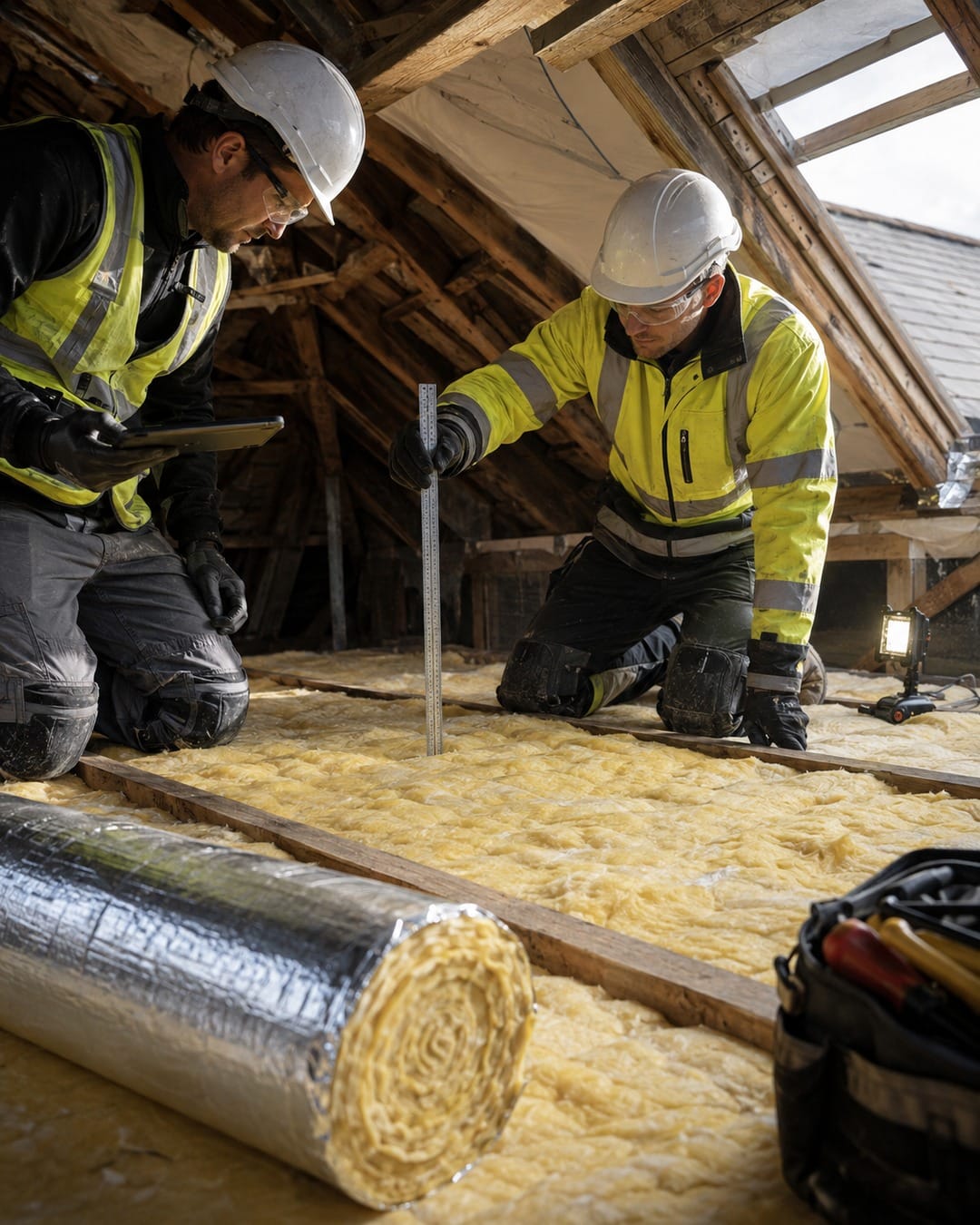
Illustration note: the featured header visual is an AI-generated illustration of an attic inspection. It is intended only as general context and does not document an actual EuConX job or a specific product installation.
Planning a project? Let’s talk.
Send the material schedule or project requirements. We’ll help match the product and prepare a clear quotation.