
Ahmet Alptekin Kasar
Founder, Managing Director
Updated: 2026-10-20
This is a decision guide by ceiling type for contractors and specifiers working on Hungarian and CEE housing. It does not repeat the membrane data sheets: weights, roll sizes and certification of EuConX BK45 and BD70 are in our membrane article (in Hungarian). The Sd values come from the Declarations of Performance: BK45 Sd 20 m (DoP), BD70 Sd 0.02 m (DoP). The full build-up is in our attic floor insulation guide (in Hungarian).
The rule: tight on the warm side, open on the cold side
In winter the air in the house is warmer and carries more moisture than the air in the loft. Vapour moves upwards through the ceiling. If it condenses in the cold wool or on a cold surface, the insulation gets wet, timber stays damp and mould follows. Two working rules follow from that:
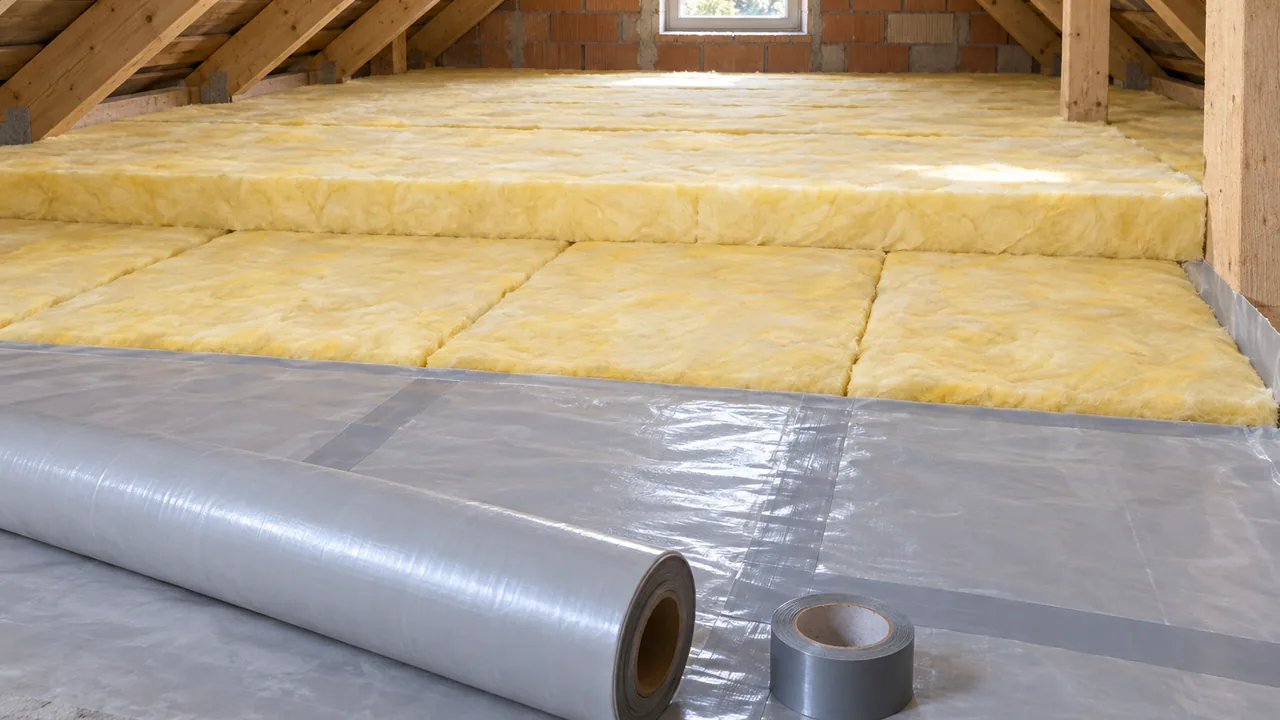
1. The vapour control layer goes on the warm side: on the ceiling surface, under the wool. Never on top of the wool. ROCKWOOL's and Stavmat's guidance both place the vapour control membrane under the insulation, and Stavmat explicitly forbids polyethylene or aluminium foil on top of the wool.
2. Airtightness counts too. Air leaking through gaps and penetrations also carries moisture, so we seal the membrane to the walls and around penetrations.
Decision by ceiling type

Cast-in-situ reinforced concrete slab
Concrete itself is a good vapour retarder. ROCKWOOL's Hungarian guidance states that a vapour control membrane between a reinforced concrete slab and the insulation is not necessary (ROCKWOOL, in Hungarian, status October 2026). A Hungarian guide published by Stavmat also calls its system's vapour control membrane unnecessary under the insulation of a non-walkable loft on timber or concrete ceilings (Stavmat, in Hungarian, updated 26 April 2024).
The weak points are not the slab surface but the penetrations: chimney, vent stacks, cables, light boxes and the loft hatch. Decision: not necessary per producer guidance, but we still lay EuConX BK45, because it lets us seal all gaps and penetrations in one continuous layer.
Beam-and-block floor (precast beams with infill blocks)
The deciding question is whether a continuous concrete topping was cast.
- With topping: ROCKWOOL counts it among adequately vapour-tight ceilings "if the topping was made".
- Without topping: air passes between beams and blocks. URSA's Hungarian guidance calls the precast beam floor "not airtight in building-physics terms" and recommends a continuous membrane under the insulation (Magyar Építéstechnika, in Hungarian, 9 May 2025).
Decision: required without topping, with taped laps and sealed wall junctions; recommended with topping. If nobody knows, we check during the survey.
Timber joist floor, boarded
Timber is moisture-sensitive and boarding is vapour-open.
- If a continuous vapour control membrane already exists on the underside, ROCKWOOL treats the ceiling as adequately vapour-tight.
- If not, ROCKWOOL requires a membrane between the floor and the insulation.
Stavmat's guide, by contrast, calls its membrane unnecessary on timber ceilings as well. Producer guidance is not uniform. Since you rarely know what is behind the plaster of an old ceiling, decision: on timber floors the vapour control layer stays in. We recommend against polystyrene on timber floors.
With existing fill (slag, earth, old wool): we recommend leaving fill in place only if it is dry. Then it is levelled and the membrane goes on top of it, under the new wool. If it is wet, musty or rodent-damaged, it is good practice to take it out and let the ceiling dry before insulating, and to check the ceiling's load capacity with the fill's weight in mind.
Wet room below
Bathrooms, kitchens and laundry rooms produce more moisture. Decision: we fit a vapour control layer regardless of ceiling type and pay particular attention to airtightness:
- We recommend that extract fans discharge outdoors, not into the loft.
- It is good practice to tape every ceiling light, vent and duct penetration.
- We recommend keeping the membrane continuous above the wet room and keeping laps away from penetrations.
Humidity of the rooms below
Use matters as well as construction. Above a rarely heated, well-ventilated room the risk is lower. Where many people live, laundry dries indoors, there is no mechanical ventilation or the windows stream in the morning, more moisture rises and any defect in the vapour control layer shows sooner.
Ask about these on the survey: mould in ceiling corners, condensation on windows, a musty loft. A leaking roof must be repaired before insulating. The Energy Saving Trust warns that insulation makes the loft colder, which makes condensation more likely and can worsen existing damp, so a damp loft needs professional advice first (Energy Saving Trust, updated 8 May 2026).
Airtightness at penetrations
A vapour control layer is only as good as its continuity. The points to watch:
- Loft hatch. Insulated and draught-stripped (Energy Saving Trust); we seal the membrane to the hatch frame.
- Cables and pipes. It is good practice to tape around every penetration.
- Chimney. We recommend sealing the membrane around it, keeping the detail next to the flue non-combustible and agreeing it with the chimney sweep.
- Wall junctions. It is good practice to turn the membrane up the wall and tape it.
- Laps. Taped, not just overlapped.
Above the wool: why vapour-open
On top of the wool, either nothing or a vapour-open layer. ROCKWOOL says no membrane is needed over the insulation, and if the roof covering is not tight, a vapour-open, wind-tight roof membrane can be laid on it. Stavmat's guide explicitly forbids vapour-tight polyethylene or aluminium foil on top of the wool, because it traps moisture coming from the rooms below.
In our Hungarian homeowner offer we lay EuConX BD70 on the wool as a dust cover: Sd 0.02 m, also 0.02 m after artificial ageing (DoP DOP-BBARIYER-L4S-BD70/082025-01). Below, BK45 has Sd 20 m (DoP DOP-BBARIYER-LW-BK45/082025-01, TS EN ISO 12572). 20 / 0.02 = 1 000, so BD70 is about 1 000 times more vapour-open than BK45.
The BBarrier range made by Bilnur also has much tighter membranes: Sd 100 m for BBarrier MET and PLATINUM MET, 50 m for ALU PRO TEK and 15 m for PLATINUM PRO (producer data sheets). These belong on the warm side, if anywhere, and never on top of the wool. Membrane selection by build-up is covered in our vapour control membrane selection guide.
EKR projects in Hungary
Hungary's EKR catalogue sets numeric conditions for loft insulation counted under the energy-efficiency obligation scheme: a vapour control layer of at least Sd 20 m under the insulation, and over fibrous or blown insulation a vapour-open dust-protection membrane of at most Sd 0.03 m, laid with overlaps (Decree 18/2025 (VII. 31.) EM, Annex, point 1.3.1.1 g for family houses and 1.5.1.1 g for apartment buildings, in Hungarian). Per their Declarations of Performance, BK45 (Sd 20 m, DoP) and BD70 (Sd 0.02 m, DoP) meet these catalogue values.
The free loft-floor scheme is still listed as free on kormany.hu, but contractors report that works are paused (for example szigetelesingyen.hu: "jelenleg szünetel", i.e. "currently paused", status October 2026). EuConX is not a HEM partner and does not promise HEM eligibility.
Decision table
| Ceiling | Vapour control layer under the wool | Watch for |
|---|---|---|
| Cast-in-situ concrete | Not necessarily needed per producer guides; we fit one | Penetrations, hatch, wall junctions |
| Beam-and-block with topping | Recommended | Penetrations, continuity of the topping |
| Beam-and-block without topping | Required | Taped laps, sealed to the walls |
| Timber, continuous membrane below | Recommended | Condition of the old membrane is unknown |
| Timber, no membrane below | Required | Polystyrene not recommended; fibrous insulation only |
| Timber with existing fill | Required, on the dry fill | Wet fill must come out; load capacity |
| Wet room below | Required | Airtightness, extract fan to outside |
Common mistakes
- Membrane on top of the wool instead of on the warm side. The most serious one.
- Laps not taped, or the membrane not sealed to the walls.
- Punctured membrane at penetrations and the hatch.
- Extract fan discharging into the loft.
- Wet fill left under the membrane.
If the loft also needs a walkway or storage, the vapour control layer continues under it: see loft floor insulation with a walkway. We build walkways as an extra, on request. For heated rooms in the roof, the job moves to the roof slope: pitched roof insulation between rafters.
For context only, the Hungarian homeowner offer at szigeteles.euconx.com is 12 700 Ft/m² gross (10 000 Ft net + 27% VAT), including the BK45 vapour control layer under the wool, 25 cm of glass wool (2 × 12.5 cm cross-laid ODE Starflex) and the BD70 breathable membrane on top, with delivery and installation. For trade supply of membranes and wool we quote per project.
Frequently asked questions
Does a concrete loft floor need a vapour control layer?
On a cast-in-situ slab, producer guidance says not necessarily, because concrete retards vapour. We fit one anyway to seal penetrations and wall junctions.
And a beam-and-block floor?
Yes if there is no continuous concrete topping, with taped laps. Recommended even with topping.
Does a timber joist floor need one?
Yes, unless you know there is a continuous membrane on the underside. In older houses you rarely do.
What goes on top of the wool?
Nothing, or a vapour-open layer such as BD70 (Sd 0.02 m). Never polyethylene or aluminium foil.
What about a bathroom below?
We always fit a vapour control layer there and pay particular attention to airtightness. It is good practice to tape every penetration, and we recommend venting the extract fan outdoors.
What if the old fill is wet?
We recommend removing it and letting the ceiling dry before insulating. It is good practice not to lay membrane or wool over wet material.
Which Sd values apply on EKR projects?
At least Sd 20 m under the insulation and at most Sd 0.03 m for the dust-protection membrane over fibrous insulation, per the EKR catalogue (points 1.3.1.1 g and 1.5.1.1 g). Per their DoPs, BK45 (Sd 20 m) and BD70 (Sd 0.02 m) meet these values.
Material quotes and project enquiries: contact form · +36 30 485 0258 · info@euconx.com. We reply on the same working day.
Sources
1. ROCKWOOL Hungary: Insulating the attic floor (in Hungarian): https://www.rockwool.com/hu/termekek-megoldasok/tetoszigeteles/tetoterek-szigetelese/padlasfodem-szigetelese/
2. Stavmat: Insulating lofts and attic floors (in Hungarian, updated 26 April 2024): https://www.stavmat.hu/tetoterek-es-padlasfodemek-hoszigetelese-a-mai-elvarasok-szerint/
3. Magyar Építéstechnika: Smart renovation, insulation guide (in Hungarian, 9 May 2025): https://magyarepitestechnika.hu/index.php/hirek/okos-felujitas-szigetelesi-utmutato/
4. Energy Saving Trust: Roof and loft insulation (updated 8 May 2026): https://energysavingtrust.org.uk/advice/roof-and-loft-insulation/
5. Decree 18/2025 (VII. 31.) EM, Annex, points 1.3.1.1 and 1.5.1.1 (Magyar Közlöny, in Hungarian): https://magyarkozlony.hu/dokumentumok/665fad784d41c3417b9f5eeeb2bab1fe61474464/letoltes
6. kormany.hu: Takarékos Otthon Program: https://kormany.hu/takarekos-otthon-program
7. BBarrier (B-Bariyer) technical documents: https://www.bbariyer.com.tr/en/technical-documents
8. EuConX: BD70 and BK45 membranes (in Hungarian): https://euconx.com/resources/bd70-es-bk45-parazaro-es-paraatereszto-foliak-az-ekr-szigetelesben
9. szigetelesingyen.hu (status October 2026, in Hungarian): https://www.szigetelesingyen.hu/
10. BK45 Declaration of Performance, DOP-BBARIYER-LW-BK45/082025-01: https://euconx.com/downloads/dop/euconx-bk45-dop.pdf
11. BD70 Declaration of Performance, DOP-BBARIYER-L4S-BD70/082025-01: https://euconx.com/downloads/dop/euconx-bd70-dop.pdf
Planning a project? Let’s talk.
Send the material schedule or project requirements. We’ll help match the product and prepare a clear quotation.