
EuConX Editorial Desk
Construction-material editorial team
The short answer
İzocam’s product page describes Optima Smart glass wool for internal walls and partition systems. It lists λD of 0.037 W/mK and reaction-to-fire class A1. These are product characteristics; they do not by themselves establish a complete wall’s U-value, sound reduction or fire-resistance period. The finished assembly must be evaluated as a whole.
Define the wall first
Confirm whether the project calls for a non-load-bearing partition, acoustic separation, service shaft or another use. Record wall height, frame material and spacing, board type and layer count, fixings, penetrations, moisture conditions and target performance. The product page identifies partition use, but the current data sheet, DoP and system designer should confirm the exact variant’s suitability.
Read performance claims precisely
λD is the declared thermal conductivity of the insulation, not the U-value of the wall. Whole-wall performance also depends on thickness, framing, thermal bridges and boundary conditions. A1 describes reaction to fire for the product; it does not give the complete wall’s fire-resistance rating. For acoustic or fire claims, request test or classification evidence for the actual frame, boards, joints and fixings.
What to include in the enquiry
Specify exact product name and thickness, current DoP/TDS, installation guidance, intended application, packaging and delivery terms. Request assembly evidence where fire or acoustic targets are contractual. Do not substitute based only on a similar lambda value or reaction-to-fire class. See the distinct applications of Dalsan FiBERO and ODE Starflex forms.
Source and limits
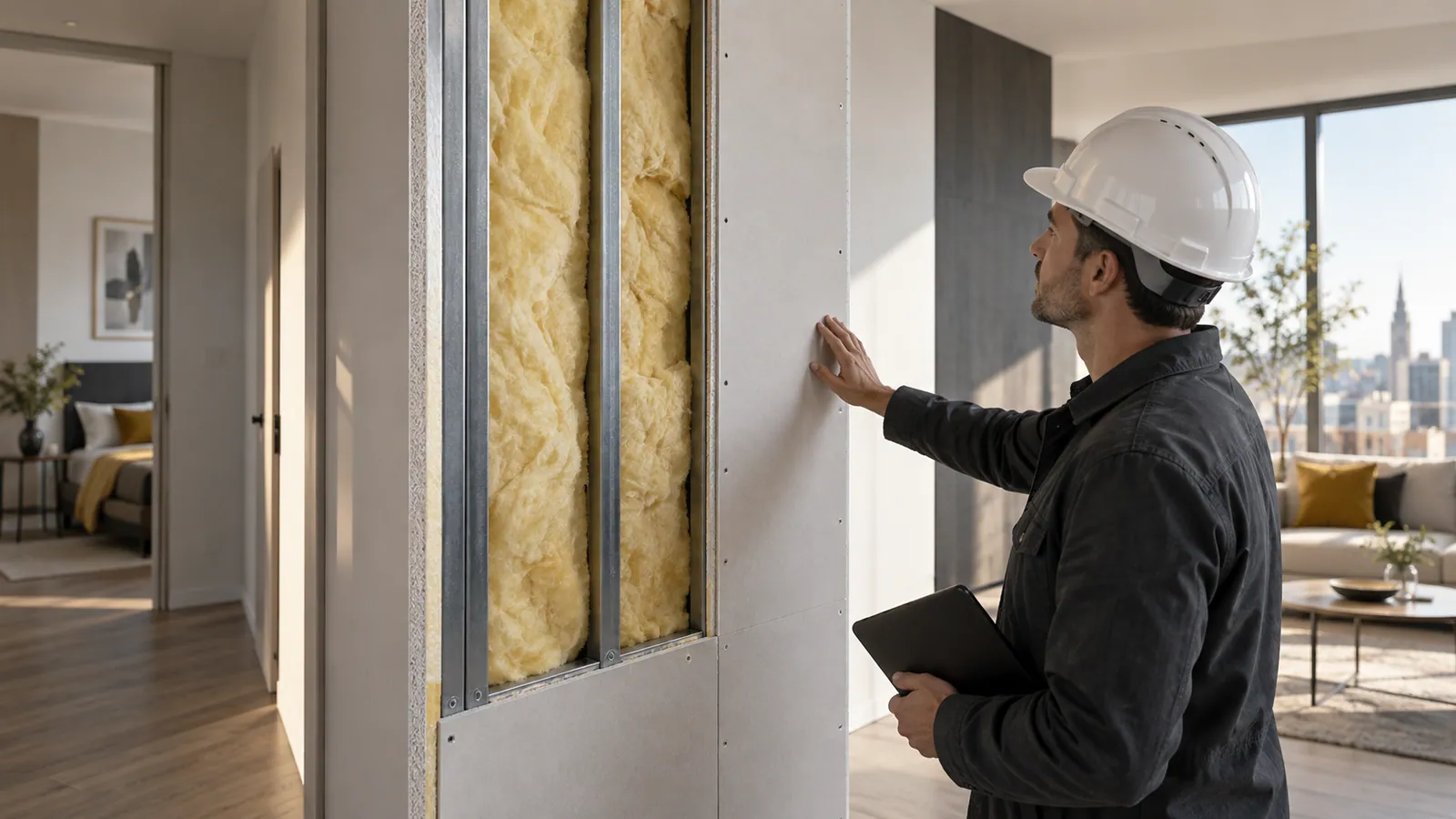
Product information was checked on 23 September 2026. Confirm the current documents for the exact variant and the complete partition system. The visual is a generic wall section, not an İzocam-approved construction detail.
Match the tested assembly
When reviewing a performance report, compare the test specimen with the proposed wall: frame profile, spacing, board type and number of layers, insulation thickness, fixing pattern and perimeter junctions. If those differ, the report’s fire or acoustic result may not transfer to the project. Keep product values and tested wall performance as separate items in the specification and submittal.
Before ordering, obtain current documents for the exact item code, pack dimensions and required quantity. Give the approved variant to the site team and send proposed substitutions to the responsible designer. Procurement coordination helps maintain an approved selection; it does not itself authorise changes to the tested wall build-up.
The insulation layer is only one part of the partition
A generic internal partition section shows board lining, a frame, glass-wool infill and lining on the opposite face. Joints, board layers, fixings and junctions affect the whole assembly along with its insulation layer.
Manufacturer material description
Glass wool
As identified on the Optima Smart product page.
Declared λD
0.037 W/mK
Product value, not a whole-wall U-value.
Reaction to fire
A1
Manufacturer-listed product class; not a fire-resistance rating for the complete partition.
Optima Smart must be matched to the structural, fire and acoustic requirements of the specified wall system.
Sources & notes
- İzocam Optima Smart product pageManufacturer identifies glass wool, λD 0.037 W/mK and A1 reaction to fire; confirm current variant documents and system suitability.